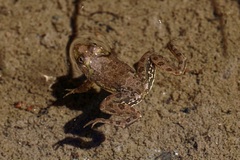
Common skittering frog

Common skittering frog

Euphlyctis cyanophlyctis

Silhouette: Jose Carlos Arenas-Monroy · PhyloPic

LCLeast ConcernNTVUENCR
Daily sighting probability ~30% · Possible
at Udawalawe National Park

In 3 days ~60% in a week ~90%

7 Verified sightings at Udawalawe National Park From 2019 to 2026
90 In all 5 parks
June Best month
🌅 Crepuscular When it's spotted

About the Common skittering frog

Euphlyctis cyanophlyctis is a common dicroglossid frog found in South Asia. It is known under numerous common names, including Indian skipper frog or skittering frog. They are often seen at the edge of bodies of water with their eyes above the water. They noisily move away from the shore when disturbed, giving them their common name. They are rarely seen outside water.

Description from George Albert Boulenger is: «Vomerine teeth in two small oblique series extending a little beyond the hinder edge of the choanae. Head moderate; snout scarcely pointed; canthus rostralis indistinct; interorbital space much narrower than the upper eyelid; tympanum distinct, about two-thirds the size of the eye. Fingers slender, pointed, first not extending beyond second; toes webbed to the tips, which are pointed, fourth not much longer than third or fifth; outer toe strongly fringed; subarticular tubercles small; inner metatarsal tubercle small, conical, much like a rudimentary toe. The tibiotarsal articulation usually reaches a little beyond the eye. Skin with small tubercles and units above, and with more or less distinct rows of pores. Brown or olive above, dark spotted or marbled... Wikipedia →

Sounds

Advertisement call0:15

India · 2002

© Olivier SWIFT · XC980943 · CC BY-NC-SA 4.0

Recording0:04

India · 2006

© Stuart Fisher · iNaturalist · CC BY-NC 4.0

Recording0:17

Bangladesh · 2015

© Jonathan Hakim · iNaturalist · CC BY-NC 4.0

Global Distribution

Parks Where Found

# Park Country Daily sighting probability
1 Wilpattu National Park 🇱🇰 Sri Lanka
~40%
2 Sinharaja Forest Reserve 🇱🇰 Sri Lanka
~30%
3 Udawalawe National Park 🇱🇰 Sri Lanka
~30%
4 Yala National Park 🇱🇰 Sri Lanka
~30%
5 Minneriya National Park 🇱🇰 Sri Lanka
~30%

Cities Where Found

# City Country Daily sighting probability
1 Pune 🇮🇳 India
~10%
2 Hyderabad 🇮🇳 India
~10%
3 New Delhi 🇮🇳 India
~10%

Before you go

What are the chances of seeing a Common skittering frog in Udawalawe National Park?

Possible

About 30% of wildlife watchers report a Common skittering frog sighting in Udawalawe National Park on a given day, based on 7 verified sightings from GBIF citizen-science data from 2019 to 2026. It is the most-seen of the 5 amphibians we can rate there. Over three days the chance rises to about 60%, and over a week to about 90%, if each day is a fresh chance.

When is the best time to see a Common skittering frog in Udawalawe National Park?

June

In that month about 50% of wildlife watchers report a Common skittering frog in Udawalawe National Park on a given day, against under 5% in January, April and August, the lowest months. That is one of Udawalawe National Park's driest months, with about 45 mm of rain against 330 mm in November.

What time of day is best to see a Common skittering frog?

Between 7 and 10 am

Across all the parks we cover, that three-hour window holds the most Common skittering frog sightings with a recorded time, and about 7 in 10 of them come between 6 am and 6 pm: it is most active around dawn and dusk.

Is Udawalawe National Park the best place to see a Common skittering frog?

3rd of 5

Of the 5 parks where we can rate Common skittering frog sightings, Udawalawe National Park ranks 3rd at about 30%. The best odds are in Wilpattu National Park (Sri Lanka, about 40%) and Sinharaja Forest Reserve (Sri Lanka, about 30%). All parks ranked.

Where does the Common skittering frog sighting chance come from?

GBIF citizen-science records

It is estimated from how often the Common skittering frog is recorded against all the amphibians logged in Udawalawe National Park (7 verified sightings from 2019 to 2026), calibrated against known sighting rates. Figures are rounded to the nearest 10% because citizen-science data supports honest approximations, not decimals, and months with records from fewer than five people show "—". How it works.

← Back to Udawalawe National Park