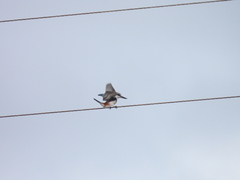
Red-backed Kingfisher

Red-backed Kingfisher

Todiramphus pyrrhopygius

Silhouette: Steven Traver · PhyloPic

LCLeast ConcernNTVUENCR Endemic
Daily sighting probability ~20% · Possible
at Uluru-Kata Tjuta National Park

In 3 days ~60% in a week ~90%

85 Verified sightings at Uluru-Kata Tjuta National Park From 2019 to 2026
139 In all 4 parks
September Best month
☀️ Diurnal When it's spotted

About the Red-backed Kingfisher

The red-backed kingfisher (Todiramphus pyrrhopygius) is a species of kingfisher in the subfamily Halcyoninae, also known as tree kingfishers. It is a predominantly blue-green and white bird with a chestnut rump. It is found across the continent of Australia, mainly inhabiting the drier regions.

The red-backed kingfisher was first described by the English ornithologist and bird artist John Gould in 1841. He coined the binomial name Halcyon pyrrhopygia. It was known for many years by this scientific name before being transferred to the genus Todiramphus. The generic name is derived from the genus Todus (Brisson, 1760), 'tody' (a West Indian insectivorous bird) and Ancient Greek rhamphos, 'bill'. Its specific epithet is derived from the Ancient Greek words pyrrho-/πυρρο- 'flame-coloured' or 'red' and pyge/πυγή 'rump'. The species is monotypic.

The red-backed kingfisher measures 20 to 24 cm (7.9 to 9.4 in); the male weighs 45–70 g (1.6–2.5 oz) and the female 41–62 g (1.4–2.2 oz). It has a streaked green and white crown, bluish-green wings and tail, and lower back, rump and upper tail coverts chestnut with white breast, abdomen, and nape. It has a black... Wikipedia →

Sounds

Call0:49

Australia · 2023

© Peter Boesman · XC860235 · CC BY-NC-ND 4.0

Song0:25

Australia · 2020

© Marc Anderson · XC594040 · CC BY-NC-ND 4.0

Song0:31

Australia · 2009

© Mark Harper · XC40764 · CC BY-NC-ND 2.5

Global Distribution

Parks Where Found

# Park Country Daily sighting probability
1 Uluru-Kata Tjuta National Park 🇦🇺 Australia
~20%
2 Flinders Ranges National Park 🇦🇺 Australia
<5%
3 Hattah-Kulkyne National Park 🇦🇺 Australia
<5%
4 Kakadu National Park 🇦🇺 Australia
<5%

Cities Where Found

# City Country Daily sighting probability
1 Melbourne 🇦🇺 Australia
<5%

Before you go

What are the chances of seeing a Red-backed Kingfisher in Uluru-Kata Tjuta National Park?

Possible

About 20% of wildlife watchers report a Red-backed Kingfisher sighting in Uluru-Kata Tjuta National Park on a given day, based on 85 verified sightings from GBIF citizen-science data from 2019 to 2026. It is the 23rd most-seen of the 84 birds we can rate there. Over three days the chance rises to about 60%, and over a week to about 90%, if each day is a fresh chance.

When is the best time to see a Red-backed Kingfisher in Uluru-Kata Tjuta National Park?

September

In that month about 50% of wildlife watchers report a Red-backed Kingfisher in Uluru-Kata Tjuta National Park on a given day, against about 10% in February–April and June–July, the lowest months.

What time of day is best to see a Red-backed Kingfisher?

Between 8 and 11 am

Across all the parks we cover, that three-hour window holds the most Red-backed Kingfisher sightings with a recorded time, and about 9 in 10 of them come between 6 am and 6 pm: it is a daytime animal.

Is Uluru-Kata Tjuta National Park the best place to see a Red-backed Kingfisher?

Yes

Of the 4 parks where we can rate Red-backed Kingfisher sightings, Uluru-Kata Tjuta National Park has the highest daily chance: about 20%. Next come Flinders Ranges National Park (Australia, under 5%) and Hattah-Kulkyne National Park (Australia, under 5%).

Where does the Red-backed Kingfisher sighting chance come from?

GBIF citizen-science records

It is estimated from how often the Red-backed Kingfisher is recorded against all the birds logged in Uluru-Kata Tjuta National Park (85 verified sightings from 2019 to 2026), calibrated against known sighting rates. Figures are rounded to the nearest 10% because citizen-science data supports honest approximations, not decimals, and months with records from fewer than five people show "—". How it works.

← Back to Uluru-Kata Tjuta National Park