Green Malkoha

Green Malkoha

Ceuthmochares australis

Silhouette: Nicolas Huet le Jeune and Jean-Gabriel Prêtre (vectorized by T. Michael Keesey) · PhyloPic

LCLeast ConcernNTVUENCR
Daily sighting probability ~10% · With luck
at uMkhuze Game Reserve

In 3 days ~20% in a week ~30%

25 Verified sightings at uMkhuze Game Reserve From 2019 to 2026
627 In all 9 parks
June Best month
☀️ Diurnal When it's spotted

About the Green Malkoha

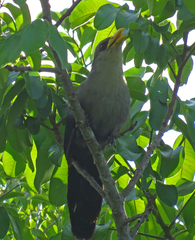
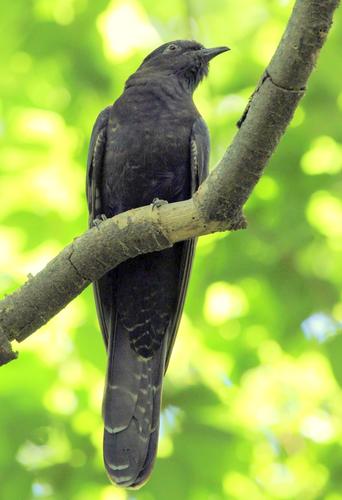
The green malkoha or whistling yellowbill (Ceuthmochares australis) is a species of cuckoo in the family Cuculidae. This species and the blue malkoha were previously considered conspecific and together known as the yellowbill.

It has a green tail, wings and back. It has a widespread distribution down the coast of Eastern Africa from Kenya to South Africa. It ranges from dense forest to riverine forest and forest edges. In the forest it typically lives in the subcanopy at between 8–30 m.

The green malkoha feeds primarily on insects, particularly caterpillars, beetles, grasshoppers and crickets; it will also take frogs, slugs, fruit, seeds and leaves. It moves through the tangled vegetation with a series of small hops, snatching prey as it travels. It will accompany other birds and squirrels, taking the insects flushed by them.

Unlike some other cuckoos the green malkoha is not a brood parasite, instead it cares for its own young. Breeding behaviour has been observed. The male and female face each other, first wagging their tails from side to side, then spreading them. The male also engages in gift giving, presenting the female with prey, then mounting her and feeding her while mounted. Two white and creamy eggs are laid in a nest that is a rough mass of sticks suspended around 2–5 m above the ground. Both parents care for the young.

The green malkoha is an uncommon species and rarely observed due to its secretive behaviour. However it is not considered threatened, and is listed as least concern by the IUCN. Wikipedia →

Sounds

Song0:10

Kenya · 2024

© Peter Boesman · XC948021 · CC BY-NC-ND 4.0

Call0:09

Tanzania · 2021

© Abdulrahman Adam · XC615263 · CC BY-NC-SA 4.0

Call0:42

Kenya · 2018

© Frank Lambert · XC456789 · CC BY-NC-ND 4.0

Global Distribution

Parks Where Found

# Park Country Daily sighting probability
1 iSimangaliso Wetland Park 🇿🇦 South Africa
~30%
2 Arusha National Park 🇹🇿 Tanzania
~20%
3 Mikumi National Park 🇹🇿 Tanzania
~10%
4 Meru National Park 🇰🇪 Kenya
~10%
5 uMkhuze Game Reserve 🇿🇦 South Africa
~10%
6 Gonarezhou National Park 🇿🇼 Zimbabwe
<5%
7 Gorongosa National Park 🇲🇿 Mozambique
<5%
8 Liwonde National Park 🇲🇼 Malawi
<5%
9 Tsavo West National Park 🇰🇪 Kenya
<5%

Cities Where Found

# City Country Daily sighting probability
1 Mombasa 🇰🇪 Kenya
~10%
2 Dar es-Salaam 🇹🇿 Tanzania
<5%
3 Durban 🇿🇦 South Africa
<5%

Before you go

What are the chances of seeing a Green Malkoha in uMkhuze Game Reserve?

With luck

About 10% of wildlife watchers report a Green Malkoha sighting in uMkhuze Game Reserve on a given day, based on 25 verified sightings from GBIF citizen-science data from 2019 to 2026. It is the 199th most-seen of the 283 birds we can rate there. Over three days the chance rises to about 20%, and over a week to about 30%, if each day is a fresh chance.

When is the best time to see a Green Malkoha in uMkhuze Game Reserve?

June

In that month about 20% of wildlife watchers report a Green Malkoha in uMkhuze Game Reserve on a given day, against under 5% in February–May and August–October, the lowest months. That is one of uMkhuze Game Reserve's driest months, with about 15 mm of rain against 120 mm in February.

What time of day is best to see a Green Malkoha?

Between 7 and 10 am

Across all the parks we cover, that three-hour window holds the most Green Malkoha sightings with a recorded time, and about 9 in 10 of them come between 6 am and 6 pm: it is a daytime animal.

Is uMkhuze Game Reserve the best place to see a Green Malkoha?

5th of 9

Of the 9 parks where we can rate Green Malkoha sightings, uMkhuze Game Reserve ranks 5th at about 10%. The best odds are in iSimangaliso Wetland Park (South Africa, about 30%), Arusha National Park (Tanzania, about 20%) and Mikumi National Park (Tanzania, about 10%).

Which relatives of the Green Malkoha live in uMkhuze Game Reserve?

Same family: Cuculidae

The closest relatives of the Green Malkoha that you can see in uMkhuze Game Reserve (family Cuculidae, Cuckoos) are White-browed Coucal (about 60%), Red-chested Cuckoo (about 40%) and Dideric Cuckoo (about 30%), with each one's daily chance of a sighting.

Where does the Green Malkoha sighting chance come from?

GBIF citizen-science records

It is estimated from how often the Green Malkoha is recorded against all the birds logged in uMkhuze Game Reserve (25 verified sightings from 2019 to 2026), calibrated against known sighting rates. Figures are rounded to the nearest 10% because citizen-science data supports honest approximations, not decimals, and months with records from fewer than five people show "—". How it works.

← Back to uMkhuze Game Reserve