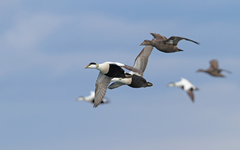
Common Eider

Common Eider

Somateria mollissima

Silhouette: Rebecca Groom · PhyloPic

LCNTNear ThreatenedVUENCR
Daily sighting probability ~60% · Likely
at Vatnajokull National Park

In 3 days >90%

686 Verified sightings at Vatnajokull National Park From 2019 to 2026
14,277 In all 8 parks
March Best month
☀️ Diurnal When it's spotted

About the Common Eider

The common eider (pronounced ) (Somateria mollissima), also called St. Cuthbert's duck or Cuddy's duck, is a large (50–71 cm (20–28 in) in body length) sea-duck that is distributed over the northern coasts of Europe, North America and eastern Siberia. It breeds in Arctic and some northern temperate regions, but winters somewhat farther south in temperate zones, when it can form large flocks on coastal waters. It can fly at speeds up to 113 km/h (70 mph).

The eider's nest is built close to the sea and is lined with eiderdown, plucked from the female's breast. This soft and warm lining has long been harvested for filling pillows and quilts, but in more recent years has been largely replaced by down from domestic farm-geese and synthetic alternatives. Although eiderdown pillows or quilts are now a rarity, typically being marketed as luxury goods, eiderdown harvesting continues and is sustainable, as it can be done after the ducklings leave the nest with no harm to the birds.

The common eider was formally named by the Swedish naturalist Carl Linnaeus in 1758 in the tenth edition of his Systema Naturae. He placed it with all the other ducks in the genus Anas and coined the... Wikipedia →

Sounds

Call1:01

Sweden · 2020

© Thomas Bergman · XC539071 · CC BY-NC-SA 4.0

Song0:38

Norway · 2017

© Terje Kolaas · XC383542 · CC BY-NC-ND 4.0

Conversation with ducklings0:39

Iceland · 2000

© Magnus Bergsson · XC118033 · CC BY-NC-SA 3.0

Global Distribution

Parks Where Found

# Park Country Daily sighting probability
1 Svalbard 🇳🇴 Norway
~90%
2 Vatnajokull National Park 🇮🇸 Iceland
~60%
3 Acadia National Park 🇺🇸 United States
~40%
4 Wadden Sea National Park 🇩🇪 Germany
~40%
5 Cape Breton Highlands National Park 🇨🇦 Canada
~20%
6 Gros Morne National Park 🇨🇦 Canada
~20%
7 Snowdonia National Park 🇬🇧 United Kingdom
~10%
8 Merritt Island National Wildlife Refuge 🇺🇸 United States
<5%

Cities Where Found

# City Country Daily sighting probability
1 Helsinki 🇫🇮 Finland
~10%
2 Boston 🇺🇸 United States
~10%
3 Copenhagen 🇩🇰 Denmark
~10%
4 Saint Petersburg 🇷🇺 Russia
<5%
5 Porto 🇵🇹 Portugal
<5%
6 Rotterdam [The Hague] 🇳🇱 Netherlands
<5%
7 Miami 🇺🇸 United States
<5%
8 Stockholm 🇸🇪 Sweden
<5%
9 New York City 🇺🇸 United States
<5%

Zoos & Centres Where Found

# Zoo / Centre Country
1 Pairi Daiza 🇧🇪 Belgium In captivity
2 Basel Zoo 🇨🇭 Switzerland In captivity
3 ZooParc de Beauval 🇫🇷 France In captivity
4 Cincinnati Zoo and Botanical Garden 🇺🇸 United States In captivity
5 Fota Wildlife Park 🇮🇪 Ireland In captivity
6 Ecomuseum Zoo 🇨🇦 Canada In captivity
7 Tallinn Zoo 🇪🇪 Estonia In captivity
8 Cotswold Wildlife Park 🇬🇧 United Kingdom In captivity
9 Slimbridge Wetland Centre 🇬🇧 United Kingdom In captivity
10 Dierenpark Hoenderdaell 🇳🇱 Netherlands In captivity
11 Wrocław Zoological Garden 🇵🇱 Poland In captivity
12 Diergaarde Blijdorp 🇳🇱 Netherlands In captivity
13 Fort Worth Zoo 🇺🇸 United States In captivity
14 Natur- und Tierpark Goldau 🇨🇭 Switzerland In captivity
15 Wilhelma 🇩🇪 Germany In captivity
16 Dudley Zoo 🇬🇧 United Kingdom In captivity
17 Cologne Zoological Garden 🇩🇪 Germany In captivity
18 Duisburg Zoo 🇩🇪 Germany In captivity
19 Cleres Zoological Park 🇫🇷 France In captivity
20 Birdworld 🇬🇧 United Kingdom In captivity
21 L'Oceanogràfic 🇪🇸 Spain In captivity
22 Salisbury Zoo 🇺🇸 United States In captivity
23 Slottsskogens Djurpark 🇸🇪 Sweden In captivity
24 Central Park Zoo 🇺🇸 United States In captivity
25 Africarium 🇵🇱 Poland In captivity
26 Fågelhuset 🇸🇪 Sweden In captivity
27 Bristol Zoo 🇬🇧 United Kingdom In captivity
28 Cologne Zoo Aquarium 🇩🇪 Germany In captivity
29 Landgoed Hoenderdaell 🇳🇱 Netherlands In captivity
30 Les Oiseaux du Marais Poitevin 🇫🇷 France In captivity
31 Montreal Biodome 🇨🇦 Canada In captivity
32 terrarium ogrodu zoologicznego we Wrocławiu 🇵🇱 Poland In captivity

Before you go

What are the chances of seeing a Common Eider in Vatnajokull National Park?

Likely

About 60% of wildlife watchers report a Common Eider sighting in Vatnajokull National Park on a given day, based on 686 verified sightings from GBIF citizen-science data from 2019 to 2026. It is the 4th most-seen of the 73 birds we can rate there. Over three days the chance rises to over 90%, if each day is a fresh chance.

When is the best time to see a Common Eider in Vatnajokull National Park?

February and March

In those months about 90% of wildlife watchers report a Common Eider in Vatnajokull National Park on a given day, against about 20% in October and November, the lowest months.

What time of day is best to see a Common Eider?

Between 3 and 6 pm

Across all the parks we cover, that three-hour window holds the most Common Eider sightings with a recorded time, and about 9 in 10 of them come between 6 am and 6 pm: it is a daytime animal.

Is Vatnajokull National Park the best place to see a Common Eider?

2nd of 8

Of the 8 parks where we can rate Common Eider sightings, Vatnajokull National Park ranks 2nd at about 60%. The best odds are in Svalbard (Norway, about 90%). All parks ranked.

Which relatives of the Common Eider live in Vatnajokull National Park?

Same family: Anatidae

The closest relatives of the Common Eider that you can see in Vatnajokull National Park (family Anatidae, Ducks, Geese, and Swans) are Barnacle Goose (about 70%), Whooper Swan (about 30%) and Greylag Goose (about 20%), with each one's daily chance of a sighting.

Where does the Common Eider sighting chance come from?

GBIF citizen-science records

It is estimated from how often the Common Eider is recorded against all the birds logged in Vatnajokull National Park (686 verified sightings from 2019 to 2026), calibrated against known sighting rates. Figures are rounded to the nearest 10% because citizen-science data supports honest approximations, not decimals, and months with records from fewer than five people show "—". How it works.

← Back to Vatnajokull National Park