Rock Ptarmigan

Rock Ptarmigan

Lagopus muta

Silhouette: PhyloPic

LCLeast ConcernNTVUENCR
Daily sighting probability ~20% · Possible
at Vatnajokull National Park

In 3 days ~40% in a week ~70%

169 Verified sightings at Vatnajokull National Park From 2019 to 2026
980 In all 7 parks
December Best month
☀️ Diurnal When it's spotted

About the Rock Ptarmigan

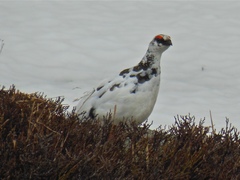
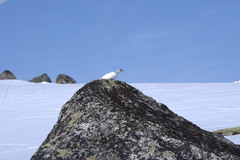
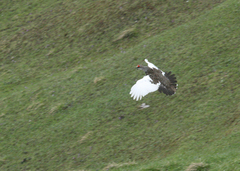
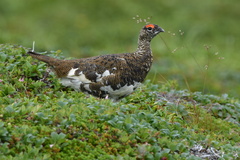
The rock ptarmigan (Lagopus muta) is a medium-sized game bird in the grouse tribe. It is known simply as the ptarmigan in Europe. It is the official bird for the Canadian territory of Nunavut, where it is known as the aqiggiq (ᐊᕿᒡᒋᖅ), and the official game bird for the province of Newfoundland and Labrador. In Japan, it is known as the raichō (雷鳥), which means "thunder bird"; it is the official bird of Gifu, Nagano, and Toyama Prefectures and is a protected species nationwide.

The ptarmigan's genus name, Lagopus, is derived from Ancient Greek lagos (λαγώς lagṓs), meaning "hare", + pous (πούς poús), "foot", in reference to the bird's feathered legs. The species name, muta, comes from Neo-Latin and means "mute", referring to the simple croaking song of the male. It was for a long time misspelt mutus, in the erroneous belief that the ending of Lagopus denotes masculine gender. However, as the Ancient Greek term λαγώπους lagṓpous is of feminine gender, and the species name has to agree with that, the feminine muta is correct.

The word ptarmigan comes from the Gaelic tarmachan, meaning croaker. The p- was added due to a mistaken belief in a Greek origin, as if the word were... Wikipedia →

Sounds

Song0:04

Sweden · 2020

© Lars Edenius · XC567563 · CC BY-NC-SA 4.0

Call1:06

Canada · 2017

© Logan McLeod · XC432601 · CC BY-NC-SA 4.0

Flight call0:09

Sweden · 2016

© Terje Kolaas · XC324352 · CC BY-NC-ND 4.0

Global Distribution

Parks Where Found

# Park Country Daily sighting probability
1 Vatnajokull National Park 🇮🇸 Iceland
~20%
2 Svalbard 🇳🇴 Norway
~20%
3 Cairngorms National Park 🇬🇧 United Kingdom
<5%
4 Denali National Park 🇺🇸 United States
<5%
5 Gros Morne National Park 🇨🇦 Canada
<5%
6 Triglav National Park 🇸🇮 Slovenia
<5%
7 Pyrénées National Park 🇫🇷 France
<5%

Zoos & Centres Where Found

# Zoo / Centre Country
1 Ueno Zoo 🇯🇵 Japan In captivity
2 Ueno Zoological Gardens (West Garden) 🇯🇵 Japan In captivity
3 Alpenzoo Innsbruck 🇦🇹 Austria In captivity
4 Ralph Perkins II Wildlife Center and Woods Garden 🇺🇸 United States In captivity
5 Adachi Park of Living Things 🇯🇵 Japan In captivity

Before you go

What are the chances of seeing a Rock Ptarmigan in Vatnajokull National Park?

Possible

About 20% of wildlife watchers report a Rock Ptarmigan sighting in Vatnajokull National Park on a given day, based on 169 verified sightings from GBIF citizen-science data from 2019 to 2026. It is the 31st most-seen of the 73 birds we can rate there. Over three days the chance rises to about 40%, and over a week to about 70%, if each day is a fresh chance.

When is the best time to see a Rock Ptarmigan in Vatnajokull National Park?

December

In that month about 50% of wildlife watchers report a Rock Ptarmigan in Vatnajokull National Park on a given day, against under 5% in November, the lowest month.

What time of day is best to see a Rock Ptarmigan?

Between 1 and 4 pm

Across all the parks we cover, that three-hour window holds the most Rock Ptarmigan sightings with a recorded time, and about 9 in 10 of them come between 6 am and 6 pm: it is a daytime animal.

Is Vatnajokull National Park the best place to see a Rock Ptarmigan?

Yes

Of the 7 parks where we can rate Rock Ptarmigan sightings, Vatnajokull National Park has the highest daily chance: about 20%. Next come Svalbard (Norway, about 20%) and Cairngorms National Park (United Kingdom, under 5%).

Where does the Rock Ptarmigan sighting chance come from?

GBIF citizen-science records

It is estimated from how often the Rock Ptarmigan is recorded against all the birds logged in Vatnajokull National Park (169 verified sightings from 2019 to 2026), calibrated against known sighting rates. Figures are rounded to the nearest 10% because citizen-science data supports honest approximations, not decimals, and months with records from fewer than five people show "—". How it works.

← Back to Vatnajokull National Park