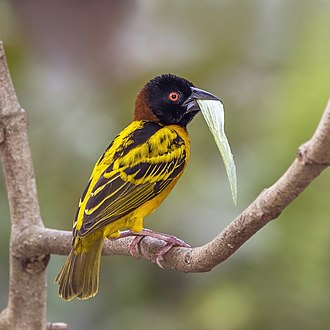
Black-winged Bishop

Black-winged Bishop

Euplectes hordeaceus

Silhouette: Sheatherius · PhyloPic

LCLeast ConcernNTVUENCR
Daily sighting probability <5% · Rare
at Virunga National Park

In 3 days <5% in a week ~10%

5 Verified sightings at Virunga National Park From 2019 to 2026
514 In all 15 parks
April Best month
☀️ Diurnal When it's spotted

About the Black-winged Bishop

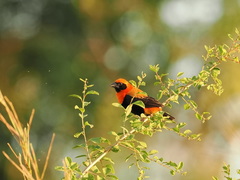
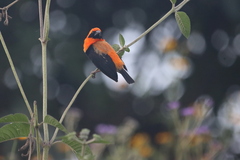
The black-winged red bishop (Euplectes hordeaceus), formerly known in southern Africa as the fire-crowned bishop, is a resident breeding bird species in tropical Africa from Senegal to Sudan and south to Angola, Tanzania, Zimbabwe and Mozambique.

The black-winged red bishop was formally described in 1758 by the Swedish naturalist Carl Linnaeus in the tenth edition of his Systema Naturae under the binomial name Loxia hordeacea. Linnaeus mistakenly specified the type location as India but this has been corrected to Senegal. The specific epithet hordeaceus is Latin meaning "of barley" from hordeum meaning "barley". The black-winged red bishop is now one of 18 species in the genus Euplectes that was introduced in 1829 by the English naturalist William Swainson.

Two subspecies are recognised: The black-winged red bishop is a stocky 13–15 cm (5.1–5.9 in) bird. The breeding male is scarlet apart from his black face, belly... Wikipedia →

Sounds

Call0:53

Uganda · 2022

© Peter Boesman · XC739668 · CC BY-NC-ND 4.0

Song0:39

Ghana · 2021

© Brendan Sloan · XC689987 · CC BY-NC-ND 4.0

Call0:10

Ethiopia · 2015

© Andrew Spencer · XC277976 · CC BY-NC-ND 4.0

Global Distribution

Parks Where Found

# Park Country Daily sighting probability
1 Kidepo Valley National Park 🇺🇬 Uganda
~10%
2 Lake Manyara National Park 🇹🇿 Tanzania
~10%
3 Mikumi National Park 🇹🇿 Tanzania
~10%
4 Mkomazi National Park 🇹🇿 Tanzania
~10%
5 Gorongosa National Park 🇲🇿 Mozambique
~10%
6 Murchison Falls National Park 🇺🇬 Uganda
~10%
7 Serengeti National Park 🇹🇿 Tanzania
<5%
8 Ruaha National Park 🇹🇿 Tanzania
<5%
9 Liwonde National Park 🇲🇼 Malawi
<5%
10 Queen Elizabeth National Park 🇺🇬 Uganda
<5%
11 South Luangwa National Park 🇿🇲 Zambia
<5%
12 Ngorongoro Conservation Area 🇹🇿 Tanzania
<5%
13 Tarangire National Park 🇹🇿 Tanzania
<5%
14 Kibale National Park 🇺🇬 Uganda
<5%
15 Virunga National Park 🇨🇩 Democratic Republic of the Congo
<5%

Cities Where Found

# City Country Daily sighting probability
1 Kumasi 🇬🇭 Ghana
~10%
2 Dar es-Salaam 🇹🇿 Tanzania
<5%
3 Accra 🇬🇭 Ghana
<5%
4 Doha 🇶🇦 Qatar
<5%
5 Serrekunda 🇬🇲 Gambia
<5%
6 Kigali 🇷🇼 Rwanda
<5%

Zoos & Centres Where Found

# Zoo / Centre Country
1 Budapest Zoo & Botanical Garden 🇭🇺 Hungary In captivity

Before you go

What are the chances of seeing a Black-winged Bishop in Virunga National Park?

Rare

Under 5% of wildlife watchers report a Black-winged Bishop sighting in Virunga National Park on a given day, based on 5 verified sightings from GBIF citizen-science data from 2019 to 2026. It is the 301st most-seen of the 316 birds we can rate there. Over three days the chance rises to under 5%, and over a week to about 10%, if each day is a fresh chance.

When is the best time to see a Black-winged Bishop in Virunga National Park?

April

In that month about 10% of wildlife watchers report a Black-winged Bishop in Virunga National Park on a given day, against under 5% in May to March, the lowest months. That is one of Virunga National Park's wettest months, with about 240 mm of rain against 15 mm in January.

What time of day is best to see a Black-winged Bishop?

Between 8 and 11 am

Across all the parks we cover, that three-hour window holds the most Black-winged Bishop sightings with a recorded time, and about 9 in 10 of them come between 6 am and 6 pm: it is a daytime animal.

Where does the Black-winged Bishop sighting chance come from?

GBIF citizen-science records

It is estimated from how often the Black-winged Bishop is recorded against all the birds logged in Virunga National Park (5 verified sightings from 2019 to 2026), calibrated against known sighting rates. Figures are rounded to the nearest 10% because citizen-science data supports honest approximations, not decimals, and months with records from fewer than five people show "—". How it works.

← Back to Virunga National Park