
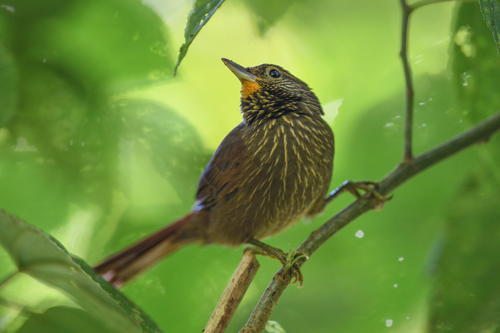
Streak-breasted Treehunter

Streak-breasted Treehunter

Thripadectes rufobrunneus

Silhouette: Sheatherius · PhyloPic

LCLeast ConcernNTVUENCR
Daily sighting probability ~20% · Possible
at Volcán Barú National Park

In 3 days ~40% in a week ~80%

316 Verified sightings at Volcán Barú National Park From 2019 to 2026
2,094 In all 9 parks
August Best month
☀️ Diurnal When it's spotted

About the Streak-breasted Treehunter

The streak-breasted treehunter (Thripadectes rufobrunneus) is a passerine bird in the Furnariinae subfamily of the ovenbird family Furnariidae. It is found in Costa Rica and Panama. The streak-breasted treehunter was formally described in 1865 by the American amateur ornithologist George Newbold Lawrence from a specimen collected by Alexander von Frantzius near San José in Costa Rica. Lawrence coined the binomial name Philydor rufobrunneus. The specific epithet rufobrunneus is Modern Latin meaning "brown". The streak-breasted treehunter is now placed in the genus Thripadectes that was introduced in 1862 by Philip Sclater.

The streak-breasted treehunter is monotypic: no subspecies are recognised. It and the black-billed treehunter (T. melanorhynchus) form a superspecies. The streak-breasted treehunter is 20 to 22 cm (7.9 to 8.7 in) long and weighs 48 to 54 g (1.7 to 1.9 oz). It is a large, dark furnariid with a thrush-like shape. The sexes have the same plumage. Adults have a mostly dark brown face with dull rufescence on their ear coverts and a dark ochraceous malar area with dark flecks. Their crown is blackish with long olive streaks... Wikipedia →

Sounds

Call0:20

Costa Rica · 2010

© Peter Boesman · XC274439 · CC BY-NC-ND 4.0

Song0:20

Costa Rica · 2011

© Andrew Spencer · XC71514 · CC BY-NC-ND 2.5

Alarm call0:08

Costa Rica · 2002

© Richard Garrigues · XC5817 · CC BY-NC-ND 2.5

Global Distribution

Parks Where Found

# Park Country Daily sighting probability
1 Volcán Barú National Park 🇵🇦 Panama
~20%
2 Monteverde Cloud Forest Reserve 🇨🇷 Costa Rica
<5%
3 Los Quetzales National Park 🇨🇷 Costa Rica
<5%
4 La Amistad International Park (Panama) 🇵🇦 Panama
<5%
5 Braulio Carrillo National Park 🇨🇷 Costa Rica
<5%
6 Tapantí-Macizo de la Muerte National Park 🇨🇷 Costa Rica
<5%
7 Chirripó National Park 🇨🇷 Costa Rica
<5%
8 Poás Volcano National Park 🇨🇷 Costa Rica
<5%
9 Arenal Volcano National Park 🇨🇷 Costa Rica
<5%

Before you go

What are the chances of seeing a Streak-breasted Treehunter in Volcán Barú National Park?

Possible

About 20% of wildlife watchers report a Streak-breasted Treehunter sighting in Volcán Barú National Park on a given day, based on 316 verified sightings from GBIF citizen-science data from 2019 to 2026. It is the 74th most-seen of the 296 birds we can rate there. Over three days the chance rises to about 40%, and over a week to about 80%, if each day is a fresh chance.

When is the best time to see a Streak-breasted Treehunter in Volcán Barú National Park?

August

In that month about 40% of wildlife watchers report a Streak-breasted Treehunter in Volcán Barú National Park on a given day, against about 10% in December to March, the lowest months.

What time of day is best to see a Streak-breasted Treehunter?

Between 7 and 10 am

Across all the parks we cover, that three-hour window holds the most Streak-breasted Treehunter sightings with a recorded time, and about 9 in 10 of them come between 6 am and 6 pm: it is a daytime animal.

Is Volcán Barú National Park the best place to see a Streak-breasted Treehunter?

Yes

Of the 9 parks where we can rate Streak-breasted Treehunter sightings, Volcán Barú National Park has the highest daily chance: about 20%. Next come Monteverde Cloud Forest Reserve (Costa Rica, under 5%) and Los Quetzales National Park (Costa Rica, under 5%).

Which relatives of the Streak-breasted Treehunter live in Volcán Barú National Park?

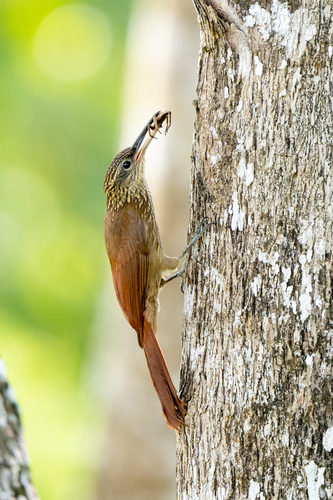
Same family: Furnariidae

The closest relatives of the Streak-breasted Treehunter that you can see in Volcán Barú National Park (family Furnariidae, Ovenbirds and Woodcreepers) are Spot-crowned Woodcreeper (about 40%), Red-faced Spinetail (about 30%) and Ruddy Treerunner (about 20%), with each one's daily chance of a sighting.

Where does the Streak-breasted Treehunter sighting chance come from?

GBIF citizen-science records

It is estimated from how often the Streak-breasted Treehunter is recorded against all the birds logged in Volcán Barú National Park (316 verified sightings from 2019 to 2026), calibrated against known sighting rates. Figures are rounded to the nearest 10% because citizen-science data supports honest approximations, not decimals, and months with records from fewer than five people show "—". How it works.

← Back to Volcán Barú National Park