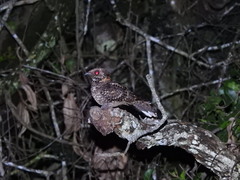

Abyssinian Nightjar

Abyssinian Nightjar

Caprimulgus poliocephalus

Silhouette: Ferran Sayol · PhyloPic

LCLeast ConcernNTVUENCR
Daily sighting probability <5% · Rare
at Volcanoes National Park

In 3 days <5% in a week ~10%

8 Verified sightings at Volcanoes National Park From 2019 to 2026
326 In all 8 parks
July Best month
🌅 Crepuscular When it's spotted

About the Abyssinian Nightjar

The montane nightjar (Caprimulgus poliocephalus), mountain nightjar or Abyssinian nightjar, is a species of nightjar in the family Caprimulgidae. It is native to upland regions of Central and Eastern Africa where it is a locally common species.

The Montane nightjar was originally described by the German naturalist Eduard Rüppell in 1840. He used the current binomial name Caprimulgus poliocephalus. The subspecies C. p. ruwenzorii was formerly sometimes treated as a separate species, the Ruwenzori nightjar. Although a molecular genetic study of these four nightjars has not been published, the results of the detailed measurement of museum specimens suggests that they should be considered as conspecific.

The montane nightjar is a rather dark nightjar growing to a length of about 23 cm (9.1 in). It has somewhat tawny, blackish or chocolate brown... Wikipedia →

Sounds

Song0:41

Kenya · 2026

© Ding Li Yong · XC1180144 · CC BY-NC-ND 4.0

Call0:57

Tanzania · 2024

© Barry Edmonston · XC899670 · CC BY-NC-SA 4.0

Uncertain0:12

Tanzania · 2022

© Aditya · XC749612 · CC BY-NC-SA 4.0

Global Distribution

Parks Where Found

# Park Country Daily sighting probability
1 Aberdare National Park 🇰🇪 Kenya
<5%
2 Bwindi Impenetrable National Park 🇺🇬 Uganda
<5%
3 Nairobi National Park 🇰🇪 Kenya
<5%
4 Nyungwe National Park 🇷🇼 Rwanda
<5%
5 Lake Nakuru National Park 🇰🇪 Kenya
<5%
6 Ngorongoro Conservation Area 🇹🇿 Tanzania
<5%
7 Volcanoes National Park 🇷🇼 Rwanda
<5%
8 Masai Mara National Reserve 🇰🇪 Kenya
<5%

Cities Where Found

# City Country Daily sighting probability
1 Nairobi 🇰🇪 Kenya
~10%
2 Addis Ababa 🇪🇹 Ethiopia
<5%

Before you go

What are the chances of seeing an Abyssinian Nightjar in Volcanoes National Park?

Rare

Under 5% of wildlife watchers report an Abyssinian Nightjar sighting in Volcanoes National Park on a given day, based on 8 verified sightings from GBIF citizen-science data from 2019 to 2026. It is the 135th most-seen of the 156 birds we can rate there. Over three days the chance rises to under 5%, and over a week to about 10%, if each day is a fresh chance.

When is the best time to see an Abyssinian Nightjar in Volcanoes National Park?

July

In that month about 10% of wildlife watchers report an Abyssinian Nightjar in Volcanoes National Park on a given day, against under 5% in August to June, the lowest months. That is one of Volcanoes National Park's driest months, with about 20 mm of rain against 250 mm in April.

What time of day is best to see an Abyssinian Nightjar?

Between 5 and 8 pm

Across all the parks we cover, that three-hour window holds the most Abyssinian Nightjar sightings with a recorded time, and about 6 in 10 of them come between 6 pm and 6 am: it is most active around dawn and dusk.

Is Volcanoes National Park the best place to see an Abyssinian Nightjar?

Among the best

Of the 8 parks where we can rate Abyssinian Nightjar sightings, Volcanoes National Park ranks 7th at under 5%, level with the leaders once rounded. The best odds are in Aberdare National Park (Kenya, under 5%), Bwindi Impenetrable National Park (Uganda, under 5%) and Nairobi National Park (Kenya, under 5%).

Where does the Abyssinian Nightjar sighting chance come from?

GBIF citizen-science records

It is estimated from how often the Abyssinian Nightjar is recorded against all the birds logged in Volcanoes National Park (8 verified sightings from 2019 to 2026), calibrated against known sighting rates. Figures are rounded to the nearest 10% because citizen-science data supports honest approximations, not decimals, and months with records from fewer than five people show "—". How it works.

← Back to Volcanoes National Park