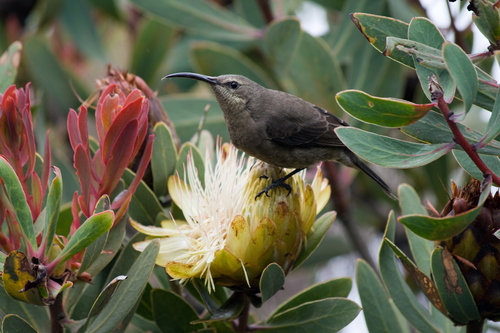
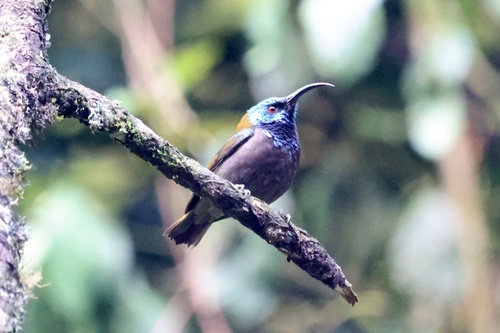
About the Malachite Sunbird
The malachite sunbird (Nectarinia famosa) is a small nectarivorous bird found from the highlands of Ethiopia southwards to South Africa. They pollinate many flowering plants, particularly those with long corolla tubes, in the Fynbos.
The malachite sunbird was formally described in 1766 by the Swedish naturalist Carl Linnaeus in the twelfth edition of his Systema Naturae under the binomial name Certhia famosa. Linnaeus specified the type locality as the Cape of Good Hope in South Africa. He based his account on "Le grimpereau à longue queue du Cap de Bonne Espérance" that had been described and illustrated in 1760 by French zoologist Mathurin Jacques Brisson. The specific epithet is from Latin famosus meaning "renowned" (from fama meaning "fame" or "repute").
The sunbirds are a group of small Old World passerine birds, and are placed within the family Nectariniidae, which is found across Africa, the Middle East and into South-east Asia. Also called green sugarbird. The malachite sunbird has two subspecies. Wikipedia →