About the Small Magpie
Anania hortulata, also known as the small magpie, is a species of moth of the family Crambidae found in Asia, Europe and North America. It was described, in 1758, by the 18th-century Swedish taxonomist, botanist, and zoologist, Carl Linnaeus.
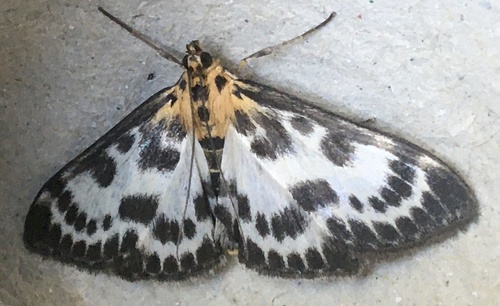
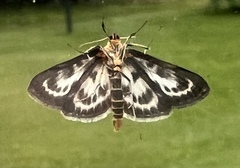
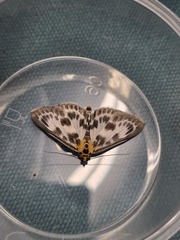
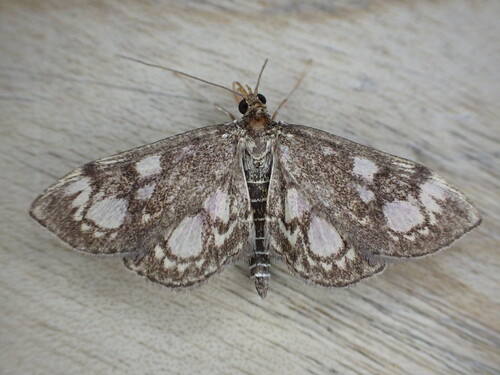
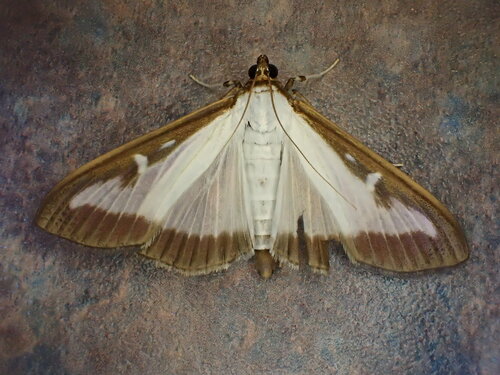
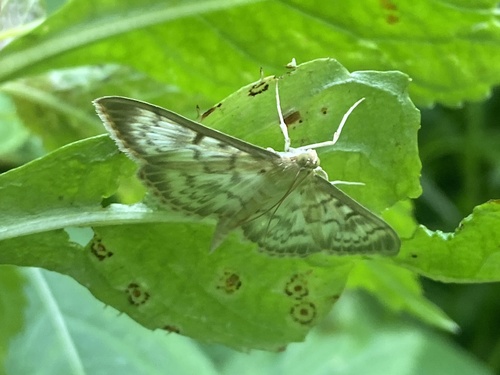
The wingspan is 24–28 millimetres (0.94–1.10 in) The head and thorax are deep ochreous-yellow, black-spotted. Forewings are yellowish-white, markings blackish; base blackish, with two ochreous-yellow marks; a suffused costal streak; lines thick, first irregular, second tending to form spots, curved, narrowest below middle; small orbicular and large round discal spots, touching costal streak; a terminal fascia tending to form spots, edge parallel to second line. Hind wings with colour, second line, and terminal fascia as in forewings; a blackish discal spot. The larva is whitish; dorsal line dull green, white-edged; head and plate of 2 black. See also Parsons et al.
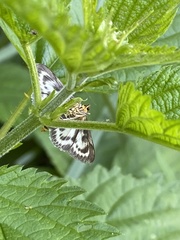
The moth flies from June to July depending on the location and is easily disturbed by day. It flies from dusk onward and comes to light. Ovum Eggs are mostly laid on stinging nettle (Urtica dioica) and occasionally on Labiatae such as white horehound (Marrubium vulgare... Wikipedia →