Cradock Thick-toed Gecko

Cradock Thick-toed Gecko

Pachydactylus geitje

Silhouette: Emmanuel Jimenez · PhyloPic

LCLeast ConcernNTVUENCR
Daily sighting probability ~10% · With luck
at West Coast National Park

In 3 days ~40% in a week ~70%

7 Verified sightings at West Coast National Park From 2019 to 2026
26 In all 4 parks
May Best month
☀️ Diurnal When it's spotted

About the Cradock Thick-toed Gecko

Pachydactylus geitje, also known commonly as the ocellated gecko, the ocellated thick-toed gecko and the Cradock thick-toed gecko, is a tiny species of thick-toed gecko, a lizard in the family Gekkonidae. The species is indigenous to the Western Cape of South Africa.

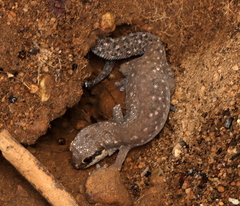
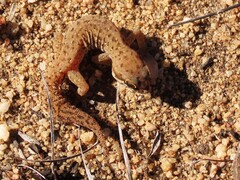
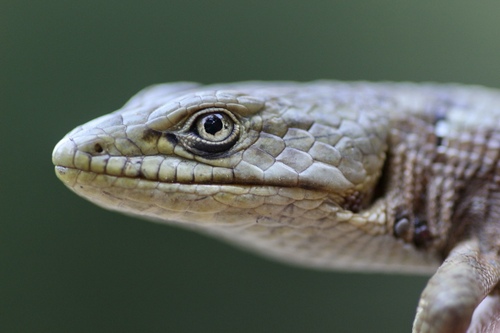
P. geitje is a very colourful, mottled little gecko. Its smooth (almost silky) body is usually covered in dark-edged white spots. P. geitje typically lives on the ground among debris and under rocks. Further inland it only lives higher in the mountains where rocky outcrops provide it with sufficient places to hide.

Pachydactylus geitje lays a clutch of two tiny eggs in the summer. Boulenger GA (1885). Catalogue of the Lizards in the British Museum (Natural History). Second Edition. Volume I. Geckonidæ.... London: Trustees of the British Museum (Natural History). (Taylor and Francis, printers). xii + 436 pp. + Plates I-XXXII. (Pachydactylus ocellatus, pp. 205–206).

Branch, Bill (2004). Field Guide to Snakes and other Reptiles of Southern Africa. Third Revised edition, Second impression. Sanibel Island, Florida: Ralph Curtis Books... Wikipedia →

Global Distribution

Parks Where Found

# Park Country Daily sighting probability
1 De Hoop Nature Reserve 🇿🇦 South Africa
~20%
2 West Coast National Park 🇿🇦 South Africa
~10%
3 Garden Route National Park 🇿🇦 South Africa
<5%
4 Table Mountain National Park 🇿🇦 South Africa
<5%

Cities Where Found

# City Country Daily sighting probability
1 Cape Town 🇿🇦 South Africa
~10%

Before you go

What are the chances of seeing a Cradock Thick-toed Gecko in West Coast National Park?

With luck

About 10% of wildlife watchers report a Cradock Thick-toed Gecko sighting in West Coast National Park on a given day, based on 7 verified sightings from GBIF citizen-science data from 2019 to 2026. It is the 18th most-seen of the 23 reptiles we can rate there. Over three days the chance rises to about 40%, and over a week to about 70%, if each day is a fresh chance.

When is the best time to see a Cradock Thick-toed Gecko in West Coast National Park?

May

In that month about 30% of wildlife watchers report a Cradock Thick-toed Gecko in West Coast National Park on a given day, against under 5% in January, April, June–August and October–November, the lowest months.

What time of day is best to see a Cradock Thick-toed Gecko?

Between 10 am and 1 pm

Across all the parks we cover, that three-hour window holds the most Cradock Thick-toed Gecko sightings with a recorded time, and about 9 in 10 of them come between 6 am and 6 pm: it is a daytime animal.

Is West Coast National Park the best place to see a Cradock Thick-toed Gecko?

2nd of 4

Of the 4 parks where we can rate Cradock Thick-toed Gecko sightings, West Coast National Park ranks 2nd at about 10%. The best odds are in De Hoop Nature Reserve (South Africa, about 20%).

Which relatives of the Cradock Thick-toed Gecko live in West Coast National Park?

Same family: Gekkonidae

The closest relatives of the Cradock Thick-toed Gecko that you can see in West Coast National Park (family Gekkonidae, Typical Geckos) are Striped Pygmy Gecko (about 20%) and Marbled Leaf-toed Gecko (about 20%), with each one's daily chance of a sighting.

Where does the Cradock Thick-toed Gecko sighting chance come from?

GBIF citizen-science records

It is estimated from how often the Cradock Thick-toed Gecko is recorded against all the reptiles logged in West Coast National Park (7 verified sightings from 2019 to 2026), calibrated against known sighting rates. Figures are rounded to the nearest 10% because citizen-science data supports honest approximations, not decimals, and months with records from fewer than five people show "—". How it works.

← Back to West Coast National Park