Brown-capped Babbler

Brown-capped Babbler

Pellorneum fuscocapillus

Silhouette: Rachael Joakim · PhyloPic

LCLeast ConcernNTVUENCR Endemic
Daily sighting probability ~30% · Possible
at Wilpattu National Park

In 3 days ~60% in a week ~90%

142 Verified sightings at Wilpattu National Park From 2019 to 2026
715 In all 6 parks
November Best month
🌅 Crepuscular When it's spotted

About the Brown-capped Babbler

The brown-capped babbler (Pellorneum fuscocapillus) is a member of the family Pellorneidae. The brown-capped babbler is an endemic resident breeding bird in Sri Lanka. Its habitat is forest undergrowth and thick scrub. This species, like most babblers, is not migratory, and has short rounded wings and a weak flight.

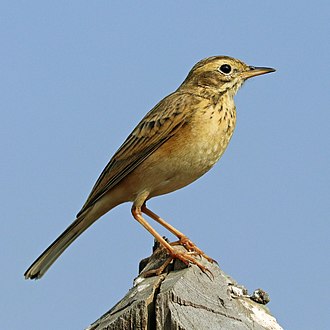
This babbler builds its nest on the ground or in a hole, concealed in dense masses of foliage. The normal clutch is two or three eggs. The brown-capped babbler is a smallish to medium-sized babbler, at 16 cm (6.3 in) including its long tail. It is brown above and rich cinnamon below. It has a dark brown crown.

Brown-capped babblers have short dark bills. Their food is mainly insects. They can be difficult to observe in the dense vegetation they prefer, but like other babblers, these are noisy birds, and their characteristic calls are often the best indication that these birds are present.

Brown-capped babblers are usually believed to occur in pairs. Male birds make a distinctive call ("pretty dear") to attract other birds. Breeding season occurs during the first half of the year, during which time males exhibit... Wikipedia →

Sounds

Song0:37

Sri Lanka · 2026

© Uku Paal · XC1096380 · CC BY-NC-SA 4.0

Call0:32

Sri Lanka · 2021

© THILANKA EDIRISINGHE · XC634464 · CC BY-NC-SA 4.0

Song0:14

Sri Lanka · 2007

© Jelle Scharringa · XC666495 · CC BY-NC-SA 4.0

Global Distribution

Parks Where Found

# Park Country Daily sighting probability
1 Wilpattu National Park 🇱🇰 Sri Lanka
~30%
2 Minneriya National Park 🇱🇰 Sri Lanka
~20%
3 Sinharaja Forest Reserve 🇱🇰 Sri Lanka
~20%
4 Yala National Park 🇱🇰 Sri Lanka
~10%
5 Udawalawe National Park 🇱🇰 Sri Lanka
~10%
6 Horton Plains National Park 🇱🇰 Sri Lanka
<5%

Before you go

What are the chances of seeing a Brown-capped Babbler in Wilpattu National Park?

Possible

About 30% of wildlife watchers report a Brown-capped Babbler sighting in Wilpattu National Park on a given day, based on 142 verified sightings from GBIF citizen-science data from 2019 to 2026. It is the 66th most-seen of the 169 birds we can rate there. Over three days the chance rises to about 60%, and over a week to about 90%, if each day is a fresh chance.

When is the best time to see a Brown-capped Babbler in Wilpattu National Park?

November

In that month about 50% of wildlife watchers report a Brown-capped Babbler in Wilpattu National Park on a given day, against about 10% in May, the lowest month. That is one of Wilpattu National Park's wettest months, with about 320 mm of rain against 40 mm in February.

What time of day is best to see a Brown-capped Babbler?

Between 4 and 7 am

Across all the parks we cover, that three-hour window holds the most Brown-capped Babbler sightings with a recorded time, and about 6 in 10 of them come between 6 am and 6 pm: it is most active around dawn and dusk.

Is Wilpattu National Park the best place to see a Brown-capped Babbler?

Yes

Of the 6 parks where we can rate Brown-capped Babbler sightings, Wilpattu National Park has the highest daily chance: about 30%. Next come Minneriya National Park (Sri Lanka, about 20%) and Sinharaja Forest Reserve (Sri Lanka, about 20%).

Which relatives of the Brown-capped Babbler live in Wilpattu National Park?

Same order: Passeriformes

The closest relatives of the Brown-capped Babbler that you can see in Wilpattu National Park (order Passeriformes, Perching Birds) are Oriental Magpie-Robin (about 60%), Indian Robin (about 60%) and Black-hooded Oriole (about 60%), with each one's daily chance of a sighting.

Where does the Brown-capped Babbler sighting chance come from?

GBIF citizen-science records

It is estimated from how often the Brown-capped Babbler is recorded against all the birds logged in Wilpattu National Park (142 verified sightings from 2019 to 2026), calibrated against known sighting rates. Figures are rounded to the nearest 10% because citizen-science data supports honest approximations, not decimals, and months with records from fewer than five people show "—". How it works.

← Back to Wilpattu National Park