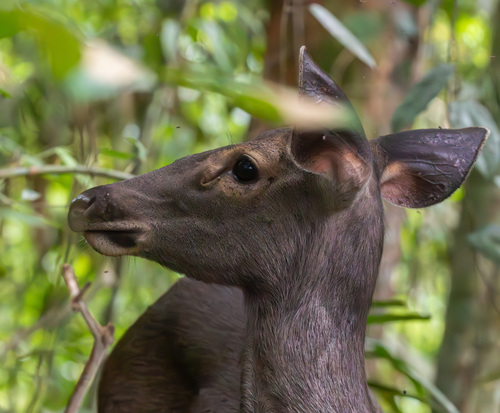
Toque Macaque

Toque Macaque

Macaca sinica

Silhouette: PhyloPic

LCNTVUENEndangeredCR Endemic
Daily sighting probability ~80% · Very likely
at Wilpattu National Park

In 3 days >90%

158 Verified sightings at Wilpattu National Park From 2019 to 2026
1,026 In all 6 parks
August Best month
☀️ Diurnal When it's spotted

About the Toque Macaque

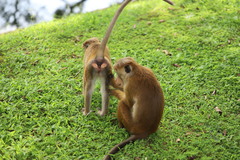
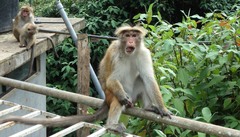
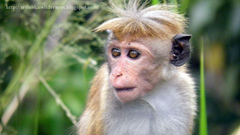
The toque macaque (Macaca sinica) is a reddish-brown-coloured Old World monkey endemic to Sri Lanka, where it is known as the riḷawā (Sinhala: රිළවා), (hence the English word rillow). Its name refers to the whorl of hair at the crown of the head, reminiscent of a brimless toque cap.

The generic name Macaca is from Portuguese macaco, of unclear origin, while sinica means "of China," even though the species is not found there. There are three recognized subspecies of toque macaques: Macaca sinica sinica, dry zone toque macaque or common toque macaque

Macaca sinica aurifrons, wet zone toque macaque or pale-fronted toque macaque Macaca sinica opisthomelas, highland toque macaque or hill zone toque macaque M. s. opisthomelas is similar to subsp. aurifrons, but has a long fur and contrasting golden color in the anterior part of its brown cap.

The three subspecies can be identified their head colour patterns. With age, the face of females turns slightly pink. Wikipedia →

Global Distribution

Parks Where Found

# Park Country Daily sighting probability
1 Wilpattu National Park 🇱🇰 Sri Lanka
~80%
2 Udawalawe National Park 🇱🇰 Sri Lanka
~60%
3 Horton Plains National Park 🇱🇰 Sri Lanka
~50%
4 Yala National Park 🇱🇰 Sri Lanka
~50%
5 Minneriya National Park 🇱🇰 Sri Lanka
~50%
6 Sinharaja Forest Reserve 🇱🇰 Sri Lanka
~40%

Zoos & Centres Where Found

# Zoo / Centre Country
1 Nashville Zoo at Grassmere 🇺🇸 United States In captivity

Before you go

What are the chances of seeing a Toque Macaque in Wilpattu National Park?

Very likely

About 80% of wildlife watchers report a Toque Macaque sighting in Wilpattu National Park on a given day, based on 158 verified sightings from GBIF citizen-science data from 2019 to 2026. It is the 4th most-seen of the 19 mammals we can rate there. Over three days the chance rises to over 90%, if each day is a fresh chance.

When is the best time to see a Toque Macaque in Wilpattu National Park?

August

In that month about 90% of wildlife watchers report a Toque Macaque in Wilpattu National Park on a given day, against about 40% in January, the lowest month. That is one of Wilpattu National Park's driest months, with about 65 mm of rain against 320 mm in November.

What time of day is best to see a Toque Macaque?

Between 10 am and 1 pm

Across all the parks we cover, that three-hour window holds the most Toque Macaque sightings with a recorded time, and about 8 in 10 of them come between 6 am and 6 pm: it is a daytime animal.

Which relatives of the Toque Macaque live in Wilpattu National Park?

Same family: Cercopithecidae

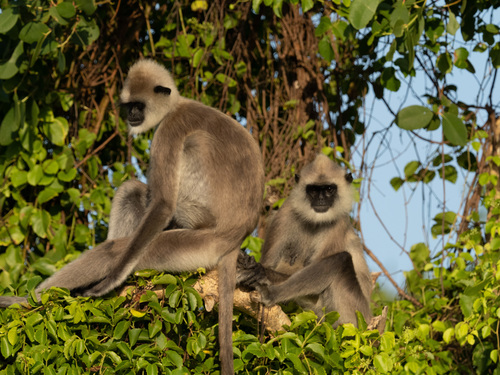
The closest relatives of the Toque Macaque that you can see in Wilpattu National Park (family Cercopithecidae, Old World Monkeys) are Tufted Langur (about 70%) and Purple-faced Lutung (about 20%), with each one's daily chance of a sighting.

Where does the Toque Macaque sighting chance come from?

GBIF citizen-science records

It is estimated from how often the Toque Macaque is recorded against all the mammals logged in Wilpattu National Park (158 verified sightings from 2019 to 2026), calibrated against known sighting rates. Figures are rounded to the nearest 10% because citizen-science data supports honest approximations, not decimals, and months with records from fewer than five people show "—". How it works.

← Back to Wilpattu National Park