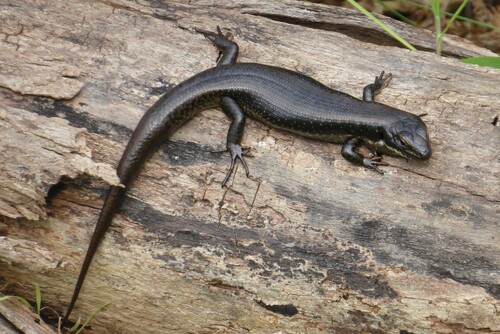
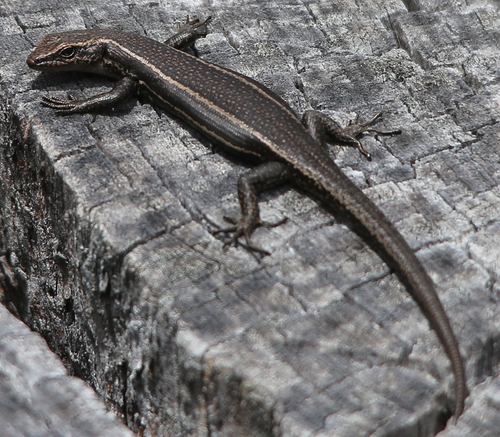
Southern Weasel Skink

Southern Weasel Skink

Saproscincus mustelinus

Silhouette: David Orr · PhyloPic

LCLeast ConcernNTVUENCR Endemic
Daily sighting probability ~10% · With luck
at Wilsons Promontory National Park

In 3 days ~30% in a week ~60%

7 Verified sightings at Wilsons Promontory National Park From 2019 to 2026
120 In all 4 parks
December Best month
☀️ Diurnal When it's spotted

About the Southern Weasel Skink

Saproscincus mustelinus, commonly known as the southern weasel skink or weasel shadeskink, is a small species of skink which is endemic to Australia. S. mustelinus is usually nocturnal, but is most active in the evening and warm mornings.

S. mustelinus hunts and feeds on small insects and other small invertebrates. The southern weasel skink is around 45 mm (1.8 in) from snout to vent, is covered in iridescent reddish brown (fine) scales, and has several distinctive white marks behind and below the eye.

If frightened this skink has the ability to lose its tail as a defence mechanism; the tail lies on the ground twitching, distracting the predator so the skink can escape. The southern weasel skink tends to utilize existing vegetation and fallen timber for shelter.

The southern weasel skink's distribution forms a coastal strip from south Victoria to southern Queensland. Females lay up to four eggs per clutch in a communal nest. The nests are normally a dugout, a burrow, which contain the eggs of numerous females. Laying normally occurs between spring and late summer... Wikipedia →

Global Distribution

Parks Where Found

# Park Country Daily sighting probability
1 Blue Mountains National Park 🇦🇺 Australia
~20%
2 Royal National Park 🇦🇺 Australia
~10%
3 Wilsons Promontory National Park 🇦🇺 Australia
~10%
4 Great Otway National Park 🇦🇺 Australia
~10%

Cities Where Found

# City Country Daily sighting probability
1 Melbourne 🇦🇺 Australia
~20%
2 Sydney 🇦🇺 Australia
~10%

Closest Relatives at Wilsons Promontory National Park

Before you go

What are the chances of seeing a Southern Weasel Skink in Wilsons Promontory National Park?

With luck

About 10% of wildlife watchers report a Southern Weasel Skink sighting in Wilsons Promontory National Park on a given day, based on 7 verified sightings from GBIF citizen-science data from 2019 to 2026. It is the 11th most-seen of the 14 reptiles we can rate there. Over three days the chance rises to about 30%, and over a week to about 60%, if each day is a fresh chance.

When is the best time to see a Southern Weasel Skink in Wilsons Promontory National Park?

December and January

In those months about 30% of wildlife watchers report a Southern Weasel Skink in Wilsons Promontory National Park on a given day, against under 5% in February–March and May–November, the lowest months.

What time of day is best to see a Southern Weasel Skink?

Between noon and 3 pm

Across all the parks we cover, that three-hour window holds the most Southern Weasel Skink sightings with a recorded time, and about 9 in 10 of them come between 6 am and 6 pm: it is a daytime animal.

Is Wilsons Promontory National Park the best place to see a Southern Weasel Skink?

3rd of 4

Of the 4 parks where we can rate Southern Weasel Skink sightings, Wilsons Promontory National Park ranks 3rd at about 10%. The best odds are in Blue Mountains National Park (Australia, about 20%) and Royal National Park (Australia, about 10%).

Which relatives of the Southern Weasel Skink live in Wilsons Promontory National Park?

Same family: Scincidae

The closest relatives of the Southern Weasel Skink that you can see in Wilsons Promontory National Park (family Scincidae, Skinks) are Cool-temperate Water Skink (about 60%), White's Rock-skink (about 50%) and Blotched Bluetongue (about 40%), with each one's daily chance of a sighting.

Where does the Southern Weasel Skink sighting chance come from?

GBIF citizen-science records

It is estimated from how often the Southern Weasel Skink is recorded against all the reptiles logged in Wilsons Promontory National Park (7 verified sightings from 2019 to 2026), calibrated against known sighting rates. Figures are rounded to the nearest 10% because citizen-science data supports honest approximations, not decimals, and months with records from fewer than five people show "—". How it works.

← Back to Wilsons Promontory National Park