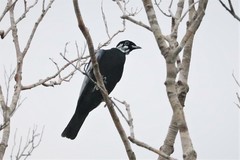
Bare-necked Fruitcrow

Bare-necked Fruitcrow

Gymnoderus foetidus

Silhouette: Edwin Price · PhyloPic

LCLeast ConcernNTVUENCR
Daily sighting probability ~20% · Possible
at Yasuní National Park

In 3 days ~50% in a week ~80%

733 Verified sightings at Yasuní National Park From 2019 to 2026
1,703 In all 7 parks
August Best month
☀️ Diurnal When it's spotted

About the Bare-necked Fruitcrow

The bare-necked fruitcrow (Gymnoderus foetidus) is a species of bird in the family Cotingidae, the cotingas. It is found in every mainland South American country except Argentina, Chile, Uruguay, and Paraguay. The bare-necked fruitcrow was formally described in 1758 by the Swedish naturalist Carl Linnaeus in the tenth edition of his Systema Naturae under the binomial name Gracula foetida. Linnaeus specified the type locality as America but in 1902 the locality was restricted to Surinam. The bare-necked fruitcrow is now the only species placed in the genus Gymnoderus that was introduced in 1809 by the French naturalist Étienne Geoffroy Saint-Hilaire. The genus name combines the Ancient Greek gumnos meaning "bare" or "naked" with dera meaning "neck" or "throat". The specific epithet foetidus is Latin meaning "stinking". The species is monotypic: no subspecies are recognized.

A large molecular phylogenetic study of the suboscines published in 2020 found that the bare-necked fruitcrow was sister to the black-faced cotinga (Conioptilon mcilhennyi). The bare-necked fruitcrow is 34 to 39 cm (13 to 15 in) long; one individual weighed 220 g (7... Wikipedia →

Sounds

Call0:05

Colombia · 2012

© Oswaldo Cortes · XC106284 · CC BY-NC-ND 2.5

Global Distribution

Parks Where Found

# Park Country Daily sighting probability
1 Cuyabeno Wildlife Reserve 🇪🇨 Ecuador
~30%
2 Yasuní National Park 🇪🇨 Ecuador
~20%
3 Amacayacu National Natural Park 🇨🇴 Colombia
~10%
4 Anavilhanas National Park 🇧🇷 Brazil
~10%
5 Manu National Park 🇵🇪 Peru
~10%
6 Tambopata National Reserve 🇵🇪 Peru
~10%
7 Sierra de la Macarena National Park 🇨🇴 Colombia
<5%

Before you go

What are the chances of seeing a Bare-necked Fruitcrow in Yasuní National Park?

Possible

About 20% of wildlife watchers report a Bare-necked Fruitcrow sighting in Yasuní National Park on a given day, based on 733 verified sightings from GBIF citizen-science data from 2019 to 2026. It is the 63rd most-seen of the 533 birds we can rate there. Over three days the chance rises to about 50%, and over a week to about 80%, if each day is a fresh chance.

When is the best time to see a Bare-necked Fruitcrow in Yasuní National Park?

July–August and October–November

In those months about 30% of wildlife watchers report a Bare-necked Fruitcrow in Yasuní National Park on a given day, against about 10% in April, the lowest month.

What time of day is best to see a Bare-necked Fruitcrow?

Between 3 and 6 pm

Across all the parks we cover, that three-hour window holds the most Bare-necked Fruitcrow sightings with a recorded time, and about 8 in 10 of them come between 6 am and 6 pm: it is a daytime animal.

Is Yasuní National Park the best place to see a Bare-necked Fruitcrow?

2nd of 7

Of the 7 parks where we can rate Bare-necked Fruitcrow sightings, Yasuní National Park ranks 2nd at about 20%. The best odds are in Cuyabeno Wildlife Reserve (Ecuador, about 30%).

Which relatives of the Bare-necked Fruitcrow live in Yasuní National Park?

Same family: Cotingidae

The closest relatives of the Bare-necked Fruitcrow that you can see in Yasuní National Park (family Cotingidae, Cotingas) are Black-tailed Tityra (about 20%), Purple-throated Fruitcrow (about 20%) and Spangled Cotinga (about 10%), with each one's daily chance of a sighting.

Where does the Bare-necked Fruitcrow sighting chance come from?

GBIF citizen-science records

It is estimated from how often the Bare-necked Fruitcrow is recorded against all the birds logged in Yasuní National Park (733 verified sightings from 2019 to 2026), calibrated against known sighting rates. Figures are rounded to the nearest 10% because citizen-science data supports honest approximations, not decimals, and months with records from fewer than five people show "—". How it works.

← Back to Yasuní National Park