Black-headed Parrot

Black-headed Parrot

Pionites melanocephalus

Silhouette: Sheatherius · PhyloPic

LCLeast ConcernNTVUENCR
Daily sighting probability ~30% · Possible
at Yasuní National Park

In 3 days ~60% in a week ~90%

846 Verified sightings at Yasuní National Park From 2019 to 2026
1,256 In all 5 parks
October Best month
☀️ Diurnal When it's spotted

About the Black-headed Parrot

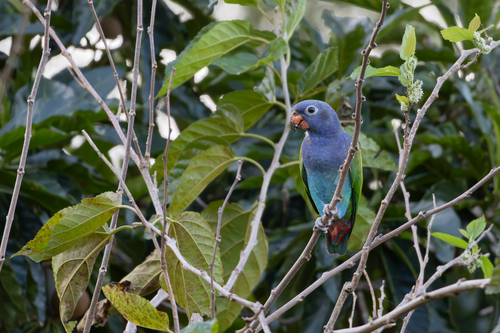
The black-headed parrot (Pionites melanocephalus; sometimes incorrectly Pionites melanocephala) is a species of bird in subfamily Arinae of the family Psittacidae, the African and New World parrots. Other colloquial names are black-crowned parrot, black-capped parrot, black-headed caique, and for subspecies P. m. pallidus, pallid caique. It is found in Brazil, Colombia, Ecuador, French Guiana, Guyana, Peru, Suriname, and Venezuela.

The black-headed parrot was formally described in 1758 by the Swedish naturalist Carl Linnaeus in the tenth edition of his Systema Naturae. He placed it with all the other parrots in the genus Psittacus and coined the binomial name Psittacus melanocephalus. Linnaeus based his account on the "white-breasted parrot" that had been described and illustrated in 1751 by the English naturalist George Edwards in his multivolume work "A Natural History of Uncommon Birds". Linnaeus gave the type locality as Mexico but this has been changed to Caracas in Venezuela as given by Edwards. The black-headed parrot is now placed together with the white-bellied parrot in the genus Pionites that was introduced in 1890 by the German ornithologist Ferdinand Heine... Wikipedia →

Sounds

Call0:23

Ecuador · 2025

© Marc Anderson · XC983005 · CC BY-NC-ND 4.0

Song0:45

Brazil · 2020

© Felipe Arantes · XC600236 · CC BY-NC-SA 4.0

Recording0:28

Colombia · 2001

© Mauricio Álvarez-Rebolledo (Colección de Sonidos Ambientales - Instituto Humboldt) · XC525638 · CC BY-NC-SA 4.0

Global Distribution

Parks Where Found

# Park Country Daily sighting probability
1 Cuyabeno Wildlife Reserve 🇪🇨 Ecuador
~30%
2 Yasuní National Park 🇪🇨 Ecuador
~30%
3 Amacayacu National Natural Park 🇨🇴 Colombia
~20%
4 Sierra de la Macarena National Park 🇨🇴 Colombia
~10%
5 Brownsberg Nature Park 🇸🇷 Suriname
<5%

Zoos & Centres Where Found

# Zoo / Centre Country
1 ZooParc de Beauval 🇫🇷 France In captivity
2 Zoofari 🇲🇽 Mexico In captivity
3 Shanghai Zoo 🇨🇳 China In captivity
4 Shenzhen Safari Park 🇨🇳 China In captivity
5 Safari World 🇹🇭 Thailand In captivity
6 Ukumarí Biopark 🇨🇴 Colombia In captivity
7 Twycross Zoo 🇬🇧 United Kingdom In captivity
8 Wilhelma 🇩🇪 Germany In captivity
9 Zoológico la pastroa 🇲🇽 Mexico In captivity
10 Austin Zoo 🇺🇸 United States In captivity
11 Halls Gap Zoo 🇦🇺 Australia In captivity
12 Melbourne Zoo 🇦🇺 Australia In captivity
13 Saigon Zoo and Botanical Gardens 🇻🇳 Vietnam In captivity
14 Paphos Zoo 🇨🇾 Cyprus In captivity
15 Loro Parque 🇪🇸 Spain In captivity
16 Hong Kong Zoological and Botanical Gardens 🇨🇳 China In captivity
17 Parque de la Conservación 🇨🇴 Colombia In captivity
18 Ecozoológico San Martín 🇪🇨 Ecuador In captivity
19 Metalzoo Staré Město 🇨🇿 Czechia In captivity
20 Emperor Valley Zoo 🇹🇹 Trinidad & Tobago In captivity
21 Entopia 🇲🇾 Malaysia In captivity
22 Agroflori Parque de las Aves 🇧🇴 Bolivia In captivity
23 Sunken Gardens 🇺🇸 United States In captivity
24 Sea World Indonesia 🇮🇩 Indonesia In captivity
25 Parrot Zoo in Bošovice 🇨🇿 Czechia In captivity
26 Xpark 🇹🇼 Taiwan In captivity
27 aquarium Cap Blanc 🇪🇸 Spain In captivity
28 Sea Life Benalmádena 🇪🇸 Spain In captivity
29 Great National Aquarium 🇵🇪 Peru In captivity
30 Seattle Marine Aquarium 🇺🇸 United States In captivity
31 Tropical Birdland, Leicestershire 🇬🇧 United Kingdom In captivity

Before you go

What are the chances of seeing a Black-headed Parrot in Yasuní National Park?

Possible

About 30% of wildlife watchers report a Black-headed Parrot sighting in Yasuní National Park on a given day, based on 846 verified sightings from GBIF citizen-science data from 2019 to 2026. It is the 46th most-seen of the 533 birds we can rate there. Over three days the chance rises to about 60%, and over a week to about 90%, if each day is a fresh chance.

When is the best time to see a Black-headed Parrot in Yasuní National Park?

October

In that month about 40% of wildlife watchers report a Black-headed Parrot in Yasuní National Park on a given day, against about 20% in April, July–September and December–February, the lowest months.

What time of day is best to see a Black-headed Parrot?

Between 7 and 10 am

Across all the parks we cover, that three-hour window holds the most Black-headed Parrot sightings with a recorded time, and about 8 in 10 of them come between 6 am and 6 pm: it is a daytime animal.

Is Yasuní National Park the best place to see a Black-headed Parrot?

Among the best

Of the 5 parks where we can rate Black-headed Parrot sightings, Yasuní National Park ranks 2nd at about 30%, level with the leaders once rounded. The best odds are in Cuyabeno Wildlife Reserve (Ecuador, about 30%).

Which relatives of the Black-headed Parrot live in Yasuní National Park?

Same family: Psittacidae

The closest relatives of the Black-headed Parrot that you can see in Yasuní National Park (family Psittacidae, New World and African Parrots) are Cobalt-winged Parakeet (about 50%), Mealy Parrot (about 40%) and Blue-headed Parrot (about 40%), with each one's daily chance of a sighting.

Where does the Black-headed Parrot sighting chance come from?

GBIF citizen-science records

It is estimated from how often the Black-headed Parrot is recorded against all the birds logged in Yasuní National Park (846 verified sightings from 2019 to 2026), calibrated against known sighting rates. Figures are rounded to the nearest 10% because citizen-science data supports honest approximations, not decimals, and months with records from fewer than five people show "—". How it works.

← Back to Yasuní National Park