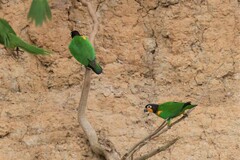
Orange-cheeked Parrot

Orange-cheeked Parrot

Pionopsitta barrabandi

Silhouette: Sheatherius · PhyloPic

LCLeast ConcernNTVUENCR
Daily sighting probability ~20% · Possible
at Yasuní National Park

In 3 days ~50% in a week ~80%

705 Verified sightings at Yasuní National Park From 2019 to 2026
1,486 In all 6 parks
November Best month
☀️ Diurnal When it's spotted

About the Orange-cheeked Parrot

The orange-cheeked parrot (Pyrilia barrabandi), also known as Barraband's parrot, is a species of parrot in the family Psittacidae. It was formerly placed in the genus Pionopsitta, which is now monotypic. It is found in the Amazonian Andes, in humid lowland forests in the northwestern, southwestern, and south-central Amazon Basin in South America.

They are threatened with loss of habitat due to the increasing deforestation of the Amazon. The binomial name of this bird commemorates the French painter Jacques Barraband. It was formerly placed in the genus Pionopsitta.

There are two subspecies: P.b. barrabandi- Found north of the upper Amazon River from east Amazonas, northern Brazil and southern Venezuela to southeast Colombia, eastern Ecuador and northeastern Peru. P.b. aurantiigena- Found south of the upper Amazon River from northern Brazil to eastern Peru and northern Bolivia.

The parrots are 25 cm (9.8 in) in size and weigh 165–190 g (5.8–6.7 oz). Adults have an olive throat and breast. The thighs are yellow, with the bend of the wing and lesser wing coverts ranging from yellow to orange, and the carpal edge and underwing coverts being... Wikipedia →

Sounds

Call0:15

Ecuador · 2025

© Marc Anderson · XC1094750 · CC BY-NC-ND 4.0

Flight call0:12

Ecuador · 2023

© rudy gelis · XC827133 · CC BY-NC-SA 4.0

Recording1:15

Colombia · 2001

© Mauricio Álvarez-Rebolledo (Colección de Sonidos Ambientales - Instituto Humboldt) · XC525648 · CC BY-NC-SA 4.0

Global Distribution

Parks Where Found

# Park Country Daily sighting probability
1 Yasuní National Park 🇪🇨 Ecuador
~20%
2 Cuyabeno Wildlife Reserve 🇪🇨 Ecuador
~20%
3 Tambopata National Reserve 🇵🇪 Peru
~10%
4 Manu National Park 🇵🇪 Peru
<5%
5 Anavilhanas National Park 🇧🇷 Brazil
<5%
6 Amacayacu National Natural Park 🇨🇴 Colombia
<5%

Before you go

What are the chances of seeing an Orange-cheeked Parrot in Yasuní National Park?

Possible

About 20% of wildlife watchers report an Orange-cheeked Parrot sighting in Yasuní National Park on a given day, based on 705 verified sightings from GBIF citizen-science data from 2019 to 2026. It is the 70th most-seen of the 533 birds we can rate there. Over three days the chance rises to about 50%, and over a week to about 80%, if each day is a fresh chance.

When is the best time to see an Orange-cheeked Parrot in Yasuní National Park?

October to December

In those months about 30% of wildlife watchers report an Orange-cheeked Parrot in Yasuní National Park on a given day, against about 10% in April and June–July, the lowest months.

What time of day is best to see an Orange-cheeked Parrot?

Between 6 and 9 am

Across all the parks we cover, that three-hour window holds the most Orange-cheeked Parrot sightings with a recorded time, and about 9 in 10 of them come between 6 am and 6 pm: it is a daytime animal.

Is Yasuní National Park the best place to see an Orange-cheeked Parrot?

Yes

Of the 6 parks where we can rate Orange-cheeked Parrot sightings, Yasuní National Park has the highest daily chance: about 20%. Next come Cuyabeno Wildlife Reserve (Ecuador, about 20%) and Tambopata National Reserve (Peru, about 10%).

Which relatives of the Orange-cheeked Parrot live in Yasuní National Park?

Same family: Psittacidae

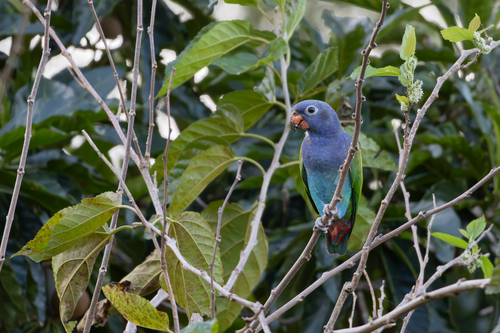
The closest relatives of the Orange-cheeked Parrot that you can see in Yasuní National Park (family Psittacidae, New World and African Parrots) are Cobalt-winged Parakeet (about 50%), Mealy Parrot (about 40%) and Blue-headed Parrot (about 40%), with each one's daily chance of a sighting.

Where does the Orange-cheeked Parrot sighting chance come from?

GBIF citizen-science records

It is estimated from how often the Orange-cheeked Parrot is recorded against all the birds logged in Yasuní National Park (705 verified sightings from 2019 to 2026), calibrated against known sighting rates. Figures are rounded to the nearest 10% because citizen-science data supports honest approximations, not decimals, and months with records from fewer than five people show "—". How it works.

← Back to Yasuní National Park