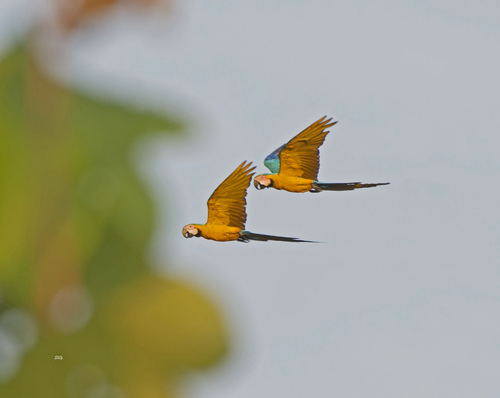
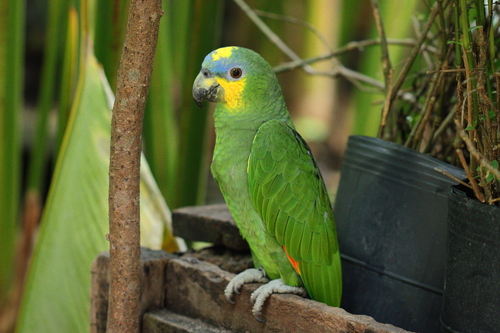
Red-bellied Macaw

Red-bellied Macaw

Orthopsittaca manilata

Silhouette: Sheatherius · PhyloPic

LCLeast ConcernNTVUENCR
Daily sighting probability ~40% · Likely
at Yasuní National Park

In 3 days ~80% in a week >90%

1,386 Verified sightings at Yasuní National Park From 2019 to 2026
2,850 In all 8 parks
September Best month
☀️ Diurnal When it's spotted

About the Red-bellied Macaw

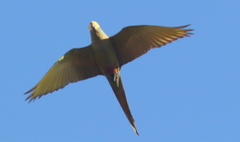
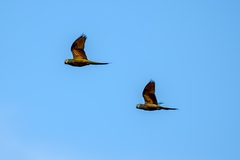
The red-bellied macaw (Orthopsittaca manilatus), also known as Guacamaya manilata, is a medium-sized, mostly green parrot, a member of a group of large Neotropical parrots known as macaws. It is the largest of what are commonly called "mini-macaws". The belly has a large maroon patch which gives the species its name.

It is endemic to tropical Amazonian South America (as well as the Caribbean island of Trinidad), from Colombia south to Amazonian Peru and Bolivia, and central Brazil as far as the northwestern cerrado. Its habitat is moriche (or buriti) palm (Mauritia flexuosa) swamp forests and sandy savannahs with palm groves. They are critically dependent on the Moriche palm for roosting, feeding and nesting. Although the bird is locally common, in places it has been adversely affected by clearing of the palms for use as posts, or to allow cattle ranching; also by capture for the pet trade.

Not to be confused with the African red-bellied parrot (Poicephalus rufiventris), a similarly named smaller parrot. The red-bellied macaw was described by the French polymath Georges-Louis Leclerc, Comte de Buffon in 1780 in his Histoire Naturelle des Oiseaux from a specimen collected... Wikipedia →

Sounds

Flight call0:08

Brazil · 2026

© JAYRSON ARAUJO DE OLIVEIRA · XC1183068 · CC BY-NC-SA 4.0

Call0:20

Ecuador · 2010

© Manuel Sánchez-Nivicela · XC1157391 · CC BY-NC-ND 4.0

Subsong0:35

Colombia · 2020

© Mauricio Cuellar Ramirez (@Birding.travel) · XC573795 · CC BY-NC-SA 4.0

Global Distribution

Parks Where Found

# Park Country Daily sighting probability
1 Yasuní National Park 🇪🇨 Ecuador
~40%
2 Cuyabeno Wildlife Reserve 🇪🇨 Ecuador
~30%
3 Tambopata National Reserve 🇵🇪 Peru
~20%
4 Manu National Park 🇵🇪 Peru
~10%
5 Chingaza National Natural Park 🇨🇴 Colombia
~10%
6 Sierra de la Macarena National Park 🇨🇴 Colombia
~10%
7 Amacayacu National Natural Park 🇨🇴 Colombia
<5%
8 Anavilhanas National Park 🇧🇷 Brazil
<5%

Cities Where Found

# City Country Daily sighting probability
1 Manaus 🇧🇷 Brazil
~50%
2 Campo Grande 🇧🇷 Brazil
~20%
3 Goiânia 🇧🇷 Brazil
~20%
4 Brasilia 🇧🇷 Brazil
<5%

Zoos & Centres Where Found

# Zoo / Centre Country
1 Zlín-Lešná Zoo 🇨🇿 Czechia In captivity
2 Safari World 🇹🇭 Thailand In captivity
3 Zoológico de Goiânia 🇧🇷 Brazil In captivity
4 Loro Parque 🇪🇸 Spain In captivity

Before you go

What are the chances of seeing a Red-bellied Macaw in Yasuní National Park?

Likely

About 40% of wildlife watchers report a Red-bellied Macaw sighting in Yasuní National Park on a given day, based on 1,386 verified sightings from GBIF citizen-science data from 2019 to 2026. It is the 21st most-seen of the 533 birds we can rate there. Over three days the chance rises to about 80%, and over a week to over 90%, if each day is a fresh chance.

When is the best time to see a Red-bellied Macaw in Yasuní National Park?

September

In that month about 60% of wildlife watchers report a Red-bellied Macaw in Yasuní National Park on a given day, against about 20% in April, the lowest month.

What time of day is best to see a Red-bellied Macaw?

Between 4 and 7 pm

Across all the parks we cover, that three-hour window holds the most Red-bellied Macaw sightings with a recorded time, and about 8 in 10 of them come between 6 am and 6 pm: it is a daytime animal.

Is Yasuní National Park the best place to see a Red-bellied Macaw?

Yes

Of the 8 parks where we can rate Red-bellied Macaw sightings, Yasuní National Park has the highest daily chance: about 40%. Next come Cuyabeno Wildlife Reserve (Ecuador, about 30%) and Tambopata National Reserve (Peru, about 20%).

Which relatives of the Red-bellied Macaw live in Yasuní National Park?

Same family: Psittacidae

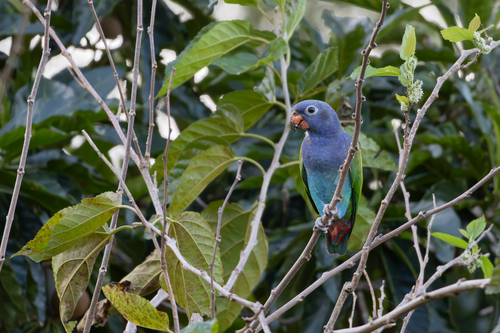
The closest relatives of the Red-bellied Macaw that you can see in Yasuní National Park (family Psittacidae, New World and African Parrots) are Cobalt-winged Parakeet (about 50%), Mealy Parrot (about 40%) and Blue-headed Parrot (about 40%), with each one's daily chance of a sighting.

Where does the Red-bellied Macaw sighting chance come from?

GBIF citizen-science records

It is estimated from how often the Red-bellied Macaw is recorded against all the birds logged in Yasuní National Park (1,386 verified sightings from 2019 to 2026), calibrated against known sighting rates. Figures are rounded to the nearest 10% because citizen-science data supports honest approximations, not decimals, and months with records from fewer than five people show "—". How it works.

← Back to Yasuní National Park