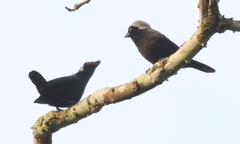
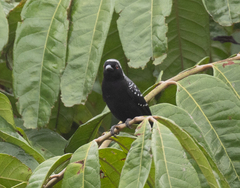
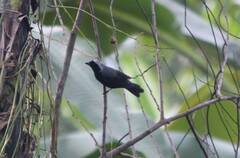

Gray-headed Negrofinch

Gray-headed Negrofinch

Nigrita canicapillus

Silhouette: Sheatherius · PhyloPic

LCLeast ConcernNTVUENCR
Daily sighting probability <5% · Rare
at Aberdare National Park

In 3 days ~10%

8 Verified sightings at Aberdare National Park From 2019 to 2026
2,029 In all 12 parks
May Best month
☀️ Diurnal When it's spotted

About the Gray-headed Negrofinch

The grey-headed nigrita (Nigrita canicapillus) is a common species of estrildid finch found in Africa. It has an estimated global extent of occurrence of 3,700,000 km2. It is widespread throughout the African tropical rainforest.

The status of the species is evaluated as Least Concern. The grey-headed nigrita was formally described in 1841 by the English naturalist Hugh Edwin Strickland based on a specimen collected on the island of Bioko (formerly named Fernando Pó), off the west coast of Africa. He coined the binomial name Aethiops canicapillus where the specific epithet combines the Latin canus meaning "grey" with -capillus meaning "-capped" or "-headed". The grey-headed nigrita is now one of four species placed in the genus Nigrita that was introduced in 1843 by Strickland.

Six subspecies are recognised: Wikipedia →

Sounds

Song0:06

Liberia · 2015

© Bram Piot · XC247293 · CC BY-NC-SA 4.0

Call0:58

Ghana · 2018

© Phil Gregory · XC611866 · CC BY-NC-SA 4.0

Begging call0:35

Cameroon · 2012

© Mike Nelson · XC99247 · CC BY-NC-ND 2.5

Global Distribution

Parks Where Found

# Park Country Daily sighting probability
1 Kibale National Park 🇺🇬 Uganda
~50%
2 Semuliki National Park 🇺🇬 Uganda
~30%
3 Bwindi Impenetrable National Park 🇺🇬 Uganda
~20%
4 Nyungwe National Park 🇷🇼 Rwanda
~20%
5 Arusha National Park 🇹🇿 Tanzania
~10%
6 Taï National Park 🇨🇮 Ivory Coast
~10%
7 Virunga National Park 🇨🇩 Democratic Republic of the Congo
~10%
8 Volcanoes National Park 🇷🇼 Rwanda
~10%
9 Queen Elizabeth National Park 🇺🇬 Uganda
~10%
10 Ngorongoro Conservation Area 🇹🇿 Tanzania
<5%
11 Aberdare National Park 🇰🇪 Kenya
<5%
12 Lake Mburo National Park 🇺🇬 Uganda
<5%

Cities Where Found

# City Country Daily sighting probability
1 Kampala 🇺🇬 Uganda
~10%
2 Yaoundé 🇨🇲 Cameroon
~10%

Before you go

What are the chances of seeing a Gray-headed Negrofinch in Aberdare National Park?

Rare

Under 5% of wildlife watchers report a Gray-headed Negrofinch sighting in Aberdare National Park on a given day, based on 8 verified sightings from GBIF citizen-science data from 2019 to 2026. It is the 173rd most-seen of the 217 birds we can rate there. Over three days the chance rises to about 10%, if each day is a fresh chance.

When is the best time to see a Gray-headed Negrofinch in Aberdare National Park?

May

In that month about 10% of wildlife watchers report a Gray-headed Negrofinch in Aberdare National Park on a given day, against under 5% in June to April, the lowest months. That is one of Aberdare National Park's wettest months, with about 210 mm of rain against 55 mm in February.

What time of day is best to see a Gray-headed Negrofinch?

Between 8 and 11 am

Across all the parks we cover, that three-hour window holds the most Gray-headed Negrofinch sightings with a recorded time, and about 9 in 10 of them come between 6 am and 6 pm: it is a daytime animal.

Which relatives of the Gray-headed Negrofinch live in Aberdare National Park?

Same family: Estrildidae

The closest relatives of the Gray-headed Negrofinch that you can see in Aberdare National Park (family Estrildidae, Waxbills and Allies) are Kandt's Waxbill (about 20%), Yellow-bellied Waxbill (about 20%) and Red-cheeked Cordon-bleu (about 10%), with each one's daily chance of a sighting.

Where does the Gray-headed Negrofinch sighting chance come from?

GBIF citizen-science records

It is estimated from how often the Gray-headed Negrofinch is recorded against all the birds logged in Aberdare National Park (8 verified sightings from 2019 to 2026), calibrated against known sighting rates. Figures are rounded to the nearest 10% because citizen-science data supports honest approximations, not decimals, and months with records from fewer than five people show "—". How it works.

← Back to Aberdare National Park