Mosque Swallow

Mosque Swallow

Cecropis senegalensis

Silhouette: Andy Wilson · PhyloPic

LCLeast ConcernNTVUENCR
Daily sighting probability ~20% · Possible
at Aberdare National Park

In 3 days ~50% in a week ~80%

79 Verified sightings at Aberdare National Park From 2019 to 2026
2,717 In all 31 parks
November Best month
☀️ Diurnal When it's spotted

About the Mosque Swallow

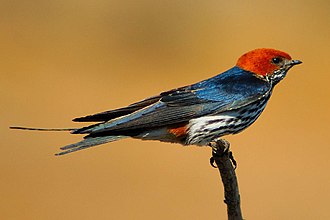
The mosque swallow (Cecropis senegalensis) is a large species of swallow. It is a resident breeder in much of sub-Saharan Africa, although most common in the west. It does not migrate but follows the rains to some extent.

In 1760, the French zoologist Mathurin Jacques Brisson included a description of the mosque swallow in his Ornithologie based on a specimen collected in Senegal. He used the French name L'hirondelle du Sénégal and the Latin Hirundo Senegalensis. Although Brisson coined Latin names, these do not conform to the binomial system and are not recognised by the International Commission on Zoological Nomenclature. In 1766, when Carl Linnaeus updated his Systema Naturae for the twelfth edition, he added 240 species that had been previously described by Brisson. One of these was the mosque swallow. Linnaeus included a brief description and used Brisson's Latin name for his binomial name Hirundo senegalensis.

Formerly placed in the genus Hirundo the mosque swallow and its relatives have been shown by molecular studies to be a separate clade and are now placed in the genus Cecropis, which was introduced by the German zoologist Friedrich Boie in 1826.

There are three... Wikipedia →

Sounds

Call0:25

South Africa · 2021

© Derek Solomon · XC696444 · CC BY-NC-SA 4.0

Song0:52

Tanzania · 2014

© Thibaut Chansac · XC201391 · CC BY-NC-SA 4.0

Call0:12

Guinea-Bissau · 2020

© Antonio Xeira · XC664826 · CC BY-NC-ND 4.0

Global Distribution

Parks Where Found

# Park Country Daily sighting probability
1 Gonarezhou National Park 🇿🇼 Zimbabwe
~30%
2 Aberdare National Park 🇰🇪 Kenya
~20%
3 Mana Pools National Park 🇿🇼 Zimbabwe
~20%
4 Ruaha National Park 🇹🇿 Tanzania
~20%
5 Tarangire National Park 🇹🇿 Tanzania
~10%
6 Masai Mara National Reserve 🇰🇪 Kenya
~10%
7 Lake Nakuru National Park 🇰🇪 Kenya
~10%
8 Kidepo Valley National Park 🇺🇬 Uganda
~10%
9 Lower Zambezi National Park 🇿🇲 Zambia
~10%
10 Kruger National Park 🇿🇦 South Africa
~10%
11 Kafue National Park 🇿🇲 Zambia
~10%
12 Kibale National Park 🇺🇬 Uganda
~10%
13 Amboseli National Park 🇰🇪 Kenya
~10%
14 Lake Mburo National Park 🇺🇬 Uganda
~10%
15 Queen Elizabeth National Park 🇺🇬 Uganda
~10%
16 Mkomazi National Park 🇹🇿 Tanzania
~10%
17 Serengeti National Park 🇹🇿 Tanzania
~10%
18 Liwonde National Park 🇲🇼 Malawi
~10%
19 Akagera National Park 🇷🇼 Rwanda
<5%
20 Lake Manyara National Park 🇹🇿 Tanzania
<5%
21 Semuliki National Park 🇺🇬 Uganda
<5%
22 Ngorongoro Conservation Area 🇹🇿 Tanzania
<5%
23 Bwindi Impenetrable National Park 🇺🇬 Uganda
<5%
24 Nyungwe National Park 🇷🇼 Rwanda
<5%
25 South Luangwa National Park 🇿🇲 Zambia
<5%
26 Hwange National Park 🇿🇼 Zimbabwe
<5%
27 Virunga National Park 🇨🇩 Democratic Republic of the Congo
<5%
28 Murchison Falls National Park 🇺🇬 Uganda
<5%
29 Tsavo West National Park 🇰🇪 Kenya
<5%
30 Arusha National Park 🇹🇿 Tanzania
<5%
31 Chobe National Park 🇧🇼 Botswana
<5%

Cities Where Found

# City Country Daily sighting probability
1 Accra 🇬🇭 Ghana
~10%
2 Mombasa 🇰🇪 Kenya
<5%
3 Kampala 🇺🇬 Uganda
<5%

Before you go

What are the chances of seeing a Mosque Swallow in Aberdare National Park?

Possible

About 20% of wildlife watchers report a Mosque Swallow sighting in Aberdare National Park on a given day, based on 79 verified sightings from GBIF citizen-science data from 2019 to 2026. It is the 58th most-seen of the 217 birds we can rate there. Over three days the chance rises to about 50%, and over a week to about 80%, if each day is a fresh chance.

When is the best time to see a Mosque Swallow in Aberdare National Park?

February and November

In those months about 30% of wildlife watchers report a Mosque Swallow in Aberdare National Park on a given day, against under 5% in October, the lowest month.

What time of day is best to see a Mosque Swallow?

Between 8 and 11 am

Across all the parks we cover, that three-hour window holds the most Mosque Swallow sightings with a recorded time, and about 9 in 10 of them come between 6 am and 6 pm: it is a daytime animal.

Is Aberdare National Park the best place to see a Mosque Swallow?

2nd of 31

Of the 31 parks where we can rate Mosque Swallow sightings, Aberdare National Park ranks 2nd at about 20%. The best odds are in Gonarezhou National Park (Zimbabwe, about 30%).

Where does the Mosque Swallow sighting chance come from?

GBIF citizen-science records

It is estimated from how often the Mosque Swallow is recorded against all the birds logged in Aberdare National Park (79 verified sightings from 2019 to 2026), calibrated against known sighting rates. Figures are rounded to the nearest 10% because citizen-science data supports honest approximations, not decimals, and months with records from fewer than five people show "—". How it works.

← Back to Aberdare National Park