Evening Grosbeak

Evening Grosbeak

Hesperiphona vespertina

Silhouette: Sheatherius · PhyloPic

LCNTVUVulnerableENCR
Daily sighting probability <5% · Rare
at Acadia National Park

In 3 days <5%

25 Verified sightings at Acadia National Park From 2019 to 2026
2,029 In all 18 parks
December Best month
☀️ Diurnal When it's spotted

About the Evening Grosbeak

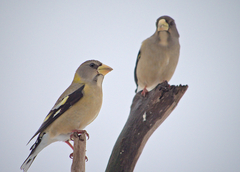
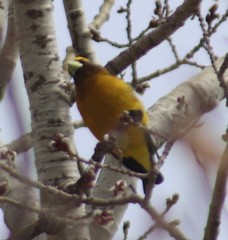
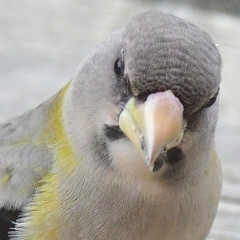
The evening grosbeak (Hesperiphona vespertina) is a passerine bird in the finch family Fringillidae found in North America. The evening grosbeak is bulky, with a large bill and short tail. The bird has a distinct appearance, with the adult male featuring a bright yellow forehead and body, brown head, and white wing patches, while the adult female has a mainly olive-brown body with greyer underparts and white wing patches.

The evening grosbeak breeds in coniferous and mixed forests across Canada, the western mountainous areas of the United States, and Mexico. Its migration pattern is variable, sometimes reaching as far south as the southern U.S. in winters. These birds forage in trees and bushes, and their diet mainly consists of seeds, berries, and insects. The bird's range has expanded eastward in historical times, likely due to the planting of Manitoba maples and other shrubs near farms and the availability of bird feeders during winter.

The evening grosbeak was formally described in 1825 by the American naturalist William Cooper and given the binomial name Fringilla vespertina. Cooper had been sent a specimen by the ethnologist Henry Schoolcraft that had been collected... Wikipedia →

Sounds

Song1:11

United States · 2026

© Valerie Heemstra · XC1096678 · CC BY-NC-SA 4.0

Call0:58

United States · 2025

© David A. Brinkman · XC1008980 · CC BY-NC-SA 4.0

Uncertain0:21

Canada · 2023

© Denis Provencher · XC783806 · CC BY-NC-SA 4.0

Global Distribution

Parks Where Found

# Park Country Daily sighting probability
1 Riding Mountain National Park 🇨🇦 Canada
~30%
2 Gros Morne National Park 🇨🇦 Canada
~10%
3 Rocky Mountain National Park 🇺🇸 United States
~10%
4 Cape Breton Highlands National Park 🇨🇦 Canada
~10%
5 Glacier National Park 🇺🇸 United States
<5%
6 Yellowstone National Park 🇺🇸 United States
<5%
7 Yosemite National Park 🇺🇸 United States
<5%
8 Grand Teton National Park 🇺🇸 United States
<5%
9 Grand Canyon National Park 🇺🇸 United States
<5%
10 Olympic National Park 🇺🇸 United States
<5%
11 Zion National Park 🇺🇸 United States
<5%
12 Sequoia and Kings Canyon National Parks 🇺🇸 United States
<5%
13 Banff National Park 🇨🇦 Canada
<5%
14 Death Valley National Park 🇺🇸 United States
<5%
15 Great Bear Rainforest 🇨🇦 Canada
<5%
16 Saguaro National Park 🇺🇸 United States
<5%
17 Great Smoky Mountains National Park 🇺🇸 United States
<5%
18 Acadia National Park 🇺🇸 United States
<5%

Cities Where Found

# City Country Daily sighting probability
1 Portland 🇺🇸 United States
<5%
2 Salt Lake City 🇺🇸 United States
<5%
3 Seattle 🇺🇸 United States
<5%
4 Vancouver 🇨🇦 Canada
<5%
5 Sacramento 🇺🇸 United States
<5%
6 Montreal 🇨🇦 Canada
<5%
7 Calgary 🇨🇦 Canada
<5%
8 New York City 🇺🇸 United States
<5%
9 Denver 🇺🇸 United States
<5%
10 Edmonton 🇨🇦 Canada
<5%

Before you go

What are the chances of seeing an Evening Grosbeak in Acadia National Park?

Rare

Under 5% of wildlife watchers report an Evening Grosbeak sighting in Acadia National Park on a given day, based on 25 verified sightings from GBIF citizen-science data from 2019 to 2026. It is the 225th most-seen of the 243 birds we can rate there. Over three days the chance rises to under 5%, if each day is a fresh chance.

When is the best time to see an Evening Grosbeak in Acadia National Park?

Any time of year

In every month with enough records, under 5% of wildlife watchers report an Evening Grosbeak in Acadia National Park on a given day, so our monthly data shows no clear season.

What time of day is best to see an Evening Grosbeak?

Between 9 am and noon

Across all the parks we cover, that three-hour window holds the most Evening Grosbeak sightings with a recorded time, and about 9 in 10 of them come between 6 am and 6 pm: it is a daytime animal.

Which relatives of the Evening Grosbeak live in Acadia National Park?

Same family: Fringillidae

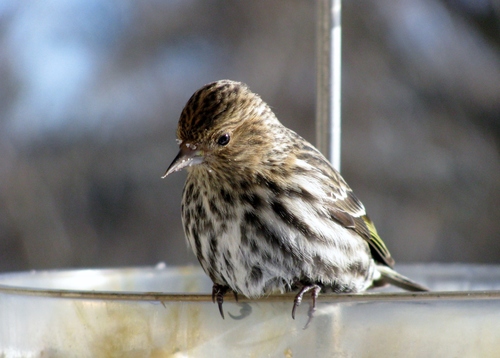
The closest relatives of the Evening Grosbeak that you can see in Acadia National Park (family Fringillidae, Finches, Euphonias, and Allies) are American Goldfinch (about 50%), Purple Finch (about 20%) and Pine Siskin (about 10%), with each one's daily chance of a sighting.

Where does the Evening Grosbeak sighting chance come from?

GBIF citizen-science records

It is estimated from how often the Evening Grosbeak is recorded against all the birds logged in Acadia National Park (25 verified sightings from 2019 to 2026), calibrated against known sighting rates. Figures are rounded to the nearest 10% because citizen-science data supports honest approximations, not decimals, and months with records from fewer than five people show "—". How it works.

← Back to Acadia National Park