Large Red Damselfly

Large Red Damselfly

Pyrrhosoma nymphula

Daily sighting probability ~20% · Possible
at Aigüestortes National Park

In 3 days ~50% in a week ~80%

13 Verified sightings at Aigüestortes National Park From 2019 to 2026
586 In all 13 parks
November Best month
☀️ Diurnal When it's spotted

About the Large Red Damselfly

The large red damselfly (Pyrrhosoma nymphula) is a species of damselflies belonging to the family Coenagrionidae. It is native to the western Palearctic. This species is a mainly European damselfly, with some populations in Northern Africa and Western Asia.

These damselflies inhabit small ponds, lakes and dikes, and occasionally slow-moving rivers. They tend to avoid fast flowing water. Pyrrhosoma nymphula can reach a body length of 33–36 millimetres (1.3–1.4 in). These large and robust damselflies show black legs and wing spots in both sexes.

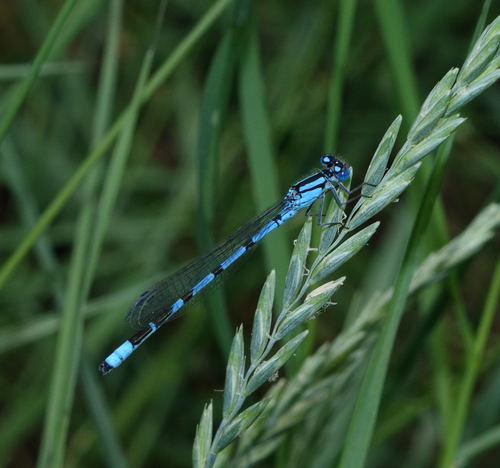
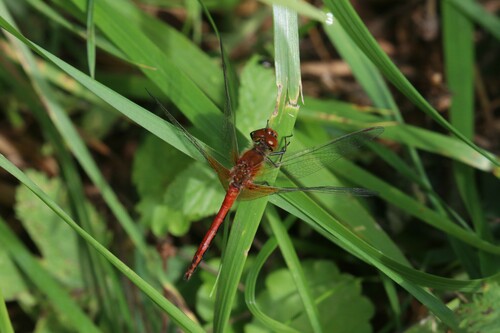
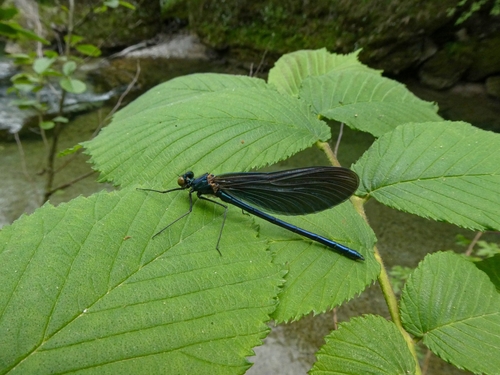
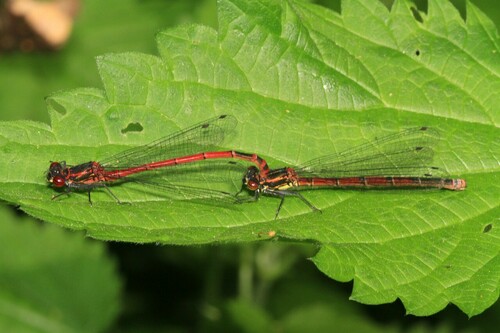
Mature males have red eyes and a black thorax with red shoulder stripes in mature specimen, but yellow stripes in immature. In fact ante-humeral stripes change to red with age. Abdomen is red with black small rings and bronze-black bands towards the apex (segments 7-9). Wings are hyaline, with a blackish pterostigma. Mature females occur in three colour forms (typical, fulvipes and melanotum), from mostly black to mostly red, but all have yellow bands around the abdominal segments. Some intermediate forms also exist.

The form typica has more black on its abdominal segments than the form fulvipes... Wikipedia →
Global Distribution

Parks Where Found

# Park Country Daily sighting probability
1 Cairngorms National Park 🇬🇧 United Kingdom
~30%
2 Plitvice Lakes National Park 🇭🇷 Croatia
~30%
3 Snowdonia National Park 🇬🇧 United Kingdom
~30%
4 Sierra Nevada National Park 🇪🇸 Spain
~20%
5 Mercantour National Park 🇫🇷 France
~20%
6 Aigüestortes National Park 🇪🇸 Spain
~20%
7 Cévennes National Park 🇫🇷 France
~20%
8 Bavarian Forest National Park 🇩🇪 Germany
~10%
9 Pyrénées National Park 🇫🇷 France
~10%
10 Vanoise National Park 🇫🇷 France
~10%
11 Tatra National Park 🇸🇰 Slovakia
~10%
12 Sierra de Guadarrama National Park 🇪🇸 Spain
~10%
13 Wadden Sea National Park 🇩🇪 Germany
~10%

Cities Where Found

# City Country Daily sighting probability
1 London 🇬🇧 United Kingdom
~20%
2 Birmingham 🇬🇧 United Kingdom
~20%
3 Leeds 🇬🇧 United Kingdom
~20%
4 Manchester 🇬🇧 United Kingdom
~20%
5 Brussels 🇧🇪 Belgium
~20%
6 Essen 🇩🇪 Germany
~10%
7 Hamburg 🇩🇪 Germany
~10%
8 Paris 🇫🇷 France
~10%
9 Porto 🇵🇹 Portugal
~10%
10 Lyon 🇫🇷 France
~10%

Before you go

What are the chances of seeing a Large Red Damselfly in Aigüestortes National Park?

Possible

About 20% of wildlife watchers report a Large Red Damselfly sighting in Aigüestortes National Park on a given day, based on 13 verified sightings from GBIF citizen-science data from 2019 to 2026. It is the 95th most-seen of the 256 insects we can rate there. Over three days the chance rises to about 50%, and over a week to about 80%, if each day is a fresh chance.

When is the best time to see a Large Red Damselfly in Aigüestortes National Park?

November

In that month about 40% of wildlife watchers report a Large Red Damselfly in Aigüestortes National Park on a given day, against under 5% in February–May, August–October and December, the lowest months.

What time of day is best to see a Large Red Damselfly?

Between noon and 3 pm

Across all the parks we cover, that three-hour window holds the most Large Red Damselfly sightings with a recorded time, and nearly all of them come between 6 am and 6 pm: it is a daytime animal.

Is Aigüestortes National Park the best place to see a Large Red Damselfly?

6th of 13

Of the 13 parks where we can rate Large Red Damselfly sightings, Aigüestortes National Park ranks 6th at about 20%. The best odds are in Cairngorms National Park (United Kingdom, about 30%), Plitvice Lakes National Park (Croatia, about 30%) and Snowdonia National Park (United Kingdom, about 30%).

Where does the Large Red Damselfly sighting chance come from?

GBIF citizen-science records

It is estimated from how often the Large Red Damselfly is recorded against all the insects logged in Aigüestortes National Park (13 verified sightings from 2019 to 2026), calibrated against known sighting rates. Figures are rounded to the nearest 10% because citizen-science data supports honest approximations, not decimals, and months with records from fewer than five people show "—". How it works.

← Back to Aigüestortes National Park