Viviparous Lizard

Viviparous Lizard

Zootoca vivipara

Silhouette: Audrey Ely · PhyloPic

LCLeast ConcernNTVUENCR
Daily sighting probability ~30% · Possible
at Aigüestortes National Park

In 3 days ~70% in a week ~90%

16 Verified sightings at Aigüestortes National Park From 2019 to 2026
926 In all 14 parks
August Best month
☀️ Diurnal When it's spotted

About the Viviparous Lizard

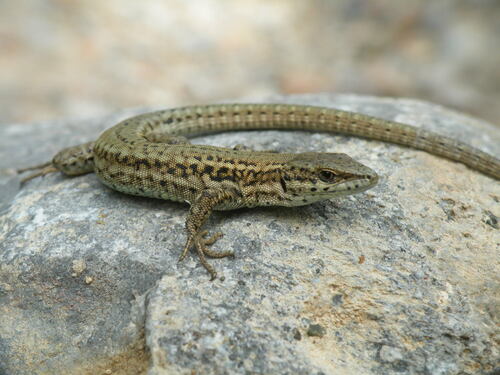
The viviparous lizard or common lizard (Zootoca vivipara) is a Eurasian lizard. It lives farther north than any other non-marine reptile species, and is named for the fact that it is viviparous, meaning it gives birth to live young (although they will sometimes lay eggs normally). Both "Zootoca" and "vivipara" mean "live birth", in (Latinized) Greek and Latin respectively. It was called Lacerta vivipara until the genus Lacerta was split into nine genera in 2007 by Arnold, Arribas & Carranza.

Zootoca vivipara lives in very cold climates, yet participates in normal thermoregulation instead of thermoconformity. They have the largest range of all terrestrial lizards which even include subarctic regions. It is able to survive these harsh climates as individuals will freeze in especially cold seasons and thaw two months later. They also live closer to geological phenomena that provide a warmer environment for them.

Zootoca vivipara is a small lizard, with an average length between 50 and 77 mm (2–3 in) and an average mass of 2 to 5 g (0.1–0.2 oz). They exhibit no particular colour, but can be brown, red, grey, green, or black. The species exhibits some sexual dimorphisms... Wikipedia →

Global Distribution

Parks Where Found

# Park Country Daily sighting probability
1 Snowdonia National Park 🇬🇧 United Kingdom
~70%
2 Tatra National Park 🇸🇰 Slovakia
~60%
3 Biebrza National Park 🇵🇱 Poland
~40%
4 Gauja National Park 🇱🇻 Latvia
~40%
5 Białowieża National Park 🇵🇱 Poland
~40%
6 Cairngorms National Park 🇬🇧 United Kingdom
~40%
7 Bavarian Forest National Park 🇩🇪 Germany
~30%
8 Pyrénées National Park 🇫🇷 France
~30%
9 Aigüestortes National Park 🇪🇸 Spain
~30%
10 Hohe Tauern National Park 🇦🇹 Austria
~30%
11 Wadden Sea National Park 🇩🇪 Germany
~20%
12 Picos de Europa National Park 🇪🇸 Spain
~10%
13 Ecrins National Park 🇫🇷 France
~10%
14 Cévennes National Park 🇫🇷 France
~10%

Cities Where Found

# City Country Daily sighting probability
1 Helsinki 🇫🇮 Finland
~20%
2 London 🇬🇧 United Kingdom
~10%
3 Liverpool 🇬🇧 United Kingdom
~10%
4 Moscow 🇷🇺 Russia
~10%
5 Birmingham 🇬🇧 United Kingdom
~10%
6 Yekaterinburg 🇷🇺 Russia
~10%
7 Copenhagen 🇩🇰 Denmark
~10%
8 Nizhny Novgorod 🇷🇺 Russia
~10%
9 Munich 🇩🇪 Germany
<5%
10 Berlin 🇩🇪 Germany
<5%

Zoos & Centres Where Found

# Zoo / Centre Country
1 Twycross Zoo 🇬🇧 United Kingdom In captivity
2 Wilhelma 🇩🇪 Germany In captivity

Before you go

What are the chances of seeing a Viviparous Lizard in Aigüestortes National Park?

Possible

About 30% of wildlife watchers report a Viviparous Lizard sighting in Aigüestortes National Park on a given day, based on 16 verified sightings from GBIF citizen-science data from 2019 to 2026. It is the 4th most-seen of the 10 reptiles we can rate there. Over three days the chance rises to about 70%, and over a week to about 90%, if each day is a fresh chance.

When is the best time to see a Viviparous Lizard in Aigüestortes National Park?

August

In that month about 50% of wildlife watchers report a Viviparous Lizard in Aigüestortes National Park on a given day, against under 5% in March–April and September–October, the lowest months.

What time of day is best to see a Viviparous Lizard?

Between noon and 3 pm

Across all the parks we cover, that three-hour window holds the most Viviparous Lizard sightings with a recorded time, and nearly all of them come between 6 am and 6 pm: it is a daytime animal.

Which relatives of the Viviparous Lizard live in Aigüestortes National Park?

Same family: Lacertidae

The closest relatives of the Viviparous Lizard that you can see in Aigüestortes National Park (family Lacertidae, Wall Lizards) are Common Wall Lizard (about 90%), Western Green Lizard (about 30%) and Aran Rock Lizard (about 30%), with each one's daily chance of a sighting.

Where does the Viviparous Lizard sighting chance come from?

GBIF citizen-science records

It is estimated from how often the Viviparous Lizard is recorded against all the reptiles logged in Aigüestortes National Park (16 verified sightings from 2019 to 2026), calibrated against known sighting rates. Figures are rounded to the nearest 10% because citizen-science data supports honest approximations, not decimals, and months with records from fewer than five people show "—". How it works.

← Back to Aigüestortes National Park