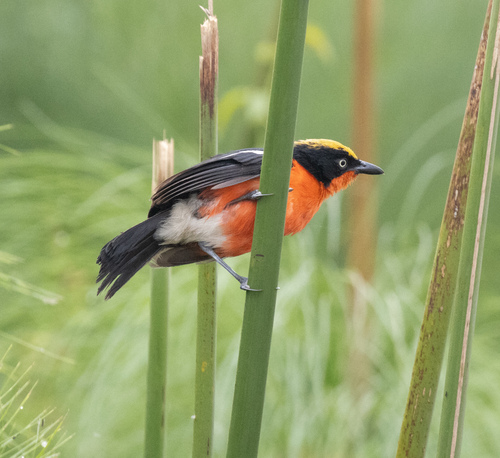
Slate-colored Boubou

Slate-colored Boubou

Laniarius funebris

Silhouette: Sheatherius · PhyloPic

LCLeast ConcernNTVUENCR
Daily sighting probability ~20% · Possible
at Akagera National Park

In 3 days ~60% in a week ~90%

125 Verified sightings at Akagera National Park From 2019 to 2026
5,893 In all 20 parks
July Best month
☀️ Diurnal When it's spotted

About the Slate-colored Boubou

The slate-colored boubou or slate-coloured boubou (Laniarius funebris) is a species of bird in the family Malaconotidae. It is found in Ethiopia, Kenya, Rwanda, Somalia, South Sudan, Tanzania, and Uganda. Its natural habitats are subtropical or tropical dry forests, dry savanna, subtropical or tropical dry shrubland, and subtropical or tropical moist shrubland.

German naturalist Gustav Hartlaub described the slate-colored boubou in 1863. Two subspecies, funebris and degener are recognised. Within the genus Laniarius its position is unclear, but it does not appear to be closely related to the black-plumaged members of the genus such as Fuelleborn's boubou, Laniarius fuelleborni, with which some authorities had previously considered it conspecific.

The adult slate-colored boubou is 20 cm (8 in) long and wholly dark slate grey. The male and female are very similar. Immature birds have a plumage more barred with tawny brown and black. The male's call repertoire includes a noisy shhhhh, or strong clicking and coco-weet, with a rising inflexion on the last syllable. The calls differ regionally across the species' range. Songs are frequently sung in a duet between the male and female of a mated pair. A 1983 study observed four types of songs sung by males in duets. Researchers concluded that one song type was for mating, two were used to indicate territory, and the final type may have been used to prevent the male boubou's mate from singing alone, which could attract other males. The frequencies with which the male boubou sang the territorial songs vary with the extent of threats from other boubous and with the level of cooperation between mates. A 1992 study of its calls found that a male's likelihood of singing a mating song was correlated with his mate's estradiol levels, rather than his own testosterone levels, suggesting that behavioral cues between a mating pair, rather than hormone levels, are most important in triggering mating songs.

The slate-colored boubou lays a clutch of 2–3 eggs in a nest in a shrub or tree around 1.5 m (5 ft) above the ground. Wikipedia →

Sounds

Uncertain0:34

Kenya · 2025

© Sharon Cooper · XC984833 · CC BY-NC-SA 4.0

Song0:13

Kenya · 2024

© Peter Boesman · XC948240 · CC BY-NC-ND 4.0

Call0:43

Kenya · 2022

© Lars Lachmann · XC753981 · CC BY-NC-SA 4.0

Global Distribution

Parks Where Found

# Park Country Daily sighting probability
1 Ruaha National Park 🇹🇿 Tanzania
~60%
2 Tsavo West National Park 🇰🇪 Kenya
~50%
3 Samburu National Reserve 🇰🇪 Kenya
~50%
4 Tsavo East National Park 🇰🇪 Kenya
~40%
5 Lake Manyara National Park 🇹🇿 Tanzania
~40%
6 Nairobi National Park 🇰🇪 Kenya
~40%
7 Meru National Park 🇰🇪 Kenya
~40%
8 Mkomazi National Park 🇹🇿 Tanzania
~40%
9 Tarangire National Park 🇹🇿 Tanzania
~30%
10 Serengeti National Park 🇹🇿 Tanzania
~30%
11 Kidepo Valley National Park 🇺🇬 Uganda
~30%
12 Masai Mara National Reserve 🇰🇪 Kenya
~30%
13 Akagera National Park 🇷🇼 Rwanda
~20%
14 Ngorongoro Conservation Area 🇹🇿 Tanzania
~20%
15 Amboseli National Park 🇰🇪 Kenya
~20%
16 Awash National Park 🇪🇹 Ethiopia
~10%
17 Arusha National Park 🇹🇿 Tanzania
<5%
18 Lake Mburo National Park 🇺🇬 Uganda
<5%
19 Lake Nakuru National Park 🇰🇪 Kenya
<5%
20 Bwindi Impenetrable National Park 🇺🇬 Uganda
<5%

Cities Where Found

# City Country Daily sighting probability
1 Nairobi 🇰🇪 Kenya
<5%

Before you go

What are the chances of seeing a Slate-colored Boubou in Akagera National Park?

Possible

About 20% of wildlife watchers report a Slate-colored Boubou sighting in Akagera National Park on a given day, based on 125 verified sightings from GBIF citizen-science data from 2019 to 2026. It is the 83rd most-seen of the 320 birds we can rate there. Over three days the chance rises to about 60%, and over a week to about 90%, if each day is a fresh chance.

When is the best time to see a Slate-colored Boubou in Akagera National Park?

March–April, July, September and December

In those months about 30% of wildlife watchers report a Slate-colored Boubou in Akagera National Park on a given day, against about 10% in August, the lowest month.

What time of day is best to see a Slate-colored Boubou?

Between 7 and 10 am

Across all the parks we cover, that three-hour window holds the most Slate-colored Boubou sightings with a recorded time, and about 8 in 10 of them come between 6 am and 6 pm: it is a daytime animal.

Which relatives of the Slate-colored Boubou live in Akagera National Park?

Same genus: Laniarius

The closest relatives of the Slate-colored Boubou that you can see in Akagera National Park (genus Laniarius, Boubous and Gonoleks) are Black-headed Gonolek (about 50%) and Tropical Boubou (about 30%), with each one's daily chance of a sighting.

Where does the Slate-colored Boubou sighting chance come from?

GBIF citizen-science records

It is estimated from how often the Slate-colored Boubou is recorded against all the birds logged in Akagera National Park (125 verified sightings from 2019 to 2026), calibrated against known sighting rates. Figures are rounded to the nearest 10% because citizen-science data supports honest approximations, not decimals, and months with records from fewer than five people show "—". How it works.

← Back to Akagera National Park