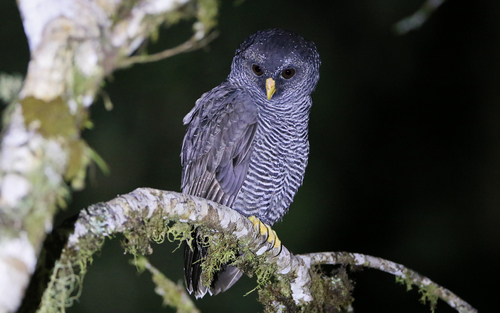
Black Banded Owl

Black Banded Owl

Strix huhula

Silhouette: Sharon Wegner-Larsen · PhyloPic

LCLeast ConcernNTVUENCR
Daily sighting probability <5% · Rare
at Amacayacu National Natural Park

In 3 days ~10%

15 Verified sightings at Amacayacu National Natural Park From 2019 to 2026
450 In all 6 parks
January Best month
🌙 Nocturnal When it's spotted

About the Black Banded Owl

The black-banded owl (Strix huhula) is a species of owl in the family Strigidae. Entirely nocturnal, this midsized black and white neotropical bird is a resident species, and therefore never migrates out of its native South America. Its natural habitats are varied subtropical or tropical forests ranging from lowlands to areas of medium altitude, and it has been found in Argentina, Bolivia, Brazil, Colombia, Ecuador, French Guiana, Guyana, Paraguay, Peru, Suriname, and Venezuela.

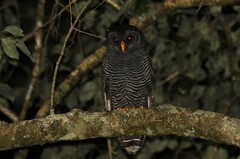
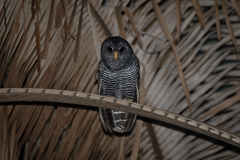
The black-banded owl is medium-sized (30–36 cm (12–14 in)), blackish all over and densely striated with horizontal, wavy, white bars. A black face mask encircle its eyes. It has a rounded head with no ear tufts, and a yellow-orange bill and feet. The tail is sooty-brown, with 4 to 5 narrow white bars and a white terminal band. Primary feathers are significantly darker than the rest of its plumage. Black bristles and feathers are found around the bill and along the leg to the base of the toes.

The taxonomy of the black-banded owl is unclear on several points. Some authors include it in the genus Ciccaba, (medium-sized wood owls found in South-America) along with the black-and... Wikipedia →
Sounds

Call1:21

Brazil · 2025

© JAYRSON ARAUJO DE OLIVEIRA · XC1034576 · CC BY-NC-SA 4.0

Song0:37

French Guiana · 2025

© Paul Lenrumé · XC961593 · CC BY-NC-SA 4.0

Alarm call0:11

Brazil · 2017

© Leonardo Moura · XC487768 · CC BY-NC-SA 4.0

Global Distribution

Parks Where Found

# Park Country Daily sighting probability
1 Manu National Park 🇵🇪 Peru
~10%
2 Serra dos Órgãos National Park 🇧🇷 Brazil
<5%
3 Amacayacu National Natural Park 🇨🇴 Colombia
<5%
4 Yasuní National Park 🇪🇨 Ecuador
<5%
5 Tambopata National Reserve 🇵🇪 Peru
<5%
6 Iguazú National Park 🇦🇷 Argentina
<5%

Zoos & Centres Where Found

# Zoo / Centre Country
1 Zoológico de Brasília 🇧🇷 Brazil In captivity
2 Rio de Janeiro Zoological Garden 🇧🇷 Brazil In captivity
3 Small Breeds Farm Park 🇬🇧 United Kingdom In captivity

Before you go

What are the chances of seeing a Black Banded Owl in Amacayacu National Natural Park?

Rare

Under 5% of wildlife watchers report a Black Banded Owl sighting in Amacayacu National Natural Park on a given day, based on 15 verified sightings from GBIF citizen-science data from 2019 to 2026. It is the 346th most-seen of the 436 birds we can rate there. Over three days the chance rises to about 10%, if each day is a fresh chance.

When is the best time to see a Black Banded Owl in Amacayacu National Natural Park?

January

In that month about 10% of wildlife watchers report a Black Banded Owl in Amacayacu National Natural Park on a given day, against under 5% in February to December, the lowest months.

What time of day is best to see a Black Banded Owl?

Between 6 and 9 pm

Across all the parks we cover, that three-hour window holds the most Black Banded Owl sightings with a recorded time, and about 9 in 10 of them come between 6 pm and 6 am: it is mostly seen at night.

Is Amacayacu National Natural Park the best place to see a Black Banded Owl?

3rd of 6

Of the 6 parks where we can rate Black Banded Owl sightings, Amacayacu National Natural Park ranks 3rd at under 5%. The best odds are in Manu National Park (Peru, about 10%) and Serra dos Órgãos National Park (Brazil, under 5%).

Which relatives of the Black Banded Owl live in Amacayacu National Natural Park?

Same family: Strigidae

The closest relatives of the Black Banded Owl that you can see in Amacayacu National Natural Park (family Strigidae, Typical Owls) are Tropical Screech-Owl (about 20%), Tawny-bellied Screech-Owl (about 10%) and Spectacled Owl (about 10%), with each one's daily chance of a sighting.

Where does the Black Banded Owl sighting chance come from?

GBIF citizen-science records

It is estimated from how often the Black Banded Owl is recorded against all the birds logged in Amacayacu National Natural Park (15 verified sightings from 2019 to 2026), calibrated against known sighting rates. Figures are rounded to the nearest 10% because citizen-science data supports honest approximations, not decimals, and months with records from fewer than five people show "—". How it works.

← Back to Amacayacu National Natural Park