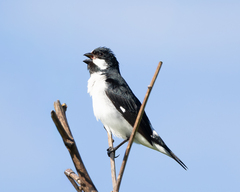
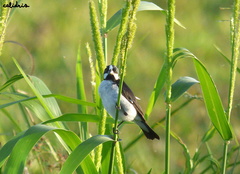
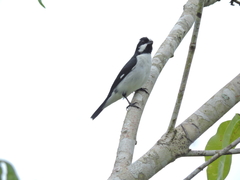

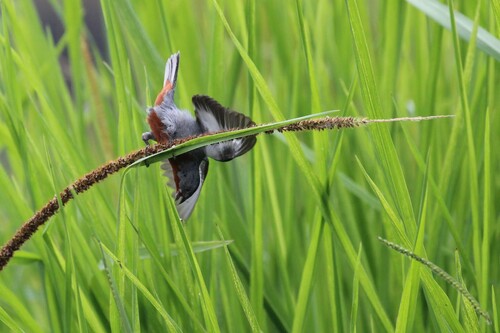
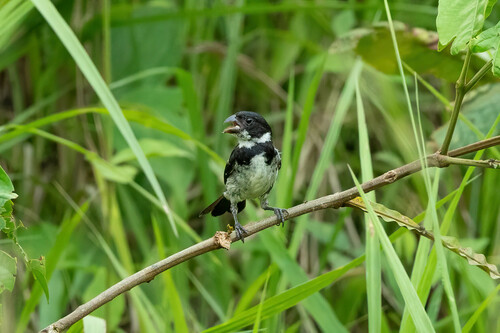
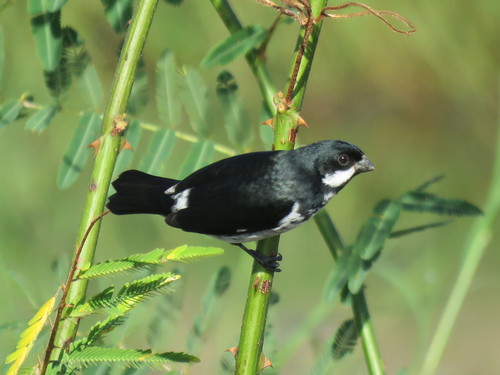
Lined Seedeater

Lined Seedeater

Sporophila lineola

Silhouette: Sheatherius · PhyloPic

LCLeast ConcernNTVUENCR
Daily sighting probability ~10% · With luck
at Amacayacu National Natural Park

In 3 days ~10% in a week ~30%

33 Verified sightings at Amacayacu National Natural Park From 2019 to 2026
152 In all 7 parks
June Best month
☀️ Diurnal When it's spotted

About the Lined Seedeater

The lined seedeater (Sporophila lineola) is a species of bird in the family Thraupidae. It is found in Argentina, Bolivia, Brazil, Colombia, Ecuador, French Guiana, Guyana, Panama, Paraguay, Peru, Suriname, and Venezuela. Its natural habitats are subtropical or tropical moist shrubland, pastureland, and heavily degraded former forest.

The lined seedeater was formally described by the Swedish naturalist Carl Linnaeus in 1758 in the tenth edition of his Systema Naturae under the binomial name Loxia lineola. Linnaeus mistakenly specified the "habitat" as Asia; the type locality was subsequently designated as the state of Bahia in Brazil. The specific epithet lineola is Latin meaning "little line" (a diminutive of linea meaning "line"). The lined seedeater is now assigned to the genus Sporophila that was introduced by the German ornithologist Jean Cabanis in 1844. The species is monotypic: no subspecies are recognised. Wikipedia →

Sounds

Call0:05

Brazil · 2026

© JAYRSON ARAUJO DE OLIVEIRA · XC1082117 · CC BY-NC-SA 4.0

Song0:40

Brazil · 2025

© Robson Silva e Silva · XC1018881 · CC BY-NC-SA 4.0

Canto0:16

Brazil · 2018

© Caio Brito · XC556600 · CC BY-NC-SA 4.0

Global Distribution

Parks Where Found

# Park Country Daily sighting probability
1 Amacayacu National Natural Park 🇨🇴 Colombia
~10%
2 El Impenetrable National Park 🇦🇷 Argentina
<5%
3 Itatiaia National Park 🇧🇷 Brazil
<5%
4 Serra da Canastra National Park 🇧🇷 Brazil
<5%
5 Parque Estadual Encontro das Águas 🇧🇷 Brazil
<5%
6 Iguaçu National Park 🇧🇷 Brazil
<5%
7 Tijuca National Park 🇧🇷 Brazil
<5%

Cities Where Found

# City Country Daily sighting probability
1 Goiânia 🇧🇷 Brazil
~10%
2 Santa Cruz de la Sierra 🇧🇴 Bolivia
~10%
3 Asuncion 🇵🇾 Paraguay
~10%
4 Campo Grande 🇧🇷 Brazil
<5%
5 Campinas 🇧🇷 Brazil
<5%
6 Belo Horizonte 🇧🇷 Brazil
<5%
7 São Paulo 🇧🇷 Brazil
<5%

Zoos & Centres Where Found

# Zoo / Centre Country
1 Aviario Nacional de Colombia 🇨🇴 Colombia In captivity
2 Mangal das Garças 🇧🇷 Brazil In captivity

Before you go

What are the chances of seeing a Lined Seedeater in Amacayacu National Natural Park?

With luck

About 10% of wildlife watchers report a Lined Seedeater sighting in Amacayacu National Natural Park on a given day, based on 33 verified sightings from GBIF citizen-science data from 2019 to 2026. It is the 250th most-seen of the 436 birds we can rate there. Over three days the chance rises to about 10%, and over a week to about 30%, if each day is a fresh chance.

When is the best time to see a Lined Seedeater in Amacayacu National Natural Park?

May–June and October–December

In those months about 10% of wildlife watchers report a Lined Seedeater in Amacayacu National Natural Park on a given day, against under 5% in January–April and July–September, the lowest months.

What time of day is best to see a Lined Seedeater?

Between 7 and 10 am

Across all the parks we cover, that three-hour window holds the most Lined Seedeater sightings with a recorded time, and about 9 in 10 of them come between 6 am and 6 pm: it is a daytime animal.

Is Amacayacu National Natural Park the best place to see a Lined Seedeater?

Yes

Of the 7 parks where we can rate Lined Seedeater sightings, Amacayacu National Natural Park has the highest daily chance: about 10%. Next come El Impenetrable National Park (Argentina, under 5%) and Itatiaia National Park (Brazil, under 5%).

Which relatives of the Lined Seedeater live in Amacayacu National Natural Park?

Same genus: Sporophila

The closest relatives of the Lined Seedeater that you can see in Amacayacu National Natural Park (genus Sporophila, Typical Seedeaters and Seed-Finches) are Chestnut-bellied Seedeater (about 20%) and Wing-barred Seedeater (about 10%), with each one's daily chance of a sighting.

Where does the Lined Seedeater sighting chance come from?

GBIF citizen-science records

It is estimated from how often the Lined Seedeater is recorded against all the birds logged in Amacayacu National Natural Park (33 verified sightings from 2019 to 2026), calibrated against known sighting rates. Figures are rounded to the nearest 10% because citizen-science data supports honest approximations, not decimals, and months with records from fewer than five people show "—". How it works.

← Back to Amacayacu National Natural Park