Ocellated Poorwill

Ocellated Poorwill

Nyctiphrynus ocellatus

Silhouette: Sheatherius · PhyloPic

LCLeast ConcernNTVUENCR
Daily sighting probability <5% · Rare
at Amboró National Park

In 3 days ~10% in a week ~20%

10 Verified sightings at Amboró National Park From 2019 to 2026
410 In all 4 parks
November Best month
🌅 Crepuscular When it's spotted

About the Ocellated Poorwill

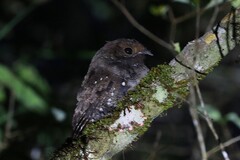
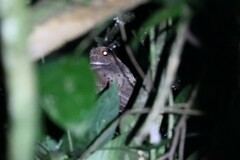
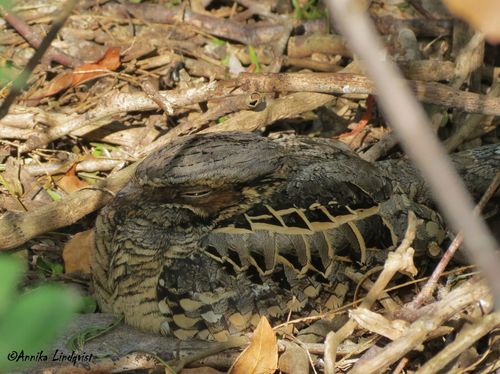
The ocellated poorwill (Nyctiphrynus ocellatus) is a species of nightjar in the family Caprimulgidae. It is found in Argentina, Bolivia, Brazil, Colombia, Costa Rica, Ecuador, Honduras, Nicaragua, Paraguay, and Peru. At one time what is now the Choco poorwill (Nyctiphrynus rosenbergi) was considered a subspecies of the ocellated poorwill, but plumage, vocalization, and genetic differences showed it to be its own species.

The ocellated poorwill is 20 to 21 cm (7.9 to 8.3 in) long. Males weigh 35 to 43 g (1.2 to 1.5 oz) and females 29 to 44 g (1.0 to 1.6 oz). There are two color morphs, one brown and one rufous. The brown morph of the nominate is mostly dark grayish brown with blackish brown spots on the wings and white spots on the belly. The white spots somewhat resemble eyes, which gives the bird its name. It has a bold white band around the throat. The outer three or four tail feathers have narrow white tips. The rufous morph is paler and reddish brown instead of dark... Wikipedia →

Sounds

Song1:16

Brazil · 2025

© JAYRSON ARAUJO DE OLIVEIRA · XC1051821 · CC BY-NC-SA 4.0

Recording0:40

Paraguay · 2024

© Guillermo Menéndez (gmmv80) · XC956275 · CC BY-NC-SA 4.0

Call1:28

Brazil · 2023

© Nunes D´Acosta · XC778722 · CC BY-NC-SA 4.0

Global Distribution

Parks Where Found

# Park Country Daily sighting probability
1 Manu National Park 🇵🇪 Peru
~10%
2 Tambopata National Reserve 🇵🇪 Peru
<5%
3 Amboró National Park 🇧🇴 Bolivia
<5%
4 Yasuní National Park 🇪🇨 Ecuador
<5%

Before you go

What are the chances of seeing an Ocellated Poorwill in Amboró National Park?

Rare

Under 5% of wildlife watchers report an Ocellated Poorwill sighting in Amboró National Park on a given day, based on 10 verified sightings from GBIF citizen-science data from 2019 to 2026. It is the 189th most-seen of the 273 birds we can rate there. Over three days the chance rises to about 10%, and over a week to about 20%, if each day is a fresh chance.

When is the best time to see an Ocellated Poorwill in Amboró National Park?

November

In that month about 10% of wildlife watchers report an Ocellated Poorwill in Amboró National Park on a given day, against under 5% in July–October and December–May, the lowest months. June has too few records to rate.

What time of day is best to see an Ocellated Poorwill?

Between 5 and 8 pm

Across all the parks we cover, that three-hour window holds the most Ocellated Poorwill sightings with a recorded time, and about 6 in 10 of them come between 6 pm and 6 am: it is most active around dawn and dusk.

Is Amboró National Park the best place to see an Ocellated Poorwill?

3rd of 4

Of the 4 parks where we can rate Ocellated Poorwill sightings, Amboró National Park ranks 3rd at under 5%. The best odds are in Manu National Park (Peru, about 10%) and Tambopata National Reserve (Peru, under 5%).

Where does the Ocellated Poorwill sighting chance come from?

GBIF citizen-science records

It is estimated from how often the Ocellated Poorwill is recorded against all the birds logged in Amboró National Park (10 verified sightings from 2019 to 2026), calibrated against known sighting rates. Figures are rounded to the nearest 10% because citizen-science data supports honest approximations, not decimals, and months with records from fewer than five people show "—". How it works.

← Back to Amboró National Park