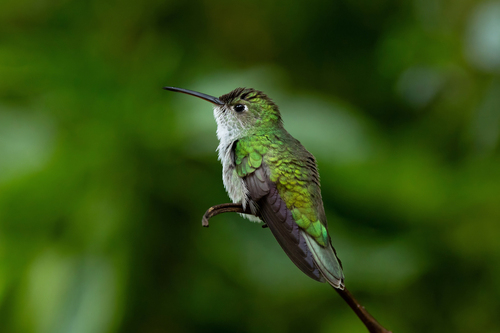
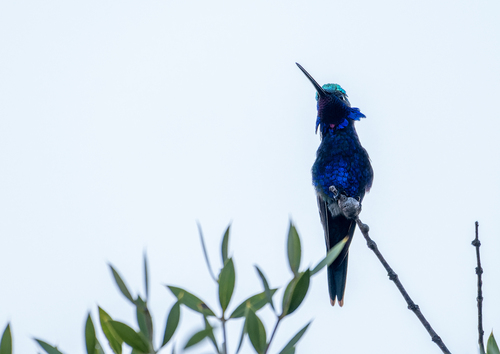
Violet-fronted Brilliant

Violet-fronted Brilliant

Heliodoxa leadbeateri

Silhouette: PhyloPic

LCLeast ConcernNTVUENCR
Daily sighting probability <5% · Rare
at Amboró National Park

In 3 days <5% in a week ~10%

7 Verified sightings at Amboró National Park From 2019 to 2026
638 In all 4 parks
May Best month
☀️ Diurnal When it's spotted

About the Violet-fronted Brilliant

The violet-fronted brilliant (Heliodoxa leadbeateri) is a species of hummingbird in the "brilliants", tribe Heliantheini in subfamily Lesbiinae. It is found in Bolivia, Colombia, Ecuador, Peru, and Venezuela. The violet-fronted brilliant has four subspecies:

Males weigh 7.1 to 8.5 g (0.25 to 0.30 oz) and females 6.6 to 7.5 g (0.23 to 0.26 oz). Both sexes have a medium length, almost straight, black bill, a white malar streak, and a small white spot behind the eye. They both have a forked tail but the female's is less deeply indented than the male's.

Males of the nominate subspecies have bronzy green upperparts with a glittering blue forehead and a coppery neck. They have a glittering emerald green gorget and a dull bronzy green breast and belly. The central pair of tail feathers are bronzy green, the next pair steel blue with bronze tips, and the rest dark steel blue. Females have coppery green upperparts with a glittering green forehead. Their... Wikipedia →

Sounds

Alarm call0:31

Ecuador · 2025

© Manuel Sánchez-Nivicela · XC1143644 · CC BY-NC-ND 4.0

Call0:14

Peru · 2022

© Guilherme de Melo Becher · XC764493 · CC BY-NC-SA 4.0

Song0:38

Ecuador · 2003

© Lelis Navarrete · XC364165 · CC BY-NC-SA 4.0

Global Distribution

Parks Where Found

# Park Country Daily sighting probability
1 Podocarpus National Park 🇪🇨 Ecuador
~30%
2 Henri Pittier National Park 🇻🇪 Venezuela
~20%
3 Amboró National Park 🇧🇴 Bolivia
<5%
4 Manu National Park 🇵🇪 Peru
<5%

Cities Where Found

# City Country Daily sighting probability
1 Caracas 🇻🇪 Venezuela
<5%

Before you go

What are the chances of seeing a Violet-fronted Brilliant in Amboró National Park?

Rare

Under 5% of wildlife watchers report a Violet-fronted Brilliant sighting in Amboró National Park on a given day, based on 7 verified sightings from GBIF citizen-science data from 2019 to 2026. It is the 221st most-seen of the 273 birds we can rate there. Over three days the chance rises to under 5%, and over a week to about 10%, if each day is a fresh chance.

When is the best time to see a Violet-fronted Brilliant in Amboró National Park?

May

In that month about 10% of wildlife watchers report a Violet-fronted Brilliant in Amboró National Park on a given day, against under 5% in July to April, the lowest months. June has too few records to rate.

What time of day is best to see a Violet-fronted Brilliant?

Between 9 am and noon

Across all the parks we cover, that three-hour window holds the most Violet-fronted Brilliant sightings with a recorded time, and about 9 in 10 of them come between 6 am and 6 pm: it is a daytime animal.

Is Amboró National Park the best place to see a Violet-fronted Brilliant?

3rd of 4

Of the 4 parks where we can rate Violet-fronted Brilliant sightings, Amboró National Park ranks 3rd at under 5%. The best odds are in Podocarpus National Park (Ecuador, about 30%) and Henri Pittier National Park (Venezuela, about 20%).

Which relatives of the Violet-fronted Brilliant live in Amboró National Park?

Same family: Trochilidae

The closest relatives of the Violet-fronted Brilliant that you can see in Amboró National Park (family Trochilidae, Hummingbirds) are Fork-tailed Woodnymph (about 30%), White-bellied Hummingbird (about 20%) and Planalto Hermit (about 20%), with each one's daily chance of a sighting.

Where does the Violet-fronted Brilliant sighting chance come from?

GBIF citizen-science records

It is estimated from how often the Violet-fronted Brilliant is recorded against all the birds logged in Amboró National Park (7 verified sightings from 2019 to 2026), calibrated against known sighting rates. Figures are rounded to the nearest 10% because citizen-science data supports honest approximations, not decimals, and months with records from fewer than five people show "—". How it works.

← Back to Amboró National Park