
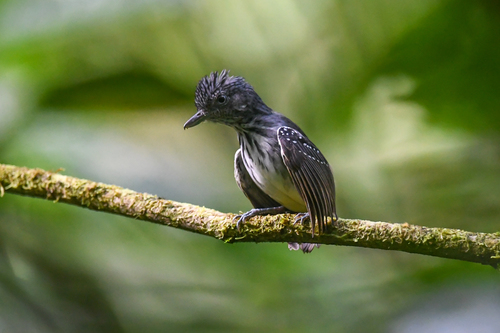
Bare-crowned Antbird

Bare-crowned Antbird

Gymnocichla nudiceps

Silhouette: Sheatherius · PhyloPic

LCLeast ConcernNTVUENCR
Daily sighting probability <5% · Rare
at Arenal Volcano National Park

In 3 days ~10% in a week ~20%

486 Verified sightings at Arenal Volcano National Park From 2019 to 2026
559 In all 7 parks
February Best month
☀️ Diurnal When it's spotted

About the Bare-crowned Antbird

The bare-crowned antbird (Gymnocichla nudiceps) is a species of bird in subfamily Thamnophilinae of family Thamnophilidae, the "typical antbirds". It is found in Belize, Colombia, Costa Rica, Guatemala, Honduras, Mexico, Nicaragua, and Panama.

The bare-crowned antbird was originally described by the American ornithologist John Cassin in 1850 with the name Myiothera nudiceps. In 1858 the English zoologist Philip Sclater erected genus Gymnocichla and transferred the species to it.

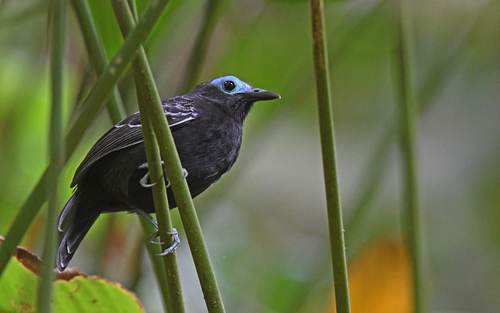
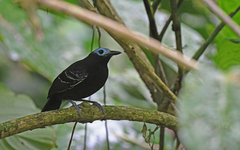
The bare-crowned antbird is the only member of its genus and has these four subspecies: Males of all four subspecies have bright blue bare skin on their forehead, forecrown, lores, and around their eyes. Females have the same blue skin on their lores and around their eyes. Adult males of the nominate subspecies G. n. nudiceps are otherwise almost entirely black. Their wing coverts have white tips, their alula and outermost primary... Wikipedia →

Sounds

Song1:02

Panama · 2022

© Teus Luijendijk · XC712235 · CC BY-NC-ND 4.0

Call0:28

Panama · 2012

© William Adsett · XC114192 · CC BY-NC-SA 3.0

Song0:43

Colombia · 2021

© Bram Vogels · XC694250 · CC BY-NC-SA 4.0

Global Distribution

Parks Where Found

# Park Country Daily sighting probability
1 San Lorenzo Protected Forest 🇵🇦 Panama
~10%
2 Arenal Volcano National Park 🇨🇷 Costa Rica
<5%
3 Cahuita National Park 🇨🇷 Costa Rica
<5%
4 Piedras Blancas National Park 🇨🇷 Costa Rica
<5%
5 Soberanía National Park 🇵🇦 Panama
<5%
6 Tortuguero National Park 🇨🇷 Costa Rica
<5%
7 Corcovado National Park 🇨🇷 Costa Rica
<5%

Before you go

What are the chances of seeing a Bare-crowned Antbird in Arenal Volcano National Park?

Rare

Under 5% of wildlife watchers report a Bare-crowned Antbird sighting in Arenal Volcano National Park on a given day, based on 486 verified sightings from GBIF citizen-science data from 2019 to 2026. It is the 235th most-seen of the 503 birds we can rate there. Over three days the chance rises to about 10%, and over a week to about 20%, if each day is a fresh chance.

When is the best time to see a Bare-crowned Antbird in Arenal Volcano National Park?

February and October

In those months about 10% of wildlife watchers report a Bare-crowned Antbird in Arenal Volcano National Park on a given day, against under 5% in March–September and November–January, the lowest months.

What time of day is best to see a Bare-crowned Antbird?

Between 7 and 10 am

Across all the parks we cover, that three-hour window holds the most Bare-crowned Antbird sightings with a recorded time, and about 9 in 10 of them come between 6 am and 6 pm: it is a daytime animal.

Is Arenal Volcano National Park the best place to see a Bare-crowned Antbird?

2nd of 7

Of the 7 parks where we can rate Bare-crowned Antbird sightings, Arenal Volcano National Park ranks 2nd at under 5%. The best odds are in San Lorenzo Protected Forest (Panama, about 10%).

Which relatives of the Bare-crowned Antbird live in Arenal Volcano National Park?

Same family: Thamnophilidae

The closest relatives of the Bare-crowned Antbird that you can see in Arenal Volcano National Park (family Thamnophilidae, Typical Antbirds) are Spotted Antbird (about 20%), Dusky Antbird (about 10%) and Dull-mantled Antbird (about 10%), with each one's daily chance of a sighting.

Where does the Bare-crowned Antbird sighting chance come from?

GBIF citizen-science records

It is estimated from how often the Bare-crowned Antbird is recorded against all the birds logged in Arenal Volcano National Park (486 verified sightings from 2019 to 2026), calibrated against known sighting rates. Figures are rounded to the nearest 10% because citizen-science data supports honest approximations, not decimals, and months with records from fewer than five people show "—". How it works.

← Back to Arenal Volcano National Park