
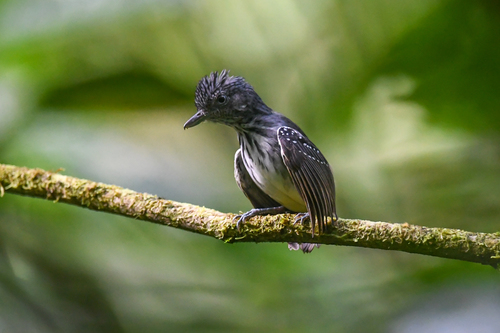
Bicolored Antbird

Bicolored Antbird

Gymnopithys leucaspis

Silhouette: Sheatherius · PhyloPic

LCLeast ConcernNTVUENCR
Daily sighting probability ~10% · With luck
at Arenal Volcano National Park

In 3 days ~20% in a week ~40%

1,114 Verified sightings at Arenal Volcano National Park From 2019 to 2026
6,661 In all 24 parks
February Best month
☀️ Diurnal When it's spotted

About the Bicolored Antbird

The white-cheeked antbird (Gymnopithys leucaspis) is an insectivorous bird in subfamily Thamnophilinae of family Thamnophilidae, the "typical antbirds". It is found in Brazil, Colombia, Ecuador, and Peru. The English zoologist Philip Sclater described what is now the white-cheeked antbird in 1855 and coined the binomial name Myrmeciza leucaspis. It was later given the English name bicolored antbird (now Gymnopithys bicolor) and included what is now that separate species. They were split into separate species based on the results of a 2007 genetic study that found that the white-cheeked antbird was more similar to the rufous-throated antbird (G. rufigula) than it was to the bicolored antbird. Because of the principle of priority it retained the original specific epithet leucaspis despite the change of English name. All three are now placed in genus Gymnopithys which was introduced by the French ornithologist Charles Lucien Bonaparte in 1857. These three antbirds are the only members of genus Gymnopithys.

The white-cheeked antbird has these four subspecies: Wikipedia →

Sounds

Song0:54

Ecuador · 2025

© Marc Anderson · XC1093984 · CC BY-NC-ND 4.0

Call0:10

Colombia · 2022

© Frank Lambert · XC1040016 · CC BY-NC-ND 4.0

Recording0:32

Colombia · 2001

© Mauricio Álvarez-Rebolledo · XC525144 · CC BY-NC-SA 4.0

Global Distribution

Parks Where Found

# Park Country Daily sighting probability
1 Soberanía National Park 🇵🇦 Panama
~20%
2 Chagres National Park 🇵🇦 Panama
~10%
3 Darién National Park 🇵🇦 Panama
~10%
4 Corcovado National Park 🇨🇷 Costa Rica
~10%
5 Amacayacu National Natural Park 🇨🇴 Colombia
~10%
6 Carara National Park 🇨🇷 Costa Rica
~10%
7 Utría National Natural Park 🇨🇴 Colombia
~10%
8 Arenal Volcano National Park 🇨🇷 Costa Rica
~10%
9 Tenorio Volcano National Park 🇨🇷 Costa Rica
~10%
10 Braulio Carrillo National Park 🇨🇷 Costa Rica
~10%
11 San Lorenzo Protected Forest 🇵🇦 Panama
~10%
12 Tapantí-Macizo de la Muerte National Park 🇨🇷 Costa Rica
<5%
13 Yasuní National Park 🇪🇨 Ecuador
<5%
14 Piedras Blancas National Park 🇨🇷 Costa Rica
<5%
15 Rincón de la Vieja National Park 🇨🇷 Costa Rica
<5%
16 Sierra de la Macarena National Park 🇨🇴 Colombia
<5%
17 Cuyabeno Wildlife Reserve 🇪🇨 Ecuador
<5%
18 Cahuita National Park 🇨🇷 Costa Rica
<5%
19 Marino Ballena National Park 🇨🇷 Costa Rica
<5%
20 La Amistad International Park (Panama) 🇵🇦 Panama
<5%
21 Farallones de Cali National Natural Park 🇨🇴 Colombia
<5%
22 Manuel Antonio National Park 🇨🇷 Costa Rica
<5%
23 Monteverde Cloud Forest Reserve 🇨🇷 Costa Rica
<5%
24 Tortuguero National Park 🇨🇷 Costa Rica
<5%

Before you go

What are the chances of seeing a Bicolored Antbird in Arenal Volcano National Park?

With luck

About 10% of wildlife watchers report a Bicolored Antbird sighting in Arenal Volcano National Park on a given day, based on 1,114 verified sightings from GBIF citizen-science data from 2019 to 2026. It is the 165th most-seen of the 503 birds we can rate there. Over three days the chance rises to about 20%, and over a week to about 40%, if each day is a fresh chance.

When is the best time to see a Bicolored Antbird in Arenal Volcano National Park?

July and September–April

In those months about 10% of wildlife watchers report a Bicolored Antbird in Arenal Volcano National Park on a given day, against under 5% in May–June and August, the lowest months.

What time of day is best to see a Bicolored Antbird?

Between 1 and 4 pm

Across all the parks we cover, that three-hour window holds the most Bicolored Antbird sightings with a recorded time, and nearly all of them come between 6 am and 6 pm: it is a daytime animal.

Is Arenal Volcano National Park the best place to see a Bicolored Antbird?

8th of 24

Of the 24 parks where we can rate Bicolored Antbird sightings, Arenal Volcano National Park ranks 8th at about 10%. The best odds are in Soberanía National Park (Panama, about 20%), Chagres National Park (Panama, about 10%) and Darién National Park (Panama, about 10%).

Which relatives of the Bicolored Antbird live in Arenal Volcano National Park?

Same family: Thamnophilidae

The closest relatives of the Bicolored Antbird that you can see in Arenal Volcano National Park (family Thamnophilidae, Typical Antbirds) are Spotted Antbird (about 20%), Dusky Antbird (about 10%) and Dull-mantled Antbird (about 10%), with each one's daily chance of a sighting.

Where does the Bicolored Antbird sighting chance come from?

GBIF citizen-science records

It is estimated from how often the Bicolored Antbird is recorded against all the birds logged in Arenal Volcano National Park (1,114 verified sightings from 2019 to 2026), calibrated against known sighting rates. Figures are rounded to the nearest 10% because citizen-science data supports honest approximations, not decimals, and months with records from fewer than five people show "—". How it works.

← Back to Arenal Volcano National Park