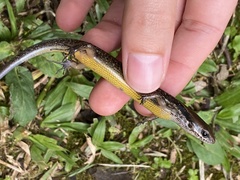
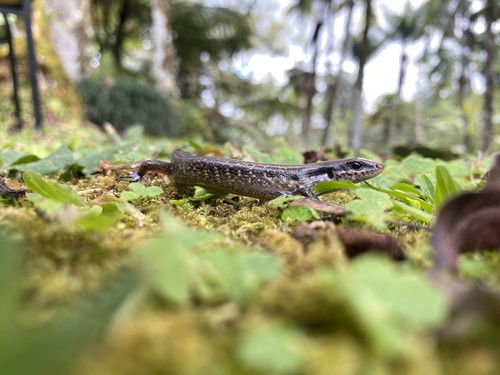
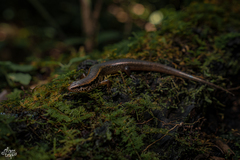
Brown Forest Skink

Brown Forest Skink

Scincella cherriei

Silhouette: David Orr · PhyloPic

LCLeast ConcernNTVUENCR
Daily sighting probability ~10% · With luck
at Arenal Volcano National Park

In 3 days ~20% in a week ~40%

7 Verified sightings at Arenal Volcano National Park From 2019 to 2026
100 In all 10 parks
September Best month
☀️ Diurnal When it's spotted

About the Brown Forest Skink

Scincella cherriei, commonly known as the brown forest skink and Cope's brown forest skink, is a species of lizard in the family Scincidae. The species is native to Central America and adjacent southeastern Mexico. Three subspecies are recognized.

The specific name, cherriei, is in honor of George Kruck Cherrie, who was an American naturalist and ornithologist. The subspecific name, stuarti, is in honor of American herpetologist Laurence Cooper Stuart. S. cherriei is found in Belize, Costa Rica, El Salvador, Guatemala, Honduras, Mexico (Puebla, Quintana Roo, Tabasco, Veracruz, Yucatán), and Nicaragua.

The preferred natural habitat of S. cherriei is forest, at altitudes from sea level to 1,860 m (6,100 ft). S. cherriei preys upon small invertebrates. S. cherriei is oviparous. Scincella cherriei cherriei (Cope, 1893) Scincella cherriei ixbaac (L. Stuart, 1940)

Scincella cherriei stuarti (H.M. Smith, 1941) Nota bene: A trinomial authority in parentheses indicates that the subspecies was... Wikipedia →
Global Distribution

Parks Where Found

# Park Country Daily sighting probability
1 Cusuco National Park 🇭🇳 Honduras
~30%
2 Piedras Blancas National Park 🇨🇷 Costa Rica
~20%
3 Carara National Park 🇨🇷 Costa Rica
~20%
4 Tenorio Volcano National Park 🇨🇷 Costa Rica
~10%
5 Cerro Azul Meámbar National Park 🇭🇳 Honduras
~10%
6 Braulio Carrillo National Park 🇨🇷 Costa Rica
~10%
7 Corcovado National Park 🇨🇷 Costa Rica
~10%
8 Manuel Antonio National Park 🇨🇷 Costa Rica
~10%
9 Arenal Volcano National Park 🇨🇷 Costa Rica
~10%
10 Monteverde Cloud Forest Reserve 🇨🇷 Costa Rica
~10%

Closest Relatives at Arenal Volcano National Park

No species of the same family or order lives in Arenal Volcano National Park, so these are its closest relatives here: other reptiles.

Before you go

What are the chances of seeing a Brown Forest Skink in Arenal Volcano National Park?

With luck

About 10% of wildlife watchers report a Brown Forest Skink sighting in Arenal Volcano National Park on a given day, based on 7 verified sightings from GBIF citizen-science data from 2019 to 2026. It is the 51st most-seen of the 64 reptiles we can rate there. Over three days the chance rises to about 20%, and over a week to about 40%, if each day is a fresh chance.

When is the best time to see a Brown Forest Skink in Arenal Volcano National Park?

April, June, September and November–December

In those months about 10% of wildlife watchers report a Brown Forest Skink in Arenal Volcano National Park on a given day, against under 5% in January–March, May, July–August and October, the lowest months.

What time of day is best to see a Brown Forest Skink?

Between 9 am and noon

Across all the parks we cover, that three-hour window holds the most Brown Forest Skink sightings with a recorded time, and about 8 in 10 of them come between 6 am and 6 pm: it is a daytime animal.

Is Arenal Volcano National Park the best place to see a Brown Forest Skink?

9th of 10

Of the 10 parks where we can rate Brown Forest Skink sightings, Arenal Volcano National Park ranks 9th at about 10%. The best odds are in Cusuco National Park (Honduras, about 30%), Piedras Blancas National Park (Costa Rica, about 20%) and Carara National Park (Costa Rica, about 20%).

Where does the Brown Forest Skink sighting chance come from?

GBIF citizen-science records

It is estimated from how often the Brown Forest Skink is recorded against all the reptiles logged in Arenal Volcano National Park (7 verified sightings from 2019 to 2026), calibrated against known sighting rates. Figures are rounded to the nearest 10% because citizen-science data supports honest approximations, not decimals, and months with records from fewer than five people show "—". How it works.

← Back to Arenal Volcano National Park