Mountain Buzzard

Mountain Buzzard

Buteo oreophilus

Silhouette: Lauren Anderson · PhyloPic

LCNTNear ThreatenedVUENCR
Daily sighting probability ~20% · Possible
at Arusha National Park

In 3 days ~50% in a week ~80%

132 Verified sightings at Arusha National Park From 2019 to 2026
944 In all 10 parks
February Best month
☀️ Diurnal When it's spotted

About the Mountain Buzzard

The mountain buzzard (Buteo oreophilus) is a bird of prey that lives in montane forests in East Africa, it and the forest buzzard (Buteo trizonatus) of southern Africa were, until recently, considered to be a single species.

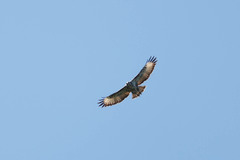
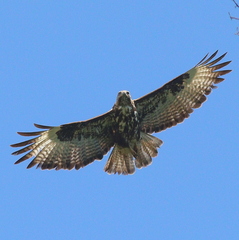
A small buzzard and quite similar to the steppe buzzard Buteo buteo vulpinus, the migratory subspecies of the Palearctic common buzzard which winters over most of Africa. The adult has brown upperparts with paler underparts with heavy brown blotches on the breast, belly, flanks and underwing coverts. The underside of the flight feathers is barred with a distinct black band along the rear edge of the wing. The tail is brown above, light grey below and shows faint narrow bars which are broadest just before the tail tip. Juveniles are buffier below and less heavily marked than the adults.

The mountain buzzard occurs in the mountainous regions of eastern Africa from Ethiopia, west through Kenya, Uganda, South Sudan and Rwanda to eastern Democratic Republic of Congo then south into Tanzania, Burundi and Malawi.

This species occurs in montane forest and fragments of montane forest, including plantations of exotic trees... Wikipedia →

Sounds

Flight call0:23

Kenya · 2026

© Ding Li Yong · XC1179286 · CC BY-NC-ND 4.0

Call0:12

Tanzania · 2022

© isaac kilusu · XC763307 · CC BY-NC-SA 4.0

Call0:20

Tanzania · 2019

© Peter Boesman · XC509947 · CC BY-NC-ND 4.0

Global Distribution

Parks Where Found

# Park Country Daily sighting probability
1 Aberdare National Park 🇰🇪 Kenya
~30%
2 Arusha National Park 🇹🇿 Tanzania
~20%
3 Volcanoes National Park 🇷🇼 Rwanda
~10%
4 Bwindi Impenetrable National Park 🇺🇬 Uganda
~10%
5 Bale Mountains National Park 🇪🇹 Ethiopia
~10%
6 Nyungwe National Park 🇷🇼 Rwanda
~10%
7 Virunga National Park 🇨🇩 Democratic Republic of the Congo
~10%
8 Ngorongoro Conservation Area 🇹🇿 Tanzania
~10%
9 Lake Manyara National Park 🇹🇿 Tanzania
<5%
10 Kibale National Park 🇺🇬 Uganda
<5%

Before you go

What are the chances of seeing a Mountain Buzzard in Arusha National Park?

Possible

About 20% of wildlife watchers report a Mountain Buzzard sighting in Arusha National Park on a given day, based on 132 verified sightings from GBIF citizen-science data from 2019 to 2026. It is the 90th most-seen of the 373 birds we can rate there. Over three days the chance rises to about 50%, and over a week to about 80%, if each day is a fresh chance.

When is the best time to see a Mountain Buzzard in Arusha National Park?

February, September–October and December

In those months about 30% of wildlife watchers report a Mountain Buzzard in Arusha National Park on a given day, against about 10% in March–April and June, the lowest months.

What time of day is best to see a Mountain Buzzard?

Between 1 and 4 pm

Across all the parks we cover, that three-hour window holds the most Mountain Buzzard sightings with a recorded time, and nearly all of them come between 6 am and 6 pm: it is a daytime animal.

Is Arusha National Park the best place to see a Mountain Buzzard?

2nd of 10

Of the 10 parks where we can rate Mountain Buzzard sightings, Arusha National Park ranks 2nd at about 20%. The best odds are in Aberdare National Park (Kenya, about 30%).

Which relatives of the Mountain Buzzard live in Arusha National Park?

Same genus: Buteo

The closest relatives of the Mountain Buzzard that you can see in Arusha National Park (genus Buteo, Buteos) are Augur Buzzard (about 40%) and Common Buzzard (about 10%), with each one's daily chance of a sighting.

Where does the Mountain Buzzard sighting chance come from?

GBIF citizen-science records

It is estimated from how often the Mountain Buzzard is recorded against all the birds logged in Arusha National Park (132 verified sightings from 2019 to 2026), calibrated against known sighting rates. Figures are rounded to the nearest 10% because citizen-science data supports honest approximations, not decimals, and months with records from fewer than five people show "—". How it works.

← Back to Arusha National Park