

Lazuli Bunting

Lazuli Bunting

Passerina amoena

Silhouette: Jonah Duckles · PhyloPic

LCLeast ConcernNTVUENCR
Daily sighting probability ~10% · With luck
at Bahía de Loreto National Park

In 3 days ~20% in a week ~40%

69 Verified sightings at Bahía de Loreto National Park From 2019 to 2026
3,134 In all 20 parks
March Best month
☀️ Diurnal When it's spotted

About the Lazuli Bunting

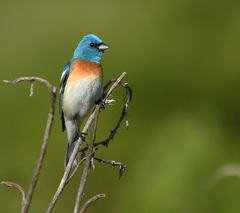
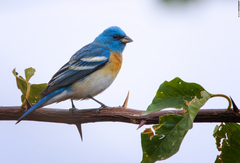
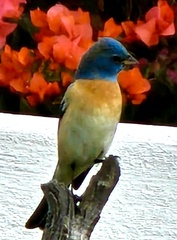
The lazuli bunting (Passerina amoena) is a North American songbird named for the gemstone lapis lazuli. Measurements: Length: 5.1–5.9 in (13–15 cm) Weight: 0.5–0.6 oz (13–18 g) Wingspan: 8.7 in (22 cm) The male is easily recognized by its bright blue head and back (lighter than the closely related indigo bunting), its conspicuous white wingbars, and its light rusty breast and white belly. The color pattern may suggest the eastern and western bluebirds, but the smaller size (13–15 cm or 5–5.9 inches long), wingbars, and short and conical bunting bill quickly distinguish it. The female is brown, grayer above and warmer underneath, told from the female indigo bunting by two thin and pale wingbars and other plumage details.

The song is a high, rapid, strident warble, similar to that of the indigo bunting but longer and with less repetition. Lazuli buntings breed mostly west of the 100th meridian from southern Canada to northern Texas, central New Mexico and Arizona, and southern California. On the Pacific coast their breeding range extends south to extreme northwestern Baja California. They migrate to southeastern Arizona and... Wikipedia →

Sounds

Song0:15

United States · 2026

© Ed Pandolfino · XC1139596 · CC BY-NC-SA 4.0

Call0:36

United States · 2022

© Paul Marvin · XC717623 · CC BY-NC-SA 4.0

Flight call0:19

Mexico · 2019

© Richard E. Webster · XC465576 · CC BY-NC-SA 4.0

Global Distribution

Parks Where Found

# Park Country Daily sighting probability
1 Sequoia and Kings Canyon National Parks 🇺🇸 United States
~20%
2 Cabo Pulmo National Park 🇲🇽 Mexico
~10%
3 Zion National Park 🇺🇸 United States
~10%
4 Death Valley National Park 🇺🇸 United States
~10%
5 Yosemite National Park 🇺🇸 United States
~10%
6 Glacier National Park 🇺🇸 United States
~10%
7 Grand Teton National Park 🇺🇸 United States
~10%
8 Saguaro National Park 🇺🇸 United States
~10%
9 Bahía de Loreto National Park 🇲🇽 Mexico
~10%
10 Yellowstone National Park 🇺🇸 United States
~10%
11 Redwood National Park 🇺🇸 United States
<5%
12 Cumbres de Monterrey National Park 🇲🇽 Mexico
<5%
13 Grand Canyon National Park 🇺🇸 United States
<5%
14 Joshua Tree National Park 🇺🇸 United States
<5%
15 Guadalupe Mountains National Park 🇺🇸 United States
<5%
16 Big Bend National Park 🇺🇸 United States
<5%
17 Channel Islands National Park 🇺🇸 United States
<5%
18 Badlands National Park 🇺🇸 United States
<5%
19 El Vizcaíno Biosphere Reserve 🇲🇽 Mexico
<5%
20 Rocky Mountain National Park 🇺🇸 United States
<5%

Cities Where Found

# City Country Daily sighting probability
1 Salt Lake City 🇺🇸 United States
~10%
2 Mesa 🇺🇸 United States
<5%
3 Los Angeles 🇺🇸 United States
<5%
4 Las Vegas 🇺🇸 United States
<5%
5 Portland 🇺🇸 United States
<5%
6 Sacramento 🇺🇸 United States
<5%
7 Guadalajara 🇲🇽 México
<5%
8 Denver 🇺🇸 United States
<5%
9 Phoenix 🇺🇸 United States
<5%
10 Vancouver 🇨🇦 Canada
<5%

Zoos & Centres Where Found

# Zoo / Centre Country
1 Xcaret 🇲🇽 Mexico In captivity

Before you go

What are the chances of seeing a Lazuli Bunting in Bahía de Loreto National Park?

With luck

About 10% of wildlife watchers report a Lazuli Bunting sighting in Bahía de Loreto National Park on a given day, based on 69 verified sightings from GBIF citizen-science data from 2019 to 2026. It is the 87th most-seen of the 169 birds we can rate there. Over three days the chance rises to about 20%, and over a week to about 40%, if each day is a fresh chance.

When is the best time to see a Lazuli Bunting in Bahía de Loreto National Park?

February–April and October–November

In those months about 10% of wildlife watchers report a Lazuli Bunting in Bahía de Loreto National Park on a given day, against under 5% in May–September and December–January, the lowest months.

What time of day is best to see a Lazuli Bunting?

Between 8 and 11 am

Across all the parks we cover, that three-hour window holds the most Lazuli Bunting sightings with a recorded time, and about 9 in 10 of them come between 6 am and 6 pm: it is a daytime animal.

Which relatives of the Lazuli Bunting live in Bahía de Loreto National Park?

Same family: Cardinalidae

The closest relatives of the Lazuli Bunting that you can see in Bahía de Loreto National Park (family Cardinalidae, Cardinals and Allies) are Northern Cardinal (about 40%) and Pyrrhuloxia (about 10%), with each one's daily chance of a sighting.

Where does the Lazuli Bunting sighting chance come from?

GBIF citizen-science records

It is estimated from how often the Lazuli Bunting is recorded against all the birds logged in Bahía de Loreto National Park (69 verified sightings from 2019 to 2026), calibrated against known sighting rates. Figures are rounded to the nearest 10% because citizen-science data supports honest approximations, not decimals, and months with records from fewer than five people show "—". How it works.

← Back to Bahía de Loreto National Park