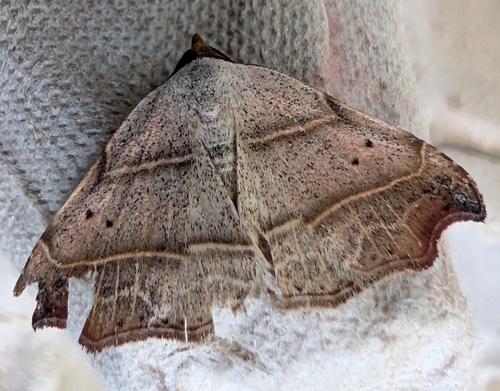
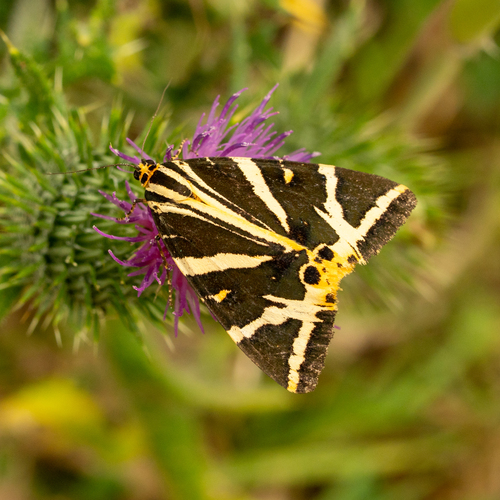
Jersey Tiger

Jersey Tiger

Euplagia quadripunctaria

Daily sighting probability ~20% · Possible
at Bavarian Forest National Park

In 3 days ~40% in a week ~70%

64 Verified sightings at Bavarian Forest National Park From 2019 to 2026
588 In all 13 parks
August Best month
☀️ Diurnal When it's spotted

About the Jersey Tiger

Euplagia quadripunctaria, the Jersey tiger, or Spanish flag, is a diurnal moth of the family Erebidae. The species was first described by Nikolaus Poda von Neuhaus in 1761. The adult wingspan is 52–65 millimetres (2.0–2.6 in), and they fly from July to September, depending on the location. They tend to fly close to hemp-agrimony, Eupatorium cannabinum. In most of their range, the aposematic adults have red underwings. In the northwest part of their range, the adults are polymorphic for underwing colour, being variously red, orange, or yellow.

The larvae (caterpillars) are polyphagous, feeding from September to May on nettles (Urtica), raspberries (Rubus), dandelion (Taraxacum), white deadnettle (Lamium), ground-ivy (Glechoma), groundsel (Senecio), plantain (Plantago), borage (Borago), lettuce (Lactuca), and hemp-agrimony (Eupratoria). The insect overwinters as a small larva.

Large groups of adults of subspecies E. q. rhodosensis can be found on occasion aestivating (sheltering from the summer heat) in Petaloudes, on Rhodes, in a place that has become known as the Valley of the Butterflies. Euplagia quadripunctaria is widely distributed in Europe from Estonia and Latvia... Wikipedia →
Global Distribution

Parks Where Found

# Park Country Daily sighting probability
1 Plitvice Lakes National Park 🇭🇷 Croatia
~40%
2 Picos de Europa National Park 🇪🇸 Spain
~40%
3 Aigüestortes National Park 🇪🇸 Spain
~40%
4 Triglav National Park 🇸🇮 Slovenia
~30%
5 Ecrins National Park 🇫🇷 France
~20%
6 Pyrénées National Park 🇫🇷 France
~20%
7 Bavarian Forest National Park 🇩🇪 Germany
~20%
8 Mercantour National Park 🇫🇷 France
~20%
9 Ordesa y Monte Perdido National Park 🇪🇸 Spain
~20%
10 Cévennes National Park 🇫🇷 France
~10%
11 Sierra de Guadarrama National Park 🇪🇸 Spain
~10%
12 Vanoise National Park 🇫🇷 France
~10%
13 Fertő-Hanság National Park 🇭🇺 Hungary
~10%

Cities Where Found

# City Country Daily sighting probability
1 London 🇬🇧 United Kingdom
~40%
2 Lyon 🇫🇷 France
~20%
3 Paris 🇫🇷 France
~10%
4 Prague 🇨🇿 Czechia
~10%
5 Turin 🇮🇹 Italy
~10%
6 Vienna 🇦🇹 Austria
~10%
7 Brussels 🇧🇪 Belgium
~10%
8 Essen 🇩🇪 Germany
~10%
9 Cologne 🇩🇪 Germany
~10%
10 Kyiv 🇺🇦 Ukraine
~10%

Before you go

What are the chances of seeing a Jersey Tiger in Bavarian Forest National Park?

Possible

About 20% of wildlife watchers report a Jersey Tiger sighting in Bavarian Forest National Park on a given day, based on 64 verified sightings from GBIF citizen-science data from 2019 to 2026. It is the 48th most-seen of the 1115 insects we can rate there. Over three days the chance rises to about 40%, and over a week to about 70%, if each day is a fresh chance.

When is the best time to see a Jersey Tiger in Bavarian Forest National Park?

August

In that month about 40% of wildlife watchers report a Jersey Tiger in Bavarian Forest National Park on a given day, against under 5% in June and October–April, the lowest months.

What time of day is best to see a Jersey Tiger?

Between 11 am and 2 pm

Across all the parks we cover, that three-hour window holds the most Jersey Tiger sightings with a recorded time, and about 8 in 10 of them come between 6 am and 6 pm: it is a daytime animal.

Which relatives of the Jersey Tiger live in Bavarian Forest National Park?

Same family: Erebidae

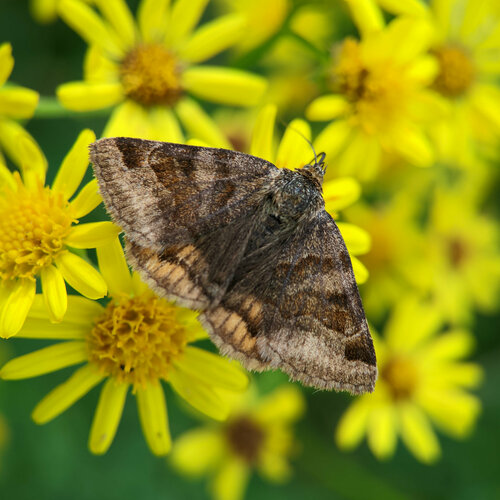
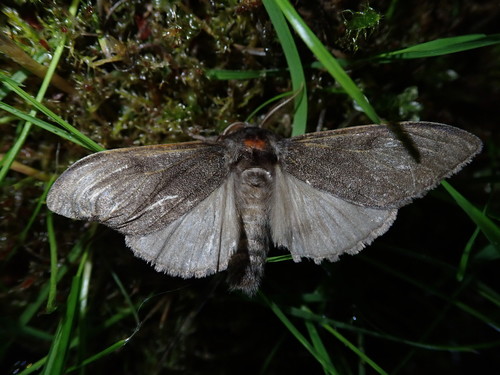
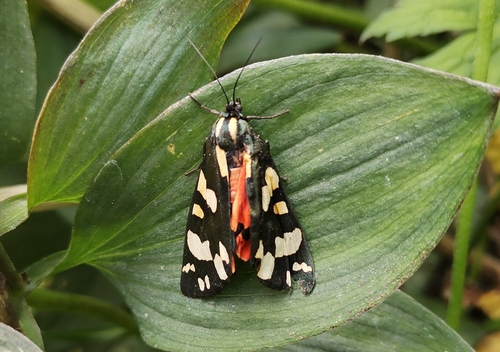
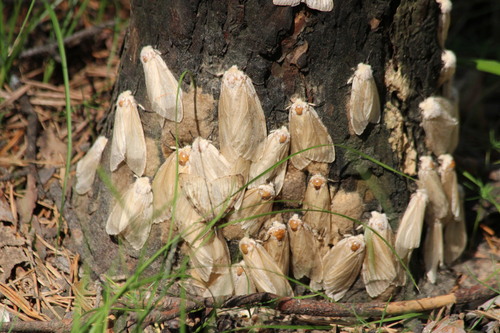
The closest relatives of the Jersey Tiger that you can see in Bavarian Forest National Park (family Erebidae, Underwing, Tiger, Tussock, and Allied Moths) are Burnet Companion (about 20%), Pale Tussock Moth (about 10%) and Scarlet Tiger (about 10%), with each one's daily chance of a sighting.

Where does the Jersey Tiger sighting chance come from?

GBIF citizen-science records

It is estimated from how often the Jersey Tiger is recorded against all the insects logged in Bavarian Forest National Park (64 verified sightings from 2019 to 2026), calibrated against known sighting rates. Figures are rounded to the nearest 10% because citizen-science data supports honest approximations, not decimals, and months with records from fewer than five people show "—". How it works.

← Back to Bavarian Forest National Park