Speckled Yellow

Speckled Yellow

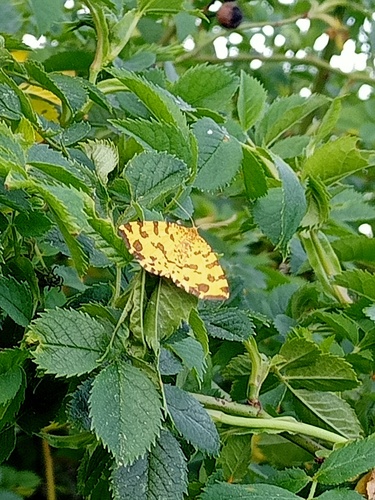
Pseudopanthera macularia

Daily sighting probability ~10% · With luck
at Białowieża National Park

In 3 days ~30% in a week ~60%

8 Verified sightings at Białowieża National Park From 2019 to 2026
181 In all 11 parks
May Best month
☀️ Diurnal When it's spotted

About the Speckled Yellow

Pseudopanthera macularia, the speckled yellow, is a moth of the family Geometridae. It is found throughout Europe, from the Iberian Peninsula through Western and Central Europe and the British Isles and Russia to the Urals. Its range extends North to South Fennoscandia, in the South from the Western Mediterranean islands and Italy and the Balkan Peninsula to the Black Sea region and the Caucasus. From Asia Minor it extends East through the rest of the Palearctic to Transbaikal.

The wingspan is 23–28 mm."Easily known by having the lines or bands altogether broken up into large irregular spots. Underside the same. Only in ab. transversaria Krulik, are the spots, at least on the forewing, joined into bands. — In ab. viridimaculata Ckll. the spots are olive-green. — ab. albicans Ob. has the ground-colour whitish. — ab. quadrimaculata Hatchett is a rare form with the spots obsolete except the 4 at costal margin of forewing. — ab. fuscaria Stgr. (18 c) is another rare form, fuscous throughout. — meridionalis Galvagni from Gorz and the Southern Tyrol, has less black dusting, the black spots small.

The larva is green, with white lines and stripes and a shining green head. The larva mainly feeds on woodsage, (Teucrium scorodonia) from July to September. The moth is common in woodland and flies in daylight, from April to the beginning of July often in numbers. Wikipedia →

Global Distribution

Parks Where Found

# Park Country Daily sighting probability
1 Triglav National Park 🇸🇮 Slovenia
~30%
2 Mercantour National Park 🇫🇷 France
~20%
3 Picos de Europa National Park 🇪🇸 Spain
~10%
4 Białowieża National Park 🇵🇱 Poland
~10%
5 Ecrins National Park 🇫🇷 France
~10%
6 Pyrénées National Park 🇫🇷 France
~10%
7 Cévennes National Park 🇫🇷 France
~10%
8 Bavarian Forest National Park 🇩🇪 Germany
~10%
9 Fertő-Hanság National Park 🇭🇺 Hungary
~10%
10 Snowdonia National Park 🇬🇧 United Kingdom
~10%
11 Sierra de Guadarrama National Park 🇪🇸 Spain
<5%

Cities Where Found

# City Country Daily sighting probability
1 Budapest 🇭🇺 Hungary
~10%
2 Vienna 🇦🇹 Austria
<5%
3 Kyiv 🇺🇦 Ukraine
<5%
4 Moscow 🇷🇺 Russia
<5%
5 Prague 🇨🇿 Czechia
<5%
6 Paris 🇫🇷 France
<5%

Before you go

What are the chances of seeing a Speckled Yellow in Białowieża National Park?

With luck

About 10% of wildlife watchers report a Speckled Yellow sighting in Białowieża National Park on a given day, based on 8 verified sightings from GBIF citizen-science data from 2019 to 2026. It is the 95th most-seen of the 158 insects we can rate there. Over three days the chance rises to about 30%, and over a week to about 60%, if each day is a fresh chance.

When is the best time to see a Speckled Yellow in Białowieża National Park?

May

In that month about 30% of wildlife watchers report a Speckled Yellow in Białowieża National Park on a given day, against under 5% in July to April, the lowest months.

What time of day is best to see a Speckled Yellow?

Between 10 am and 1 pm

Across all the parks we cover, that three-hour window holds the most Speckled Yellow sightings with a recorded time, and about 9 in 10 of them come between 6 am and 6 pm: it is a daytime animal.

Which relatives of the Speckled Yellow live in Białowieża National Park?

Same family: Geometridae

The closest relatives of the Speckled Yellow that you can see in Białowieża National Park (family Geometridae, Geometer Moths) are Latticed Heath (about 20%), Common Heath (about 20%) and Blood Vein (about 10%), with each one's daily chance of a sighting.

Where does the Speckled Yellow sighting chance come from?

GBIF citizen-science records

It is estimated from how often the Speckled Yellow is recorded against all the insects logged in Białowieża National Park (8 verified sightings from 2019 to 2026), calibrated against known sighting rates. Figures are rounded to the nearest 10% because citizen-science data supports honest approximations, not decimals, and months with records from fewer than five people show "—". How it works.

← Back to Białowieża National Park