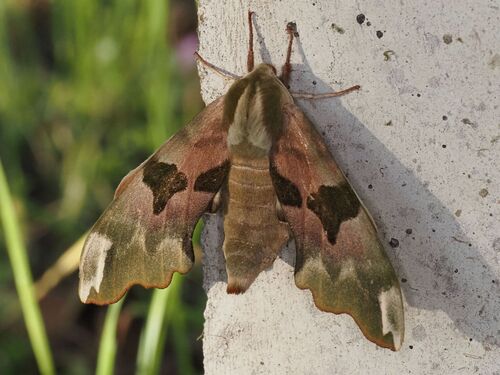
Purple-Shot Copper

Purple-Shot Copper

Lycaena alciphron

Daily sighting probability ~20% · Possible
at Biebrza National Park

In 3 days ~40% in a week ~80%

12 Verified sightings at Biebrza National Park From 2019 to 2026
360 In all 9 parks
July Best month
☀️ Diurnal When it's spotted

About the Purple-Shot Copper

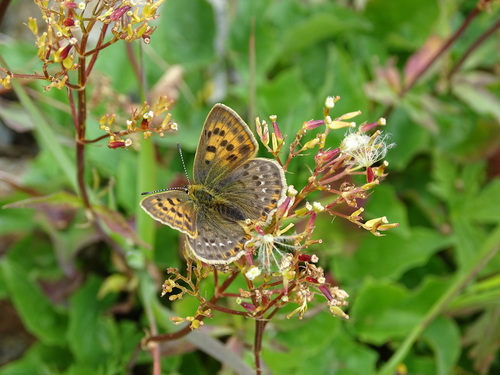
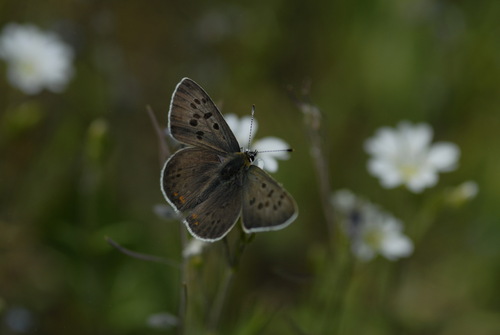
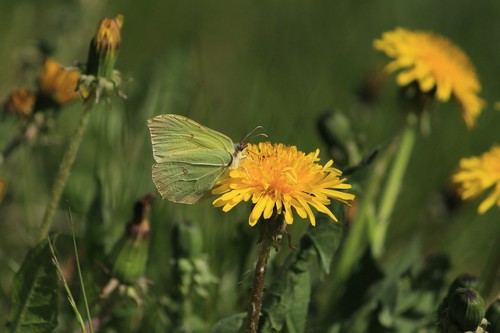
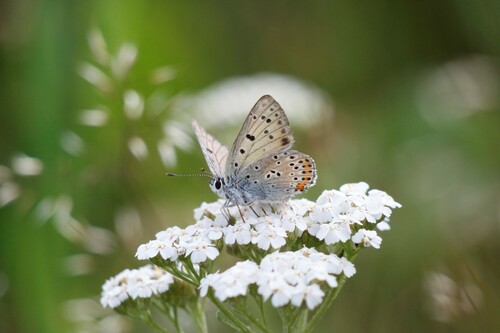
The purple-shot copper (Lycaena alciphron) is a butterfly in the family of the Lycaenidae or copper butterflies and in the genus of the Lycaena. The coloring of the males and the females is very different, i.e. the sexual dimorphism is very strong. The top sides of the wings are red-gold with black spots. The males fluoresce purple, while the females' top side is brown, also with black spots. The rear wings have submarginal spots.

The caterpillar is nocturnal and eats sorrel. The fully-grown butterfly feeds from wild thyme, ground-elder, and blackberry flowers. The purple-shot copper can be found in Europe, Morocco, and Turkey at heights between 500 and 900 meters.

This butterfly migrates from June to July. C. alciphron Rott. (= lampetie Schiff., virgaureae Hufn., hiere F., helle Bkh., hipponoe Esp.) (77 a), Lighter yellow and less golden [than hippothoe]; the upperside of the male in the name-typical form quite unlike that... Wikipedia →
Global Distribution

Parks Where Found

# Park Country Daily sighting probability
1 Sierra Nevada National Park 🇪🇸 Spain
~20%
2 Aigüestortes National Park 🇪🇸 Spain
~20%
3 Mercantour National Park 🇫🇷 France
~20%
4 Biebrza National Park 🇵🇱 Poland
~20%
5 Sierra de Guadarrama National Park 🇪🇸 Spain
~20%
6 Ecrins National Park 🇫🇷 France
~10%
7 Pyrénées National Park 🇫🇷 France
~10%
8 Cévennes National Park 🇫🇷 France
~10%
9 Bavarian Forest National Park 🇩🇪 Germany
<5%

Cities Where Found

# City Country Daily sighting probability
1 Berlin 🇩🇪 Germany
~10%
2 Warsaw 🇵🇱 Poland
<5%
3 Moscow 🇷🇺 Russia
<5%

Before you go

What are the chances of seeing a Purple-Shot Copper in Biebrza National Park?

Possible

About 20% of wildlife watchers report a Purple-Shot Copper sighting in Biebrza National Park on a given day, based on 12 verified sightings from GBIF citizen-science data from 2019 to 2026. It is the 60th most-seen of the 97 insects we can rate there. Over three days the chance rises to about 40%, and over a week to about 80%, if each day is a fresh chance.

When is the best time to see a Purple-Shot Copper in Biebrza National Park?

July

In that month about 40% of wildlife watchers report a Purple-Shot Copper in Biebrza National Park on a given day, against under 5% in March–May and August–October, the lowest months. That is one of Biebrza National Park's wettest months, with about 95 mm of rain against 35 mm in March. December has too few records to rate.

What time of day is best to see a Purple-Shot Copper?

Between 11 am and 2 pm

Across all the parks we cover, that three-hour window holds the most Purple-Shot Copper sightings with a recorded time, and about 9 in 10 of them come between 6 am and 6 pm: it is a daytime animal.

Is Biebrza National Park the best place to see a Purple-Shot Copper?

Among the best

Of the 9 parks where we can rate Purple-Shot Copper sightings, Biebrza National Park ranks 4th at about 20%, level with the leaders once rounded. The best odds are in Sierra Nevada National Park (Spain, about 20%), Aigüestortes National Park (Spain, about 20%) and Mercantour National Park (France, about 20%).

Which relatives of the Purple-Shot Copper live in Biebrza National Park?

Same genus: Lycaena

The closest relatives of the Purple-Shot Copper that you can see in Biebrza National Park (genus Lycaena, Lycaena butterflies) are Scarce Copper (about 30%) and Small Copper (about 20%), with each one's daily chance of a sighting.

Where does the Purple-Shot Copper sighting chance come from?

GBIF citizen-science records

It is estimated from how often the Purple-Shot Copper is recorded against all the insects logged in Biebrza National Park (12 verified sightings from 2019 to 2026), calibrated against known sighting rates. Figures are rounded to the nearest 10% because citizen-science data supports honest approximations, not decimals, and months with records from fewer than five people show "—". How it works.

← Back to Biebrza National Park