Fraternal Potter Wasp

Fraternal Potter Wasp

Eumenes fraternus

Daily sighting probability ~10% · With luck
at Big Cypress National Preserve

In 3 days ~40% in a week ~70%

20 Verified sightings at Big Cypress National Preserve From 2019 to 2026
68 In all 5 parks
July Best month
☀️ Diurnal When it's spotted

About the Fraternal Potter Wasp

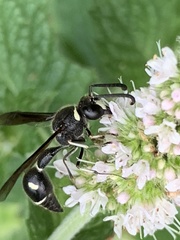
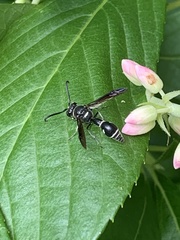
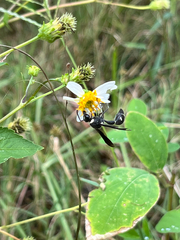
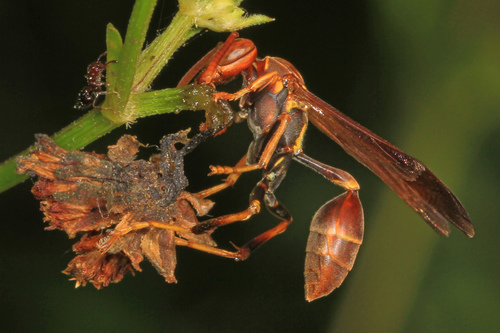
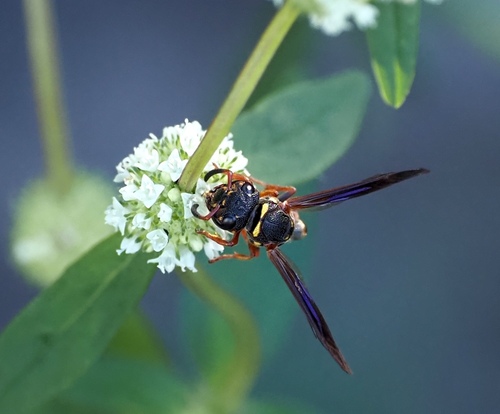
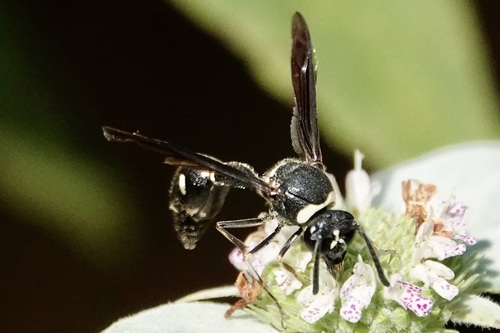
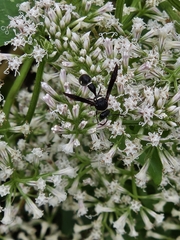
Eumenes fraternus is a species of potter wasp in the subfamily Eumeninae of the family Vespidae. It is native to the eastern United States and Canada. The female builds a miniature pot out of mud in which it lays an egg and places a live caterpillar. Its developing larva feeds on this whereas the adult wasp feeds primarily on nectar.

Wasps in the genus Eumenes can be recognised by the fact that the first abdominal segment is long and slender, very thin at the front and widening towards the back. Eumenes fraternus is about 15 to 20 mm (0.6 to 0.8 in) long and is similar in appearance to other members of the genus. Its colouring is black with a scattering of ivory-coloured markings. The forewings are 8 to 10.5 mm (0.3 to 0.4 in) long in the male and 10 to 12.5 mm (0.4 to 0.5 in) in the female. It has shorter pubescence on the first segment of the antenna than do the otherwise similar E. crucifera and E. verticalis.

Eumenes fraternus is found in the eastern United States and Canada. Its range extends west as far as Ontario, Minnesota, Kansas and Texas. It is on the wing from about April to November in North Carolina and is found in glades... Wikipedia →

Global Distribution

Parks Where Found

# Park Country Daily sighting probability
1 Big Cypress National Preserve 🇺🇸 United States
~10%
2 Point Pelee National Park 🇨🇦 Canada
~10%
3 Shenandoah National Park 🇺🇸 United States
~10%
4 Great Smoky Mountains National Park 🇺🇸 United States
~10%
5 Everglades National Park 🇺🇸 United States
~10%

Cities Where Found

# City Country Daily sighting probability
1 Minneapolis [Saint Paul] 🇺🇸 United States
~10%
2 Boston 🇺🇸 United States
~10%
3 Baltimore 🇺🇸 United States
~10%
4 Detroit 🇺🇸 United States
~10%
5 Washington 🇺🇸 United States
~10%
6 Houston 🇺🇸 United States
~10%
7 Toronto 🇨🇦 Canada
~10%
8 Montreal 🇨🇦 Canada
~10%
9 New York City 🇺🇸 United States
~10%
10 Philadelphia 🇺🇸 United States
~10%

Before you go

What are the chances of seeing a Fraternal Potter Wasp in Big Cypress National Preserve?

With luck

About 10% of wildlife watchers report a Fraternal Potter Wasp sighting in Big Cypress National Preserve on a given day, based on 20 verified sightings from GBIF citizen-science data from 2019 to 2026. It is the 57th most-seen of the 262 insects we can rate there. Over three days the chance rises to about 40%, and over a week to about 70%, if each day is a fresh chance.

When is the best time to see a Fraternal Potter Wasp in Big Cypress National Preserve?

July

In that month about 30% of wildlife watchers report a Fraternal Potter Wasp in Big Cypress National Preserve on a given day, against under 5% in April and September, the lowest months. That is one of Big Cypress National Preserve's wettest months, with about 210 mm of rain against 40 mm in March.

What time of day is best to see a Fraternal Potter Wasp?

Between 11 am and 2 pm

Across all the parks we cover, that three-hour window holds the most Fraternal Potter Wasp sightings with a recorded time, and nearly all of them come between 6 am and 6 pm: it is a daytime animal.

Is Big Cypress National Preserve the best place to see a Fraternal Potter Wasp?

Yes

Of the 5 parks where we can rate Fraternal Potter Wasp sightings, Big Cypress National Preserve has the highest daily chance: about 10%. Next come Point Pelee National Park (Canada, about 10%) and Shenandoah National Park (United States, about 10%).

Where does the Fraternal Potter Wasp sighting chance come from?

GBIF citizen-science records

It is estimated from how often the Fraternal Potter Wasp is recorded against all the insects logged in Big Cypress National Preserve (20 verified sightings from 2019 to 2026), calibrated against known sighting rates. Figures are rounded to the nearest 10% because citizen-science data supports honest approximations, not decimals, and months with records from fewer than five people show "—". How it works.
← Back to Big Cypress National Preserve