Bearded Dragon

Bearded Dragon

Pogona barbata

Silhouette: Felix Vaux · PhyloPic

LCLeast ConcernNTVUENCR Endemic
Daily sighting probability ~20% · Possible
at Blue Mountains National Park

In 3 days ~50% in a week ~80%

56 Verified sightings at Blue Mountains National Park From 2019 to 2026
103 In all 4 parks
October Best month
☀️ Diurnal When it's spotted

About the Bearded Dragon

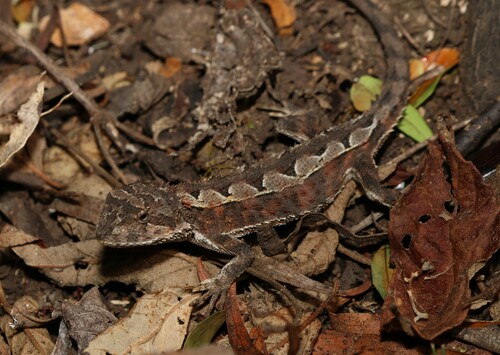
The eastern bearded dragon (Pogona barbata), also known as common bearded dragon or simply bearded lizard, is an agamid lizard found in wooded parts of Australia. It is one of a group of species known commonly as bearded dragons. Other common names for this species include Jew lizard and frilly lizard, the latter being a confusion between this and another dragon, the frill-necked lizard (Chlamydosaurus kingii). This species was originally described in 1829 by Georges Cuvier, who named it Amphibolurus barbatus.

P. barbata is one of the eight recognized species within the genus Pogona. Adult males can grow to about 60 cm (24 in) from the snout to the tip of the tail, while females may reach 50 cm (20 in) in overall length. The head is large and triangular in shape. The throat is covered with spiny, dark grey scales which can be raised to form an impressive "beard". Several groups of even longer spiny scales are located at the back of the head, the corners of the mouth, the external ear openings, and running posteriorly along both sides of the abdomen. The thorax and abdomen are relatively slender and flattened dorsoventrally.

It is usually grey-black or red in skin colour... Wikipedia →

Global Distribution

Parks Where Found

# Park Country Daily sighting probability
1 Grampians National Park 🇦🇺 Australia
~20%
2 Blue Mountains National Park 🇦🇺 Australia
~20%
3 Noosa National Park 🇦🇺 Australia
~10%
4 Lamington National Park 🇦🇺 Australia
~10%

Cities Where Found

# City Country Daily sighting probability
1 Brisbane 🇦🇺 Australia
~20%
2 Sydney 🇦🇺 Australia
<5%

Zoos & Centres Where Found

# Zoo / Centre Country
1 Australia Zoo 🇦🇺 Australia In captivity
2 Melbourne Zoo 🇦🇺 Australia In captivity
3 Auckland Zoo 🇳🇿 New Zealand In captivity
4 Lincoln Park Zoo 🇺🇸 United States In captivity
5 Byron Bay Wildlife Sanctuary 🇦🇺 Australia In captivity
6 Zoo Koki (Parque zoológico y botánico) 🇪🇸 Spain In captivity
7 Wingspan National Bird of Prey Centre 🇳🇿 New Zealand In captivity
8 Alexandra Park Zoo 🇦🇺 Australia In captivity

Before you go

What are the chances of seeing a Bearded Dragon in Blue Mountains National Park?

Possible

About 20% of wildlife watchers report a Bearded Dragon sighting in Blue Mountains National Park on a given day, based on 56 verified sightings from GBIF citizen-science data from 2019 to 2026. It is the 19th most-seen of the 44 reptiles we can rate there. Over three days the chance rises to about 50%, and over a week to about 80%, if each day is a fresh chance.

When is the best time to see a Bearded Dragon in Blue Mountains National Park?

October

In that month about 30% of wildlife watchers report a Bearded Dragon in Blue Mountains National Park on a given day, against under 5% in May and June, the lowest months.

What time of day is best to see a Bearded Dragon?

Between 11 am and 2 pm

Across all the parks we cover, that three-hour window holds the most Bearded Dragon sightings with a recorded time, and nearly all of them come between 6 am and 6 pm: it is a daytime animal.

Is Blue Mountains National Park the best place to see a Bearded Dragon?

Among the best

Of the 4 parks where we can rate Bearded Dragon sightings, Blue Mountains National Park ranks 2nd at about 20%, level with the leaders once rounded. The best odds are in Grampians National Park (Australia, about 20%).

Which relatives of the Bearded Dragon live in Blue Mountains National Park?

Same family: Agamidae

The closest relatives of the Bearded Dragon that you can see in Blue Mountains National Park (family Agamidae, Dragons) are Mountain Dragon (about 50%), Australian Water Dragon (about 50%) and Jacky Lashtail (about 30%), with each one's daily chance of a sighting.

Where does the Bearded Dragon sighting chance come from?

GBIF citizen-science records

It is estimated from how often the Bearded Dragon is recorded against all the reptiles logged in Blue Mountains National Park (56 verified sightings from 2019 to 2026), calibrated against known sighting rates. Figures are rounded to the nearest 10% because citizen-science data supports honest approximations, not decimals, and months with records from fewer than five people show "—". How it works.

← Back to Blue Mountains National Park