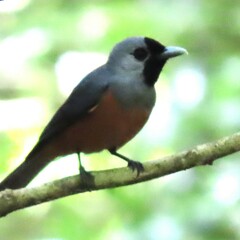

Black-faced Monarch

Black-faced Monarch

Monarcha melanopsis

Silhouette: Sheatherius · PhyloPic

LCLeast ConcernNTVUENCR
Daily sighting probability ~10% · With luck
at Blue Mountains National Park

In 3 days ~20% in a week ~40%

416 Verified sightings at Blue Mountains National Park From 2019 to 2026
2,347 In all 7 parks
January Best month
☀️ Diurnal When it's spotted

About the Black-faced Monarch

The black-faced monarch (Monarcha melanopsis) is a passerine songbird in the family Monarchidae found along the eastern seaboard of Australia, and also New Guinea (where most birds migrate to during the austral winter; May to August).

The black-faced monarch was originally described as Muscicapa melanopsis by Louis Pierre Vieillot in 1818 from a specimen collected in New South Wales. The species is now placed in the genus Monarcha that was introduced by the naturalists Nicholas Vigors and Thomas Horsfield in 1827. The specific name is from the Ancient Greek words melas "black" and ops "face". English naturalist William Swainson described it in 1823 as Muscipeta carinata, or "keel-billed flycatcher", unaware of Vieillot's earlier description. In his 1848 work The Birds of Australia, John Gould called it Monarcha carinata "Carinated flycatcher".

Australian amateur ornithologist Gregory Mathews described a paler specimen from Cape York as a distinct subspecies pallidus, though this was not recognised subsequently. "Black-faced monarch" has been designated as the official common name for the species by the International Ornithologists' Union (IOC). Alternate... Wikipedia →

Sounds

Song0:35

Australia · 2024

© Romuald Mikusek · XC1172491 · CC BY-NC-SA 4.0

Call0:56

Australia · 2025

© Marc Anderson · XC1087418 · CC BY-NC-ND 4.0

Song0:36

Australia · 2025

© Peter Boesman · XC1066712 · CC BY-NC-ND 4.0

Global Distribution

Parks Where Found

# Park Country Daily sighting probability
1 Lamington National Park 🇦🇺 Australia
~30%
2 Royal National Park 🇦🇺 Australia
~20%
3 Springbrook National Park 🇦🇺 Australia
~10%
4 Blue Mountains National Park 🇦🇺 Australia
~10%
5 Booderee National Park 🇦🇺 Australia
~10%
6 Daintree National Park 🇦🇺 Australia
<5%
7 Noosa National Park 🇦🇺 Australia
<5%

Cities Where Found

# City Country Daily sighting probability
1 Brisbane 🇦🇺 Australia
<5%
2 Sydney 🇦🇺 Australia
<5%
3 Melbourne 🇦🇺 Australia
<5%

Before you go

What are the chances of seeing a Black-faced Monarch in Blue Mountains National Park?

With luck

About 10% of wildlife watchers report a Black-faced Monarch sighting in Blue Mountains National Park on a given day, based on 416 verified sightings from GBIF citizen-science data from 2019 to 2026. It is the 68th most-seen of the 196 birds we can rate there. Over three days the chance rises to about 20%, and over a week to about 40%, if each day is a fresh chance.

When is the best time to see a Black-faced Monarch in Blue Mountains National Park?

November to January

In those months about 20% of wildlife watchers report a Black-faced Monarch in Blue Mountains National Park on a given day, against under 5% in March to September, the lowest months.

What time of day is best to see a Black-faced Monarch?

Between 9 am and noon

Across all the parks we cover, that three-hour window holds the most Black-faced Monarch sightings with a recorded time, and about 9 in 10 of them come between 6 am and 6 pm: it is a daytime animal.

Is Blue Mountains National Park the best place to see a Black-faced Monarch?

4th of 7

Of the 7 parks where we can rate Black-faced Monarch sightings, Blue Mountains National Park ranks 4th at about 10%. The best odds are in Lamington National Park (Australia, about 30%), Royal National Park (Australia, about 20%) and Springbrook National Park (Australia, about 10%).

Which relatives of the Black-faced Monarch live in Blue Mountains National Park?

Same family: Monarchidae

The closest relatives of the Black-faced Monarch that you can see in Blue Mountains National Park (family Monarchidae, Monarch Flycatchers) are Magpie-lark (about 30%) and Leaden Flycatcher (about 10%), with each one's daily chance of a sighting.

Where does the Black-faced Monarch sighting chance come from?

GBIF citizen-science records

It is estimated from how often the Black-faced Monarch is recorded against all the birds logged in Blue Mountains National Park (416 verified sightings from 2019 to 2026), calibrated against known sighting rates. Figures are rounded to the nearest 10% because citizen-science data supports honest approximations, not decimals, and months with records from fewer than five people show "—". How it works.

← Back to Blue Mountains National Park