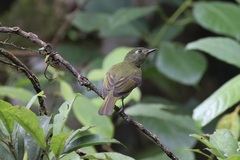
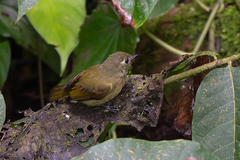
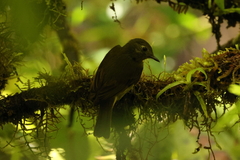
Olive-striped Flycatcher (Olive-streaked)

Olive-striped Flycatcher (Olive-streaked)

Mionectes olivaceus

Silhouette: Emily Willoughby · PhyloPic

LCLeast ConcernNTVUENCR
Daily sighting probability <5% · Rare
at Cahuita National Park

In 3 days <5%

5 Verified sightings at Cahuita National Park From 2019 to 2026
4,873 In all 12 parks
October Best month
☀️ Diurnal When it's spotted

About the Olive-striped Flycatcher (Olive-streaked)

The olive-streaked flycatcher (Mionectes olivaceus) is a species of bird in the family Tyrannidae, the tyrant flycatchers. It is found in Costa Rica and Panama. The four subspecies of what is now the olive-striped flycatcher (Mionnectes galbinus) were previously treated as subspecies of what is now the olive-streaked flycatcher. (Confusingly, the original unsplit species was called the olive-striped flycatcher but bore the present olive-streaked flycatcher's binomial Mionectes olivaceus.) Based primarily on vocal differences the species were separated by taxonomic systems beginning in 2016, leaving the olive-streaked flycatcher as a monotypic species. However, as of late 2024, the North American and South American Classification Committees of the American Ornithological Society have not agreed to the split. They retain the olive-striped flycatcher/Mionectes olivaceus names.

This article follows the monotypic species model. The olive-streaked flycatcher is 13 cm (5.1 in) long. The sexes have the same plumage. Adults have a dark olive face with white streaks and a small triangular white spot behind the eye. Their crown and nape are dark... Wikipedia →

Sounds

Call0:10

Costa Rica · 2017

© Albert Lastukhin · XC1101499 · CC BY-NC-ND 4.0

Song0:33

Ecuador · 2025

© Marc Anderson · XC983012 · CC BY-NC-ND 4.0

Song0:09

Colombia · 2019

© Iván Lau · XC670190 · CC BY-NC-SA 4.0

Global Distribution

Parks Where Found

# Park Country Daily sighting probability
1 Monteverde Cloud Forest Reserve 🇨🇷 Costa Rica
~20%
2 Arenal Volcano National Park 🇨🇷 Costa Rica
~10%
3 Tapantí-Macizo de la Muerte National Park 🇨🇷 Costa Rica
~10%
4 Volcán Barú National Park 🇵🇦 Panama
~10%
5 Braulio Carrillo National Park 🇨🇷 Costa Rica
~10%
6 Chirripó National Park 🇨🇷 Costa Rica
~10%
7 Los Quetzales National Park 🇨🇷 Costa Rica
<5%
8 Poás Volcano National Park 🇨🇷 Costa Rica
<5%
9 La Amistad International Park (Panama) 🇵🇦 Panama
<5%
10 Tenorio Volcano National Park 🇨🇷 Costa Rica
<5%
11 Cahuita National Park 🇨🇷 Costa Rica
<5%
12 Rincón de la Vieja National Park 🇨🇷 Costa Rica
<5%

Cities Where Found

# City Country Daily sighting probability
1 San José 🇨🇷 Costa Rica
<5%

Before you go

What are the chances of seeing an Olive-striped Flycatcher (Olive-streaked) in Cahuita National Park?

Rare

Under 5% of wildlife watchers report an Olive-striped Flycatcher (Olive-streaked) sighting in Cahuita National Park on a given day, based on 5 verified sightings from GBIF citizen-science data from 2019 to 2026. It is the 290th most-seen of the 303 birds we can rate there. Over three days the chance rises to under 5%, if each day is a fresh chance.

When is the best time to see an Olive-striped Flycatcher (Olive-streaked) in Cahuita National Park?

Any time of year

In every month with enough records, under 5% of wildlife watchers report an Olive-striped Flycatcher (Olive-streaked) in Cahuita National Park on a given day, so our monthly data shows no clear season.

What time of day is best to see an Olive-striped Flycatcher (Olive-streaked)?

Between 9 am and noon

Across all the parks we cover, that three-hour window holds the most Olive-striped Flycatcher (Olive-streaked) sightings with a recorded time, and about 9 in 10 of them come between 6 am and 6 pm: it is a daytime animal.

Where does the Olive-striped Flycatcher (Olive-streaked) sighting chance come from?

GBIF citizen-science records

It is estimated from how often the Olive-striped Flycatcher (Olive-streaked) is recorded against all the birds logged in Cahuita National Park (5 verified sightings from 2019 to 2026), calibrated against known sighting rates. Figures are rounded to the nearest 10% because citizen-science data supports honest approximations, not decimals, and months with records from fewer than five people show "—". How it works.
← Back to Cahuita National Park