Sipurio Snouted Treefrog

Sipurio Snouted Treefrog

Scinax elaeochroa

Silhouette: Robbi Bishop-Taylor · PhyloPic

LCLeast ConcernNTVUENCR
Daily sighting probability ~20% · Possible
at Cahuita National Park

In 3 days ~50% in a week ~80%

26 Verified sightings at Cahuita National Park From 2019 to 2026
463 In all 12 parks
April Best month
🌙 Nocturnal When it's spotted

About the Sipurio Snouted Treefrog

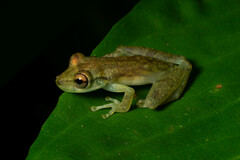
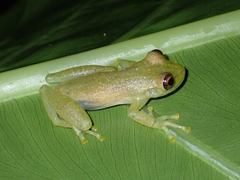
Scinax elaeochroa, commonly known as the Sipurio snouted treefrog, or olive snouted treefrog, is a species of frog in the family Hylidae. It is found in the Caribbean lowlands of Nicaragua and Panama and in the Pacific lowlands of Costa Rica and Panama, with an isolated population in Colombia.

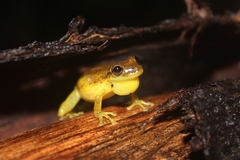
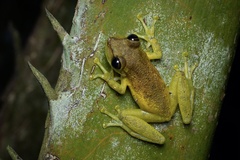
Males grow to 38 mm (1.5 in) and females to 40 mm (1.6 in) in snout–vent length. The snout is protruding. The dorsum is yellowish, sometimes with a hint of green or light brown, and turns brilliant yellow in breeding males. There are usually some darker markings on the dorsum. The arms and legs are usually barred. The venter varies from cream to yellow to orange; the throat is usually yellow.

The vocal sac in breeding males is bright yellow-orange. The advertisement call is a series of short "waaks". The natural habitats of Scinax elaeochroa are humid lowland and lower premontane forests, occurring also in secondary and disturbed forest habitats. It can be found from sea level to 1,200 m (3,900 ft) above sea level (to 1,500 m (4,900 ft) asl in Colombia). It is primarily a nocturnal species that breeds in temporary ponds during the wet season. Eggs... Wikipedia →

Sounds

Advertisement call0:19

Costa Rica · 2025

© Chris Harrison · XC1029812 · CC BY-NC-SA 4.0

Recording0:11

Costa Rica · 2021

© Jan Ebr & Ivana Ebrová · iNaturalist · CC BY 4.0

Recording0:01

Costa Rica · 2014

© probreviceps · iNaturalist · CC BY-NC 4.0

Global Distribution

Parks Where Found

# Park Country Daily sighting probability
1 Braulio Carrillo National Park 🇨🇷 Costa Rica
~40%
2 Tenorio Volcano National Park 🇨🇷 Costa Rica
~40%
3 Piedras Blancas National Park 🇨🇷 Costa Rica
~40%
4 Gandoca-Manzanillo Wildlife Refuge 🇨🇷 Costa Rica
~30%
5 Tortuguero National Park 🇨🇷 Costa Rica
~30%
6 Bastimentos Island National Marine Park 🇵🇦 Panama
~20%
7 Cahuita National Park 🇨🇷 Costa Rica
~20%
8 Arenal Volcano National Park 🇨🇷 Costa Rica
~20%
9 Carara National Park 🇨🇷 Costa Rica
~20%
10 La Amistad International Park (Panama) 🇵🇦 Panama
~10%
11 Corcovado National Park 🇨🇷 Costa Rica
~10%
12 Tapantí-Macizo de la Muerte National Park 🇨🇷 Costa Rica
~10%

Before you go

What are the chances of seeing a Sipurio Snouted Treefrog in Cahuita National Park?

Possible

About 20% of wildlife watchers report a Sipurio Snouted Treefrog sighting in Cahuita National Park on a given day, based on 26 verified sightings from GBIF citizen-science data from 2019 to 2026. It is the 6th most-seen of the 15 amphibians we can rate there. Over three days the chance rises to about 50%, and over a week to about 80%, if each day is a fresh chance.

When is the best time to see a Sipurio Snouted Treefrog in Cahuita National Park?

April, June and December

In those months about 30% of wildlife watchers report a Sipurio Snouted Treefrog in Cahuita National Park on a given day, against under 5% in May and July, the lowest months.

What time of day is best to see a Sipurio Snouted Treefrog?

Between 6 and 9 pm

Across all the parks we cover, that three-hour window holds the most Sipurio Snouted Treefrog sightings with a recorded time, and about 9 in 10 of them come between 6 pm and 6 am: it is mostly seen at night.

Where does the Sipurio Snouted Treefrog sighting chance come from?

GBIF citizen-science records

It is estimated from how often the Sipurio Snouted Treefrog is recorded against all the amphibians logged in Cahuita National Park (26 verified sightings from 2019 to 2026), calibrated against known sighting rates. Figures are rounded to the nearest 10% because citizen-science data supports honest approximations, not decimals, and months with records from fewer than five people show "—". How it works.

← Back to Cahuita National Park