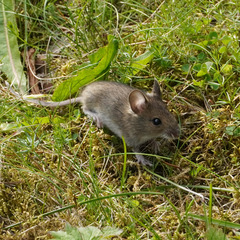
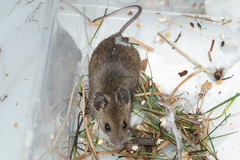
European Wood Mouse

European Wood Mouse

Apodemus sylvaticus

Silhouette: Anthony Caravaggi · PhyloPic

LCLeast ConcernNTVUENCR
Daily sighting probability ~20% · Possible
at Cairngorms National Park

In 3 days ~40% in a week ~70%

16 Verified sightings at Cairngorms National Park From 2019 to 2026
43 In all 4 parks
January Best month
☀️🌙 Day & Night When it's spotted

About the European Wood Mouse

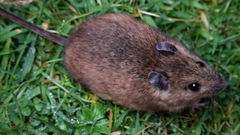
The wood mouse (Apodemus sylvaticus) is a murid rodent native to Europe and northwestern Africa. It is closely related to the yellow-necked mouse (A. flavicollis) but differs in that it has no band of yellow fur around the neck, has slightly smaller ears, and is usually slightly smaller overall: around 90 mm (3.54 in) in length and 23 g in weight. It is found across most of Europe and is a very common and widespread species, is commensal with people and is sometimes considered a pest. Other common names are long-tailed field mouse, field mouse, common field mouse, and European wood mouse. This species is a known potential carrier of the Dobrava sequence of hantavirus which affects humans and may pose serious risks to human health.

Wood mice inhabit forests, grasslands, and cultivated fields, tending to seek out more wooded areas in winter. Almost entirely nocturnal and terrestrial, wood mice burrow extensively, build nests of plants and live in buildings during harsh seasons. It is one of the most intensively studied species in the genus. In Europe, it ranges north to Scandinavia and east to Ukraine. The wood mouse is also found in northwestern Africa... Wikipedia →

Global Distribution

Parks Where Found

# Park Country Daily sighting probability
1 Snowdonia National Park 🇬🇧 United Kingdom
~20%
2 Cairngorms National Park 🇬🇧 United Kingdom
~20%
3 Pyrénées National Park 🇫🇷 France
~10%
4 Sierra de Guadarrama National Park 🇪🇸 Spain
<5%

Cities Where Found

# City Country Daily sighting probability
1 Manchester 🇬🇧 United Kingdom
~10%
2 Liverpool 🇬🇧 United Kingdom
~10%
3 Birmingham 🇬🇧 United Kingdom
~10%
4 Leeds 🇬🇧 United Kingdom
~10%
5 London 🇬🇧 United Kingdom
~10%
6 Cologne 🇩🇪 Germany
~10%
7 Brussels 🇧🇪 Belgium
~10%
8 Dublin 🇮🇪 Ireland
~10%
9 Paris 🇫🇷 France
~10%
10 Amsterdam 🇳🇱 Netherlands
~10%

Zoos & Centres Where Found

# Zoo / Centre Country
1 Budapest Zoo & Botanical Garden 🇭🇺 Hungary In captivity
2 British Wildlife Centre 🇬🇧 United Kingdom In captivity

Before you go

What are the chances of seeing a European Wood Mouse in Cairngorms National Park?

Possible

About 20% of wildlife watchers report a European Wood Mouse sighting in Cairngorms National Park on a given day, based on 16 verified sightings from GBIF citizen-science data from 2019 to 2026. It is the 11th most-seen of the 19 mammals we can rate there. Over three days the chance rises to about 40%, and over a week to about 70%, if each day is a fresh chance.

When is the best time to see a European Wood Mouse in Cairngorms National Park?

January

In that month about 40% of wildlife watchers report a European Wood Mouse in Cairngorms National Park on a given day, against under 5% in February–March, August and December, the lowest months.

What time of day is best to see a European Wood Mouse?

Between 10 am and 1 pm

Across all the parks we cover, that three-hour window holds the most European Wood Mouse sightings with a recorded time, and about 6 in 10 of them come between 6 am and 6 pm: it is seen both by day and at night.

Is Cairngorms National Park the best place to see a European Wood Mouse?

Among the best

Of the 4 parks where we can rate European Wood Mouse sightings, Cairngorms National Park ranks 2nd at about 20%, level with the leaders once rounded. The best odds are in Snowdonia National Park (United Kingdom, about 20%).

Which relatives of the European Wood Mouse live in Cairngorms National Park?

Same order: Rodentia

The closest relatives of the European Wood Mouse that you can see in Cairngorms National Park (order Rodentia, Rodents) are Eurasian Red Squirrel (about 50%), Bank Vole (about 10%) and Field Vole (about 10%), with each one's daily chance of a sighting.

Where does the European Wood Mouse sighting chance come from?

GBIF citizen-science records

It is estimated from how often the European Wood Mouse is recorded against all the mammals logged in Cairngorms National Park (16 verified sightings from 2019 to 2026), calibrated against known sighting rates. Figures are rounded to the nearest 10% because citizen-science data supports honest approximations, not decimals, and months with records from fewer than five people show "—". How it works.

← Back to Cairngorms National Park