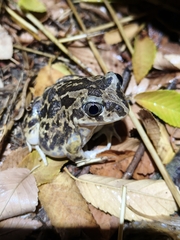
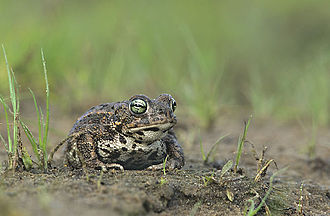
Iberian Spadefoot Toad

Iberian Spadefoot Toad

Pelobates cultripes

Silhouette: Dmitry Bogdanov (vectorized by T. Michael Keesey) · PhyloPic

LCNTVUVulnerableENCR
Daily sighting probability ~10% · With luck
at Camargue

In 3 days ~20% in a week ~40%

20 Verified sightings at Camargue From 2019 to 2026
144 In all 5 parks
March Best month
🌙 Nocturnal When it's spotted

About the Iberian Spadefoot Toad

Pelobates cultripes is a toad species in the family Pelobatidae. It is known under many different common names, including the western spadefoot, Iberian spadefoot toad, Spanish spadefoot toad, and Wagler's spadefoot toad. It is found in most of the Iberian Peninsula with isolated populations southern and western France.

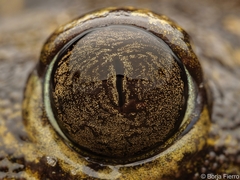
Pelobates cultripes is a big smooth-skinned toad with a silvery gold or greenish eye and a vertical pupil. It has a black spade on the hind foot, hence its name. The edged callus internus of the hind foot is converted to allow digging. The upperside is greyish-yellowish with dark brown or greenish blotches and spots. It grows up to 11 cm and is larger and greener than the common spadefoot, Pelobates fuscus. The tadpoles are larger than those of most other toad species.

This toad is mostly nocturnal, but occasionally vast numbers of it can be seen after rain. It hides in burrows up to 20 cm deep and can dig itself into earth quite fast. When threatened it inflates its body and mews, kitten-like.

It breeds often in temporary water that is sometimes brackish. During mating season males appear first on wet nights at breeding sites, the... Wikipedia →

Sounds

Territorial call1:03

Spain · 2025

© Carles Martorell Gendra · XC979364 · CC BY-NC-SA 4.0

Recording0:24

France · 2025

© Samuel GUIRAUDOU · iNaturalist · CC BY 4.0

Global Distribution

Parks Where Found

# Park Country Daily sighting probability
1 Doñana National Park 🇪🇸 Spain
~20%
2 Monfragüe National Park 🇪🇸 Spain
~20%
3 Cévennes National Park 🇫🇷 France
~20%
4 Camargue 🇫🇷 France
~10%
5 Sierra de Guadarrama National Park 🇪🇸 Spain
~10%

Before you go

What are the chances of seeing an Iberian Spadefoot Toad in Camargue?

With luck

About 10% of wildlife watchers report an Iberian Spadefoot Toad sighting in Camargue on a given day, based on 20 verified sightings from GBIF citizen-science data from 2019 to 2026. Over three days the chance rises to about 20%, and over a week to about 40%, if each day is a fresh chance.

When is the best time to see an Iberian Spadefoot Toad in Camargue?

March

In that month about 20% of wildlife watchers report an Iberian Spadefoot Toad in Camargue on a given day, against under 5% in May–July and December–January, the lowest months.

What time of day is best to see an Iberian Spadefoot Toad?

Between 9 pm and midnight

Across all the parks we cover, that three-hour window holds the most Iberian Spadefoot Toad sightings with a recorded time, and about 8 in 10 of them come between 6 pm and 6 am: it is mostly seen at night.

Which relatives of the Iberian Spadefoot Toad live in Camargue?

Same order: Anura

The closest relatives of the Iberian Spadefoot Toad that you can see in Camargue (order Anura, Frogs and Toads) are Mediterranean Tree Frog (about 40%) and Natterjack Toad (about 10%), with each one's daily chance of a sighting.

Where does the Iberian Spadefoot Toad sighting chance come from?

GBIF citizen-science records

It is estimated from how often the Iberian Spadefoot Toad is recorded against all the amphibians logged in Camargue (20 verified sightings from 2019 to 2026), calibrated against known sighting rates. Figures are rounded to the nearest 10% because citizen-science data supports honest approximations, not decimals, and months with records from fewer than five people show "—". How it works.

← Back to Camargue