Natterjack Toad

Natterjack Toad

Epidalea calamita

Silhouette: Michael Scroggie, from original photograph by Gary M. Stolz, USFWS (original photograph in public domain). · PhyloPic

LCLeast ConcernNTVUENCR
Daily sighting probability ~10% · With luck
at Camargue

In 3 days ~40% in a week ~60%

9 Verified sightings at Camargue From 2019 to 2026
413 In all 8 parks
October Best month
🌙 Nocturnal When it's spotted

About the Natterjack Toad

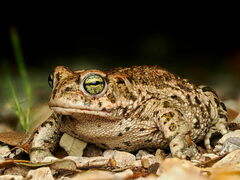
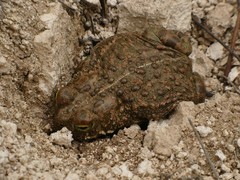
The natterjack toad (Epidalea calamita) is a toad native to sandy and heathland areas of Europe. Adults are 60–70 mm (2.4–2.8 in) in length, and are distinguished from common toads by a yellow line down the middle of the back and parallel paratoid glands. They have relatively short legs, which gives them a distinctive gait, contrasting with the hopping movement of many other toad species.

Natterjacks have a very loud and distinctive mating call amplified by the single vocal sac found under the chin of the male. Natterjacks live for up to 15 years, and feed mainly on insects, especially beetles. At night, they move around open terrain with sparse vegetation, and their tracks can often be seen in loose sand. They move considerable distances each night, enabling the species to colonize new habitats shut up.

The natterjack toad spawns between the end of April and July, laying strings of eggs in shallow, warm pools. Because the natterjack toad is often present in low numbers, its loud mating calls are important so that the sexes can find each other.

Natterjacks can only spawn in pools that have a very slightly sloping bottom, and tolerate only sparse... Wikipedia →

Sounds

Advertisement call0:41

France · 2026

© Guillaume Dillenseger · XC1157573 · CC BY-NC-SA 4.0

Uncertain0:33

France · 2026

© Alain Malengreau · XC1106303 · CC BY-NC-SA 4.0

Territorial call0:13

France · 2026

© Le Louaver Manuel · XC1104564 · CC BY-NC-SA 4.0

Global Distribution

Parks Where Found

# Park Country Daily sighting probability
1 Doñana National Park 🇪🇸 Spain
~30%
2 Monfragüe National Park 🇪🇸 Spain
~30%
3 Sierra de Guadarrama National Park 🇪🇸 Spain
~20%
4 Wadden Sea National Park 🇩🇪 Germany
~20%
5 Sierra Nevada National Park 🇪🇸 Spain
~20%
6 Cévennes National Park 🇫🇷 France
~10%
7 Camargue 🇫🇷 France
~10%
8 Pyrénées National Park 🇫🇷 France
~10%

Cities Where Found

# City Country Daily sighting probability
1 Madrid 🇪🇸 Spain
~20%
2 Barcelona 🇪🇸 Spain
~10%
3 Essen 🇩🇪 Germany
~10%
4 Berlin 🇩🇪 Germany
<5%
5 Paris 🇫🇷 France
<5%

Zoos & Centres Where Found

# Zoo / Centre Country
1 Copenhagen Zoo 🇩🇰 Denmark In captivity
2 Lisbon Oceanarium 🇵🇹 Portugal In captivity
3 Knuthenborg Safaripark 🇩🇰 Denmark In captivity
4 The Living Planet Aquarium 🇺🇸 United States In captivity
5 Universeum 🇸🇪 Sweden In captivity

Before you go

What are the chances of seeing a Natterjack Toad in Camargue?

With luck

About 10% of wildlife watchers report a Natterjack Toad sighting in Camargue on a given day, based on 9 verified sightings from GBIF citizen-science data from 2019 to 2026. Over three days the chance rises to about 40%, and over a week to about 60%, if each day is a fresh chance.

When is the best time to see a Natterjack Toad in Camargue?

September and October

In those months about 30% of wildlife watchers report a Natterjack Toad in Camargue on a given day, against under 5% in June–July and December–March, the lowest months. Those are among Camargue's wettest months, with about 80 mm of rain a month against 10 mm in July.

What time of day is best to see a Natterjack Toad?

Between 9 pm and midnight

Across all the parks we cover, that three-hour window holds the most Natterjack Toad sightings with a recorded time, and about 8 in 10 of them come between 6 pm and 6 am: it is mostly seen at night.

Which relatives of the Natterjack Toad live in Camargue?

Same order: Anura

The closest relatives of the Natterjack Toad that you can see in Camargue (order Anura, Frogs and Toads) are Mediterranean Tree Frog (about 40%) and Iberian Spadefoot Toad (about 10%), with each one's daily chance of a sighting.

Where does the Natterjack Toad sighting chance come from?

GBIF citizen-science records

It is estimated from how often the Natterjack Toad is recorded against all the amphibians logged in Camargue (9 verified sightings from 2019 to 2026), calibrated against known sighting rates. Figures are rounded to the nearest 10% because citizen-science data supports honest approximations, not decimals, and months with records from fewer than five people show "—". How it works.

← Back to Camargue