
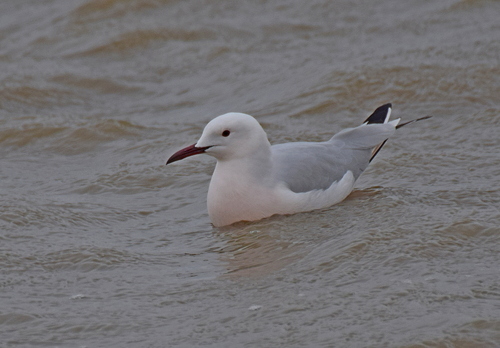
Little Gull

Little Gull

Hydrocoloeus minutus

Silhouette: Sheatherius · PhyloPic

LCLeast ConcernNTVUENCR
Daily sighting probability <5% · Rare
at Camargue

In 3 days ~10% in a week ~20%

47 Verified sightings at Camargue From 2019 to 2026
1,367 In all 9 parks
August Best month
☀️ Diurnal When it's spotted

About the Little Gull

The little gull (Hydrocoloeus minutus) is a species of gull belonging to the family Laridae which is mainly found in the Palearctic with some small colonies in North America. It breeds on freshwater lakes and marshes, and spends winters at sea. It is the smallest species of gull in the world, and the only species in the monospecific genus Hydrocoloeus.

The little gull was first formally described as Larus minutus in 1776 by the German ornithologist Peter Simon Pallas with its type locality given as Berezovo, Tobolsk in Siberia. In 1829, Johann Jakob Kaup proposed the genus Hydrocoloeus for this species, and George Robert Gray later formally designated Larus minutus as the type species of the genus. Kaup had also included Larus plumbiceps Meyer, 1822 in his genus Hydrocoloeus; this is a synonym of Chroicocephalus cirrocephalus (grey-headed gull). Hydrocoloeus minutus is the binomial accepted for this species and it is classified in the family Laridae, the gulls and terns, in the order Charadriiformes.

Within the Laridae, its closest relative is Ross's gull Rhodostethia rosea; some authors have even included Ross's gull in Hydrocoloeus rather than giving it its own genus... Wikipedia →

Sounds

Flight call0:16

Italy · 2026

© Francesco Sottile · XC1080622 · CC BY-NC-SA 4.0

Call0:35

Sweden · 2025

© Ulf Elman · XC1001546 · CC BY-NC-ND 4.0

Begging call0:36

Sweden · 2022

© Alan Dalton · XC737141 · CC BY-NC-SA 4.0

Global Distribution

Parks Where Found

# Park Country Daily sighting probability
1 Hortobágy National Park 🇭🇺 Hungary
~10%
2 Kiskunság National Park 🇭🇺 Hungary
~10%
3 Fertő-Hanság National Park 🇭🇺 Hungary
~10%
4 Wadden Sea National Park 🇩🇪 Germany
~10%
5 Point Pelee National Park 🇨🇦 Canada
<5%
6 Camargue 🇫🇷 France
<5%
7 Biebrza National Park 🇵🇱 Poland
<5%
8 Doñana National Park 🇪🇸 Spain
<5%
9 Sierra de Guadarrama National Park 🇪🇸 Spain
<5%

Cities Where Found

# City Country Daily sighting probability
1 Novosibirsk 🇷🇺 Russia
~10%
2 Liverpool 🇬🇧 United Kingdom
~10%
3 Kunming 🇨🇳 China
<5%
4 Helsinki 🇫🇮 Finland
<5%
5 Turin 🇮🇹 Italy
<5%
6 Saint Petersburg 🇷🇺 Russia
<5%
7 Rotterdam [The Hague] 🇳🇱 Netherlands
<5%
8 Istanbul 🇹🇷 Turkey
<5%
9 Minsk 🇧🇾 Belarus
<5%
10 Warsaw 🇵🇱 Poland
<5%

Before you go

What are the chances of seeing a Little Gull in Camargue?

Rare

Under 5% of wildlife watchers report a Little Gull sighting in Camargue on a given day, based on 47 verified sightings from GBIF citizen-science data from 2019 to 2026. It is the 138th most-seen of the 212 birds we can rate there. Over three days the chance rises to about 10%, and over a week to about 20%, if each day is a fresh chance.

When is the best time to see a Little Gull in Camargue?

August

In that month about 20% of wildlife watchers report a Little Gull in Camargue on a given day, against under 5% in September to July, the lowest months.

What time of day is best to see a Little Gull?

Between 1 and 4 pm

Across all the parks we cover, that three-hour window holds the most Little Gull sightings with a recorded time, and about 9 in 10 of them come between 6 am and 6 pm: it is a daytime animal.

Which relatives of the Little Gull live in Camargue?

Same family: Laridae

The closest relatives of the Little Gull that you can see in Camargue (family Laridae, Gulls, Terns, and Skimmers) are Black-headed Gull (about 70%), Yellow-legged Gull (about 70%) and Gull-billed Tern (about 30%), with each one's daily chance of a sighting.

Where does the Little Gull sighting chance come from?

GBIF citizen-science records

It is estimated from how often the Little Gull is recorded against all the birds logged in Camargue (47 verified sightings from 2019 to 2026), calibrated against known sighting rates. Figures are rounded to the nearest 10% because citizen-science data supports honest approximations, not decimals, and months with records from fewer than five people show "—". How it works.

← Back to Camargue