Pacific Screech-Owl

Pacific Screech-Owl

Megascops cooperi

Silhouette: Jason Dilworth · PhyloPic

LCLeast ConcernNTVUENCR
Daily sighting probability ~10% · With luck
at Carara National Park

In 3 days ~20% in a week ~40%

476 Verified sightings at Carara National Park From 2019 to 2026
1,107 In all 11 parks
March Best month
☀️ Diurnal When it's spotted

About the Pacific Screech-Owl

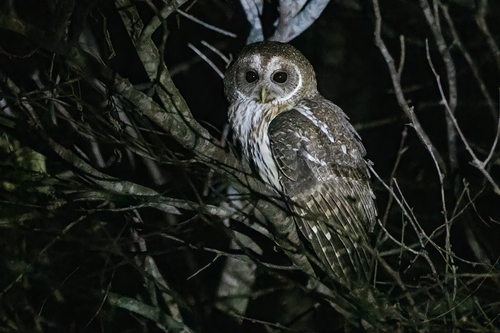
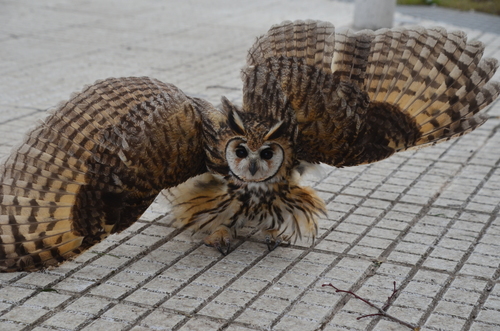
The Pacific screech owl (Megascops cooperi) is a species of owl in the family Strigidae. It is found in Costa Rica, El Salvador, Guatemala, Honduras, Mexico, and Nicaragua. The Pacific screech owl has sometimes been treated as a race of western screech owl (Megascops kennicottii) or eastern screech owl (M. asio) but its vocalizations are distinct from theirs. The latter has also sometimes been treated as a separate species. The IUCN has assessed the Pacific screech owl as being of Least Concern. Its population is estimated to exceed 50,000 mature individuals but is believed to be decreasing.

The Pacific screech owl is a medium-sized member of Megascops and has prominent "ear" tufts and bright yellow eyes. The nominate subspecies is 23 to 26 cm (9.1 to 10.2 in) long and weighs 145 to 175 g (5.1 to 6.2 oz). Its facial disc is pale gray with a white and blackish border. Its crown and upperparts are a pale tawny gray with dusky and black vermiculation. Its closed wing shows two pale lines. It has paler off-white underparts with a darker herringbone pattern. M. c. lambi is 20 to 22 cm (7.9 to 8... Wikipedia →

Sounds

Song0:45

Costa Rica · 2022

© Brendan Sloan · XC749268 · CC BY-NC-ND 4.0

Call0:23

Honduras · 2014

© Mayron McKewy Mejía · XC174187 · CC BY-NC-SA 4.0

Dawn song0:26

Costa Rica · 2025

© Linzy L. · XC1068708 · CC BY-NC-SA 4.0

Global Distribution

Parks Where Found

# Park Country Daily sighting probability
1 Rincón de la Vieja National Park 🇨🇷 Costa Rica
~10%
2 Carara National Park 🇨🇷 Costa Rica
~10%
3 Santa Rosa National Park 🇨🇷 Costa Rica
~10%
4 Palo Verde National Park 🇨🇷 Costa Rica
~10%
5 Cabo Blanco Absolute Nature Reserve 🇨🇷 Costa Rica
<5%
6 Ostional Wildlife Refuge 🇨🇷 Costa Rica
<5%
7 Las Baulas Marine National Park 🇨🇷 Costa Rica
<5%
8 Masaya Volcano National Park 🇳🇮 Nicaragua
<5%
9 Tenorio Volcano National Park 🇨🇷 Costa Rica
<5%
10 Arenal Volcano National Park 🇨🇷 Costa Rica
<5%
11 Monteverde Cloud Forest Reserve 🇨🇷 Costa Rica
<5%

Cities Where Found

# City Country Daily sighting probability
1 Managua 🇳🇮 Nicaragua
<5%
2 San José 🇨🇷 Costa Rica
<5%

Before you go

What are the chances of seeing a Pacific Screech-Owl in Carara National Park?

With luck

About 10% of wildlife watchers report a Pacific Screech-Owl sighting in Carara National Park on a given day, based on 476 verified sightings from GBIF citizen-science data from 2019 to 2026. It is the 210th most-seen of the 414 birds we can rate there. Over three days the chance rises to about 20%, and over a week to about 40%, if each day is a fresh chance.

When is the best time to see a Pacific Screech-Owl in Carara National Park?

February–March, June–July and December

In those months about 10% of wildlife watchers report a Pacific Screech-Owl in Carara National Park on a given day, against under 5% in January, April–May and August–November, the lowest months.

What time of day is best to see a Pacific Screech-Owl?

Between 3 and 6 pm

Across all the parks we cover, that three-hour window holds the most Pacific Screech-Owl sightings with a recorded time, and about 7 in 10 of them come between 6 am and 6 pm: it is a daytime animal.

Is Carara National Park the best place to see a Pacific Screech-Owl?

Among the best

Of the 11 parks where we can rate Pacific Screech-Owl sightings, Carara National Park ranks 2nd at about 10%, level with the leaders once rounded. The best odds are in Rincón de la Vieja National Park (Costa Rica, about 10%).

Where does the Pacific Screech-Owl sighting chance come from?

GBIF citizen-science records

It is estimated from how often the Pacific Screech-Owl is recorded against all the birds logged in Carara National Park (476 verified sightings from 2019 to 2026), calibrated against known sighting rates. Figures are rounded to the nearest 10% because citizen-science data supports honest approximations, not decimals, and months with records from fewer than five people show "—". How it works.

← Back to Carara National Park