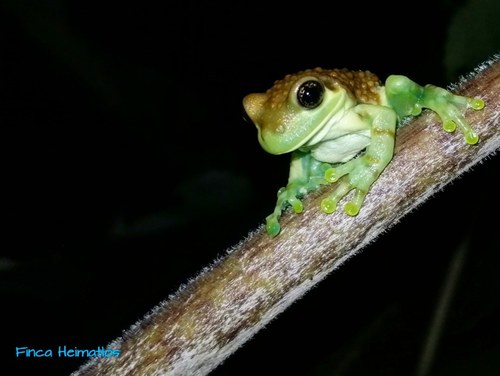
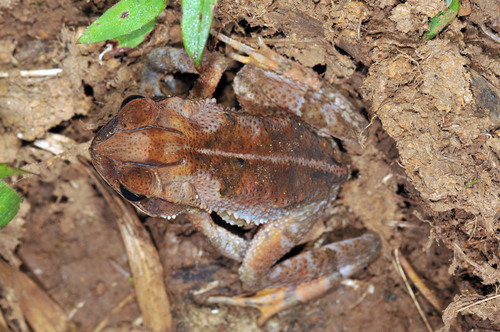
Rosenberg's Gladiator Frog

Rosenberg's Gladiator Frog

Boana rosenbergi

Silhouette: Andy Wilson · PhyloPic

LCLeast ConcernNTVUENCR
Daily sighting probability ~20% · Possible
at Carara National Park

In 3 days ~40% in a week ~70%

19 Verified sightings at Carara National Park From 2019 to 2026
603 In all 8 parks
June Best month
🌅 Crepuscular When it's spotted

About the Rosenberg's Gladiator Frog

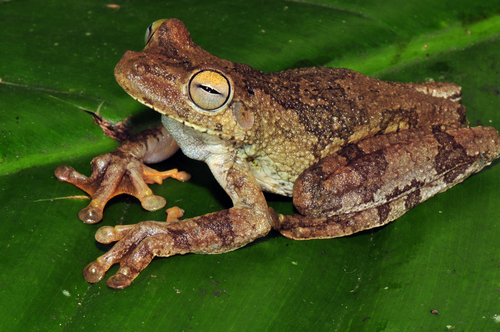
Rosenberg's treefrog (Hypsiboas rosenbergi), also known as Rosenberg's gladiator frog or Rosenberg's gladiator treefrog, is a species of frog in the family of tree frogs (Hylidae) and genus of gladiator frogs (Boana) found in Costa Rica, Panama, Colombia, Trinidad and Tobago and north-western Ecuador. Its scientific name is a testimony to Mr. W. F. H. Rosenberg who collected the type series, and its common name refers to the aggressiveness of males of the species.

The size of H. rosenbergi varies based on the population that they belong to, with individuals from the Costa Rican population being smaller in size than those from the Panamanian population. In the Panamanian population, males of H. rosenbergi measure on average 83 mm (3.3 in) in snout–vent length and females 86 mm (3.4 in). Females also tend to be heavier than males.

It has partly webbed fingers and entirely webbed toes and large disks on both fingers and toes. Its skin is granulated with small warts, and yellowish, greyish, or reddish in colour, with brown or blackish marbling or spots. It also has dark worm-like markings across the dorsal surfaces of the body and limbs, with gray-white undersurfaces and... Wikipedia →
Sounds

Advertisement call0:21

Costa Rica · 2023

© Chris Harrison · XC893969 · CC BY-NC-SA 4.0

Uncertain0:17

Costa Rica · 2026

© Guido Saborío · XC1091025 · CC BY-NC-SA 4.0

Recording1:10

Ecuador · 1987

© M.S. Hoogmoed · XC882729 · CC BY 4.0

Global Distribution

Parks Where Found

# Park Country Daily sighting probability
1 Piedras Blancas National Park 🇨🇷 Costa Rica
~60%
2 Manuel Antonio National Park 🇨🇷 Costa Rica
~40%
3 Soberanía National Park 🇵🇦 Panama
~40%
4 Marino Ballena National Park 🇨🇷 Costa Rica
~40%
5 Corcovado National Park 🇨🇷 Costa Rica
~30%
6 Machalilla National Park 🇪🇨 Ecuador
~20%
7 Carara National Park 🇨🇷 Costa Rica
~20%
8 Parque Natural Metropolitano 🇵🇦 Panama
~10%

Before you go

What are the chances of seeing a Rosenberg's Gladiator Frog in Carara National Park?

Possible

About 20% of wildlife watchers report a Rosenberg's Gladiator Frog sighting in Carara National Park on a given day, based on 19 verified sightings from GBIF citizen-science data from 2019 to 2026. It is the 11th most-seen of the 22 amphibians we can rate there. Over three days the chance rises to about 40%, and over a week to about 70%, if each day is a fresh chance.

When is the best time to see a Rosenberg's Gladiator Frog in Carara National Park?

June

In that month about 40% of wildlife watchers report a Rosenberg's Gladiator Frog in Carara National Park on a given day, against under 5% in August to February, the lowest months. That is one of Carara National Park's wettest months, with about 580 mm of rain against 35 mm in February.

What time of day is best to see a Rosenberg's Gladiator Frog?

Between 6 and 9 pm

Across all the parks we cover, that three-hour window holds the most Rosenberg's Gladiator Frog sightings with a recorded time, and about 7 in 10 of them come between 6 pm and 6 am: it is most active around dawn and dusk.

Which relatives of the Rosenberg's Gladiator Frog live in Carara National Park?

Same family: Hylidae

The closest relatives of the Rosenberg's Gladiator Frog that you can see in Carara National Park (family Hylidae, Hylid Tree Frogs) are Harlequin Treefrog (about 30%), Yellow Treefrog (about 30%) and Masked Tree Frog (about 30%), with each one's daily chance of a sighting.

Where does the Rosenberg's Gladiator Frog sighting chance come from?

GBIF citizen-science records

It is estimated from how often the Rosenberg's Gladiator Frog is recorded against all the amphibians logged in Carara National Park (19 verified sightings from 2019 to 2026), calibrated against known sighting rates. Figures are rounded to the nearest 10% because citizen-science data supports honest approximations, not decimals, and months with records from fewer than five people show "—". How it works.

← Back to Carara National Park