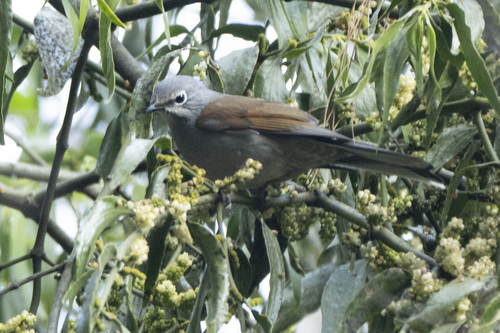
Eastern Bluebird

Eastern Bluebird

Sialia sialis

Silhouette: Andy Wilson · PhyloPic

LCLeast ConcernNTVUENCR
Daily sighting probability ~20% · Possible
at Celaque National Park

In 3 days ~50% in a week ~80%

62 Verified sightings at Celaque National Park From 2019 to 2026
7,380 In all 17 parks
December Best month
☀️ Diurnal When it's spotted

About the Eastern Bluebird

The eastern bluebird (Sialia sialis) is a small North American migratory thrush found in open woodlands, farmlands, and orchards. The bright-blue breeding plumage of the male, easily observed on a wire or open perch, makes this species a favorite of birders. The male's call includes sometimes soft warbles of jeew or chir-wi, or the melodious song chiti WEEW wewidoo.

It is the state bird of Missouri and New York. The eastern bluebird was formally described by the Swedish naturalist Carl Linnaeus in 1758 in the tenth edition of his Systema Naturae under the binomial name Motacilla sialis. The type location is South Carolina. Linnaeus based his short Latin description on the earlier more detailed descriptions by the English naturalists Mark Catesby and George Edwards. The eastern bluebird is now placed in the genus Sialia that was introduced by the English naturalist William Swainson in 1827 with the eastern bluebird as the type species.

Seven subspecies are recognized: S. s... Wikipedia →

Sounds

Call0:27

United States · 2025

© Rory Nefdt · XC1138577 · CC BY-NC-SA 4.0

Dawn song1:22

United States · 2022

© Patrick J. Blake · XC712412 · CC BY-NC-SA 4.0

Song0:39

United States · 2021

© Christopher McPherson · XC638302 · CC BY-NC-SA 4.0

Global Distribution

Parks Where Found

# Park Country Daily sighting probability
1 Shenandoah National Park 🇺🇸 United States
~40%
2 Great Smoky Mountains National Park 🇺🇸 United States
~40%
3 Congaree National Park 🇺🇸 United States
~30%
4 Reserva de la Biosfera Mariposa Monarca 🇲🇽 Mexico
~30%
5 Celaque National Park 🇭🇳 Honduras
~20%
6 Celestún Biosphere Reserve 🇲🇽 Mexico
~20%
7 El Triunfo 🇲🇽 Mexico
~10%
8 Point Pelee National Park 🇨🇦 Canada
~10%
9 Acadia National Park 🇺🇸 United States
~10%
10 La Tigra National Park 🇭🇳 Honduras
<5%
11 Big Cypress National Preserve 🇺🇸 United States
<5%
12 Big Bend National Park 🇺🇸 United States
<5%
13 Guadalupe Mountains National Park 🇺🇸 United States
<5%
14 Badlands National Park 🇺🇸 United States
<5%
15 Merritt Island National Wildlife Refuge 🇺🇸 United States
<5%
16 Cerro Azul Meámbar National Park 🇭🇳 Honduras
<5%
17 Cumbres de Monterrey National Park 🇲🇽 Mexico
<5%

Cities Where Found

# City Country Daily sighting probability
1 Washington 🇺🇸 United States
~30%
2 Dallas 🇺🇸 United States
~20%
3 Houston 🇺🇸 United States
~20%
4 Orlando 🇺🇸 United States
~10%
5 Baltimore 🇺🇸 United States
~10%
6 Austin 🇺🇸 United States
~10%
7 Minneapolis [Saint Paul] 🇺🇸 United States
~10%
8 Montreal 🇨🇦 Canada
~10%
9 Philadelphia 🇺🇸 United States
<5%
10 Guatemala City 🇬🇹 Guatemala
<5%

Zoos & Centres Where Found

# Zoo / Centre Country
1 Columbus Zoo and Aquarium 🇺🇸 United States In captivity
2 Montreal Biodome 🇨🇦 Canada In captivity

Before you go

What are the chances of seeing an Eastern Bluebird in Celaque National Park?

Possible

About 20% of wildlife watchers report an Eastern Bluebird sighting in Celaque National Park on a given day, based on 62 verified sightings from GBIF citizen-science data from 2019 to 2026. It is the 33rd most-seen of the 193 birds we can rate there. Over three days the chance rises to about 50%, and over a week to about 80%, if each day is a fresh chance.

When is the best time to see an Eastern Bluebird in Celaque National Park?

December

In that month about 50% of wildlife watchers report an Eastern Bluebird in Celaque National Park on a given day, against about 10% in April, August and October, the lowest months. That is one of Celaque National Park's driest months, with about 100 mm of rain against 370 mm in September.

What time of day is best to see an Eastern Bluebird?

Between 8 and 11 am

Across all the parks we cover, that three-hour window holds the most Eastern Bluebird sightings with a recorded time, and about 9 in 10 of them come between 6 am and 6 pm: it is a daytime animal.

Which relatives of the Eastern Bluebird live in Celaque National Park?

Same family: Turdidae

The closest relatives of the Eastern Bluebird that you can see in Celaque National Park (family Turdidae, Thrushes) are Clay-colored Thrush (about 50%), Brown-backed Solitaire (about 30%) and Swainson's Thrush (about 10%), with each one's daily chance of a sighting.

Where does the Eastern Bluebird sighting chance come from?

GBIF citizen-science records

It is estimated from how often the Eastern Bluebird is recorded against all the birds logged in Celaque National Park (62 verified sightings from 2019 to 2026), calibrated against known sighting rates. Figures are rounded to the nearest 10% because citizen-science data supports honest approximations, not decimals, and months with records from fewer than five people show "—". How it works.

← Back to Celaque National Park