
Black Catbird

Black Catbird

Melanoptila glabrirostris

Silhouette: Sheatherius · PhyloPic

LCLeast ConcernNTVUENCR
Daily sighting probability <5% · Rare
at Celestún Biosphere Reserve

In 3 days ~10%

32 Verified sightings at Celestún Biosphere Reserve From 2019 to 2026
3,061 In all 5 parks
June Best month
☀️ Diurnal When it's spotted

About the Black Catbird

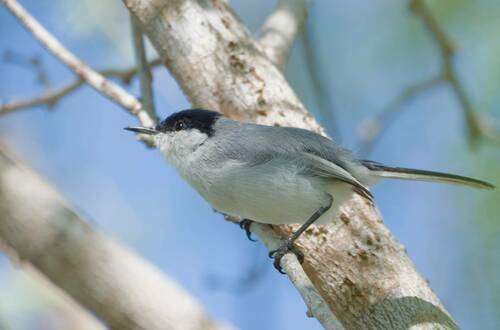
The black catbird (Melanoptila glabrirostris) is a songbird species in the monotypic genus Melanoptila, part of the family Mimidae. At 19–20.5 cm (7.5–8.1 in) in length and 31.6–42 g (1.11–1.48 oz) in mass, it is the smallest of the mimids. Sexes appear similar, with glossy black plumage, black legs and bill, and dark brownish eyes. The species is endemic to the Yucatán Peninsula, and is found as far south as Campeche, northern Guatemala and northern Belize. Although there are historical records from Honduras and the US state of Texas, the species is not now known to occur in either location. It is found at low elevations in semi-arid to humid habitats ranging from shrubland and abandoned farmland to woodland with thick understory, and is primarily sedentary.

Although it is a mimid, the black catbird is not known to imitate any other species. Its song is a mix of harsh notes and clear flute-like whistles, with the phrases repeated. It builds a cup nest in low bushes or trees, and lays two bluish eggs. It is threatened by habitat loss, and has been assessed as near threatened by the International Union for Conservation of Nature.

When Philip Sclater first described the... Wikipedia →

Sounds

Call0:16

Mexico · 2019

© Steve Hampton · XC474387 · CC BY-NC-SA 4.0

Song0:49

Mexico · 2018

© Manuel Grosselet · XC429406 · CC BY-NC-SA 4.0

Call0:10

Mexico · 2016

© Ross Gallardy · XC332424 · CC BY-NC-SA 4.0

Global Distribution

Parks Where Found

# Park Country Daily sighting probability
1 Arrecifes de Cozumel National Park 🇲🇽 Mexico
~70%
2 Sian Ka'an Biosphere Reserve 🇲🇽 Mexico
~40%
3 Calakmul Biosphere Reserve 🇲🇽 Mexico
<5%
4 Celestún Biosphere Reserve 🇲🇽 Mexico
<5%
5 Ría Lagartos Biosphere Reserve 🇲🇽 Mexico
<5%

Zoos & Centres Where Found

# Zoo / Centre Country
1 Xcaret 🇲🇽 Mexico In captivity

Before you go

What are the chances of seeing a Black Catbird in Celestún Biosphere Reserve?

Rare

Under 5% of wildlife watchers report a Black Catbird sighting in Celestún Biosphere Reserve on a given day, based on 32 verified sightings from GBIF citizen-science data from 2019 to 2026. It is the 187th most-seen of the 297 birds we can rate there. Over three days the chance rises to about 10%, if each day is a fresh chance.

When is the best time to see a Black Catbird in Celestún Biosphere Reserve?

May to August

In those months about 10% of wildlife watchers report a Black Catbird in Celestún Biosphere Reserve on a given day, against under 5% in September to April, the lowest months. Those are among Celestún Biosphere Reserve's wettest months, with about 90 mm of rain a month against 10 mm in February.

What time of day is best to see a Black Catbird?

Between 7 and 10 am

Across all the parks we cover, that three-hour window holds the most Black Catbird sightings with a recorded time, and about 9 in 10 of them come between 6 am and 6 pm: it is a daytime animal.

Which relatives of the Black Catbird live in Celestún Biosphere Reserve?

Same family: Mimidae

The closest relatives of the Black Catbird that you can see in Celestún Biosphere Reserve (family Mimidae, Mockingbirds and Thrashers) are Tropical Mockingbird (about 70%) and Gray Catbird (about 10%), with each one's daily chance of a sighting.

Where does the Black Catbird sighting chance come from?

GBIF citizen-science records

It is estimated from how often the Black Catbird is recorded against all the birds logged in Celestún Biosphere Reserve (32 verified sightings from 2019 to 2026), calibrated against known sighting rates. Figures are rounded to the nearest 10% because citizen-science data supports honest approximations, not decimals, and months with records from fewer than five people show "—". How it works.

← Back to Celestún Biosphere Reserve