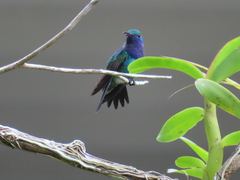
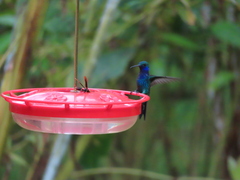
Sapphire-throated Hummingbird

Sapphire-throated Hummingbird

Chrysuronia coeruleogularis

Silhouette: Ferran Sayol · PhyloPic

LCLeast ConcernNTVUENCR
Daily sighting probability <5% · Rare
at Chagres National Park

In 3 days ~10% in a week ~20%

31 Verified sightings at Chagres National Park From 2019 to 2026
658 In all 6 parks
May Best month
☀️ Diurnal When it's spotted

About the Sapphire-throated Hummingbird

The sapphire-throated hummingbird (Chrysuronia coeruleogularis) is a shiny metallic-green hummingbird found in Panama, Colombia, and more recently Costa Rica. The sapphire-throated hummingbird is separated into three subspecies; Chrysuronia coeruleogularis coeruleogularis, Chrysuronia coeruleogularis coelina, and Chrysuronia coeruleogularis conifis.

Measuring 9 cm (3.5 in), this hummingbird sports a distinctively forked tail, which helps to distinguish it from other similarly sized and colored hummingbirds. The male is metallic green overall, with a violet-blue throat and dark tail. The female has entirely white underparts from throat to vent and distinctive green spots along the sides of the breast.

Due to its large home range and adaptability to habitat change, the sapphire-throated hummingbird is listed as a species of least concern by the IUCN Red List. It prefers to live in mangroves, scrubs, and light forests, however is able to adapt if need be.

The sapphire-throated hummingbird is part of the order Apodiformes, which includes the hummingbirds, swifts and treeswifts. They are part of the family Trochilidae, also known as the hummingbirds, which are distinguished... Wikipedia →

Sounds

Song0:05

Panama · 2018

© Kent Livezey · XC402077 · CC BY-NC-SA 4.0

Call0:13

Panama · 2015

© Peter Boesman · XC271350 · CC BY-NC-ND 4.0

Song1:00

Colombia · 2011

© Oswaldo Cortes · XC86125 · CC BY-NC-ND 2.5

Global Distribution

Parks Where Found

# Park Country Daily sighting probability
1 Parque Natural Metropolitano 🇵🇦 Panama
~10%
2 Coiba National Park 🇵🇦 Panama
~10%
3 San Lorenzo Protected Forest 🇵🇦 Panama
~10%
4 Chagres National Park 🇵🇦 Panama
<5%
5 Soberanía National Park 🇵🇦 Panama
<5%
6 Corcovado National Park 🇨🇷 Costa Rica
<5%

Cities Where Found

# City Country Daily sighting probability
1 Panama City 🇵🇦 Panama
~20%
2 Barranquilla 🇨🇴 Colombia
<5%

Before you go

What are the chances of seeing a Sapphire-throated Hummingbird in Chagres National Park?

Rare

Under 5% of wildlife watchers report a Sapphire-throated Hummingbird sighting in Chagres National Park on a given day, based on 31 verified sightings from GBIF citizen-science data from 2019 to 2026. It is the 248th most-seen of the 372 birds we can rate there. Over three days the chance rises to about 10%, and over a week to about 20%, if each day is a fresh chance.

When is the best time to see a Sapphire-throated Hummingbird in Chagres National Park?

January, May and October

In those months about 10% of wildlife watchers report a Sapphire-throated Hummingbird in Chagres National Park on a given day, against under 5% in February–April, June–September and November–December, the lowest months.

What time of day is best to see a Sapphire-throated Hummingbird?

Between 9 am and noon

Across all the parks we cover, that three-hour window holds the most Sapphire-throated Hummingbird sightings with a recorded time, and about 9 in 10 of them come between 6 am and 6 pm: it is a daytime animal.

Which relatives of the Sapphire-throated Hummingbird live in Chagres National Park?

Same family: Trochilidae

The closest relatives of the Sapphire-throated Hummingbird that you can see in Chagres National Park (family Trochilidae, Hummingbirds) are Rufous-tailed Hummingbird (about 70%), Snowy-bellied Hummingbird (about 60%) and White-necked Jacobin (about 50%), with each one's daily chance of a sighting.

Where does the Sapphire-throated Hummingbird sighting chance come from?

GBIF citizen-science records

It is estimated from how often the Sapphire-throated Hummingbird is recorded against all the birds logged in Chagres National Park (31 verified sightings from 2019 to 2026), calibrated against known sighting rates. Figures are rounded to the nearest 10% because citizen-science data supports honest approximations, not decimals, and months with records from fewer than five people show "—". How it works.

← Back to Chagres National Park